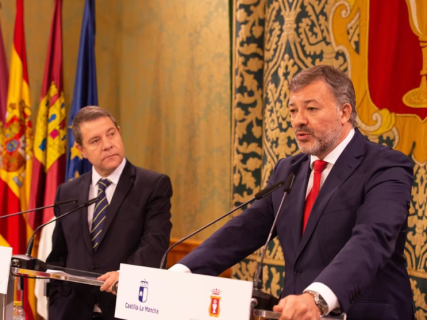
After the Ceuta crisis, the socialist mayor of Cuenca asks Sánchez for general elections "as soon as possible"

Darío Dolz, close to the PSOE of Castilla-La Mancha of García-Page, demands Sánchez an electoral advance while the discontent over the management of Ceuta opens a rift within the PSOE itself.

5 minutes

Captura de pantalla 2026 08 16 190430

Captura de pantalla 2026 08 16 190430

Add DEMÓCRATA to Google

Ask FREN

Published

Last updated

5 minutes

Most read

The mayor of Cuenca, Darío Dolz (PSOE), has demanded this Sunday that Pedro Sánchez call for general elections "as soon as possible" and has considered that "it is time" for Spaniards to return to the polls. The Cuenca mayor maintains that the political situation is "totally unsustainable" at times and has emphasized that he makes his request "from loyalty to a party," as he stated in an interview with Europa Press.

The request comes amid the crisis in Ceuta and at a particularly delicate moment for the PSOE, after the socialist deputy from Ceuta, Melchor León, has publicly demanded the resignation of the Government delegate in the city, Miguel Ángel Pérez Triano. León, also vice president of the Assembly of Ceuta, has accused the delegate of not stepping up during the crisis and has defended that the city needs someone to defend it, according to El Faro de Ceuta.

The two positions come from different territories, but they have a common element: they are socialist leaders who question, from their respective responsibilities, the management of a situation that is having a strong political impact. In Cuenca, Dolz asks Sánchez to call elections; in Ceuta, León demands accountability within the Government structure.

Dolz calls for voting before May 2027

The mayor of Cuenca has not limited himself to asking for an electoral advance. He has also rejected that the general elections coincide with the regional and municipal elections scheduled for May 23, 2027. In his view, local elections have their own dynamics and are more linked to the candidates and the management of each municipality, so he considers it appropriate for the general elections to be held earlier.

Dolz thus coincides with a position that Emiliano García-Page has been defending from Castilla-La Mancha: that general elections should not be mixed with regional and municipal ones. The mayor is part of the PSOE of Castilla-La Mancha and governs the regional capital of the province of Cuenca under the socialist banner.

His demand therefore acquires a territorial dimension. It is not an opposition leader who asks Sánchez to advance the elections, but the mayor of a provincial capital governed by the PSOE, who also explicitly links his request to the political situation of the country.

The crisis in Ceuta opens a rift in the PSOE

In parallel, the crisis in Ceuta has generated one of the largest displays of internal disagreement within the PSOE in recent weeks. Melchor León has called for the resignation of Miguel Ángel Pérez Triano, who in addition to being the Government delegate is the general secretary of the PSOE of Ceuta and the socialist candidate for the upcoming regional elections.

León has focused his criticisms on the management of the migration crisis and has reproached the delegate for not facing the problems that the city is facing. "Ceuta deserves someone who defends it," the socialist leader has stated, according to statements disseminated by local media and collected by El Faro de Ceuta.

The rupture is particularly relevant because it occurs within the very socialist structure of Ceuta. León is not questioning a decision of a Government in which the opposition is part, but demanding the departure of someone who represents the central Executive in the city and simultaneously leads the PSOE of Ceuta.

The tension has also shifted to the health sector. The Minister of Health, Mónica García, visited Ceuta this Sunday, more than two weeks after the massive entry, and was received with boos and shouts of "resignation." The minister has defended that the health system is "stressed," but not "collapsed," after health professionals have demanded more resources.

A Government questioned from within while the crisis continues

The crisis in Ceuta thus accumulates several open fronts for the Executive. The pressure does not come solely from the PP or Vox nor from the institutions of the autonomous city. In recent days, socialist representatives have also publicly spoken out demanding changes or questioning the Government's response.

The case of Melchor León has a particularly sensitive dimension because Pérez Triano simultaneously holds the Government Delegation and the leadership of the PSOE of Ceuta. The resignation request therefore represents a direct confrontation within the party's structure in a city that continues to manage the consequences of the massive entry.

Meanwhile, the health situation has added a new focal point of tension. The visit of Mónica García took place after the Autonomous City activated extraordinary cleaning and health surveillance measures and after the Medical College demanded reinforcements. The minister maintained that there is no collapse in care, while professionals have publicly expressed their concern about the pressure on the system.

The electoral request comes from the García-Page environment

In this context, the request from Darío Dolz introduces a second territorial crack in the debate over the electoral calendar. The mayor has not positioned his stance as a break with the PSOE. On the contrary, he insists that he speaks from loyalty to the party and claims the management of his team in Cuenca.

But his request has a clear political consequence: he demands that Sánchez not exhaust the calendar and that citizens can decide before the regional and municipal elections in May 2027.

The proposal fits with the discourse that García-Page has maintained about the need to separate the general elections from the municipal and regional ones. The PSOE of Castilla-La Mancha thus reappears as a territorial space from which the calendar designed by the federal leadership is questioned, although in this case the request comes directly from the mayor of a provincial capital.

The PP demands that he moves from words to actions

The PP of Cuenca has reacted to Dolz's statements demanding that he turn his request into an effective political position. The popular party believes that if the mayor understands that the situation is "unsustainable," he should also ask the socialist leaders with representation in Congress to withdraw their support for Sánchez.

The provincial president of the PP, José Martín-Buro, has pointed to the secretary general of the Cuenca socialists and national deputy, Luis Carlos Sahuquillo, and to García-Page himself. His argument seeks to move Dolz's request from the realm of public declaration to that of the parliamentary majority that supports the Government.

The underlying issue is thus posed: a socialist mayor calls for elections while another socialist leader, this time in Ceuta, demands the resignation of the Government delegate. These are two different situations and there is no coordination between them, but both occur at the same moment and within the ranks of the PSOE.

The crisis in Ceuta also adds a particularly sensitive context. Seventeen days after the massive entry, the city continues to face open issues of security, healthcare, housing, and sanitation, and the visit of a government minister has ended with protests and boos. In that scenario, the request for elections from a socialist mayor of Castilla-La Mancha adds to the internal voices that are demanding accountability for the management of the crisis.

The electoral calendar still depends on Sánchez's decision, but the political picture this Sunday incorporates a new element: the criticisms no longer come only from outside the PSOE.

More key points, information and questions with FREN

AI-GENERATED CONTENT

What is the legal procedure for calling general elections in Spain and what deadlines does the Constitution establish?

The procedure for calling general elections in Spain is basically regulated by the Spanish Constitution (CE) and by the Organic Law 5/1985, of the General Electoral Regime (LOREG), amended, among others, by LO 2/2016 in the case of a deadlock in the investiture. The following summarizes the cases of dissolution, who decides, and the main deadlines.

1. Duration of the legislature and ordinary dissolution

Article 68.4 CE establishes that the mandate of the Congress lasts four years from the date of its election. In parallel, Article 69 CE sets the duration of the Senate also at four years.

Once that period ends without early dissolution, elections must be called. The LOREG specifies in its Article 42 that, when early dissolution is not used:

  • The call decree is issued on the 25th day before the expiration of the Chambers' mandate.
  • It is published the next day in the BOE and comes into force that same day.
  • The elections are held on the 54th day after the call.

These deadlines comply with the provisions of Article 68.6 CE, which requires that elections be held between 30 and 60 days from the expiration of the mandate.

2. “Ordinary” early dissolution (art. 115 CE)

Article 115 CE allows the President of the Government, after deliberation of the Council of Ministers and under his exclusive responsibility, to propose to the King the dissolution of the Congress, the Senate, or both Chambers. The King issues the royal decree of dissolution, which includes the electoral call and sets the date of the elections.

The Constitution introduces three relevant limits:

  • Dissolution cannot be proposed if there is a motion of censure in process (art. 115.2 CE).
  • A new dissolution cannot occur before one year has passed since the previous one (art. 115.3 CE), except for the special case of article 99.5 (lack of investiture).
  • Article 116.5 CE prohibits dissolving the Congress while states of alarm, exception, or siege are in force.

In these cases of “ordinary” early dissolution, the deadlines of Article 42 LOREG also apply: the decree must publish the call and the elections are held on the 54th day after.

3. Automatic dissolution due to lack of investiture (art. 99.5 CE)

Article 99 CE regulates the investiture of the President of the Government. Its section 5 provides that, if two months pass from the first investiture vote without any candidate obtaining the confidence of the Congress, the King must dissolve both Chambers and call new elections, with the countersignature of the President of the Congress.

LO 2/2016 introduces a seventh additional provision in the LOREG for this special case:

  • The royal decree of call is issued the day after the expiration of the two-month period.
  • It is published that same day and comes into force immediately.
  • The elections are held on the 47th day after the call (an abbreviated process compared to the 54 days of the general regime).

This procedure shortens deadlines (especially the campaign) but remains within the 30–60 day limits set by Article 68.6 CE for holding elections to the Congress.

4. Calling and constitution of the new Cortes

In all cases, the call for general elections is formalized by Royal Decree of the King:

  • In the general regime, with the countersignature of the President of the Government, at the proposal of the President himself and after deliberation of the Council of Ministers (art. 42 LOREG in connection with art. 115 CE).
  • In the case of investiture deadlock (art. 99.5 CE), with the countersignature of the Presidency of the Congress.

Finally, Article 68.6 CE provides that the elected Congress must be convened within a maximum period of 25 days from the holding of the elections. That constitutive session marks the start of the mandate of the new Cortes Generales, ending the previous legislature and the acting Government, which remains only until the new Executive takes office (art. 101 CE).

What powers and functions does a Government delegate have in an autonomous city like Ceuta according to Spanish legislation?

In Spanish legislation, the Government Delegate in an autonomous city like Ceuta is the ordinary representative of the Government of the Nation in that territory and the highest authority of the General State Administration (AGE) in the city. Their powers are mainly regulated in the Law 40/2015, on the Legal Regime of the Public Sector, in the Organic Law 2/1986, on the Forces and Security Corps of the State, in the Law 17/2015, of the National Civil Protection System, and in the Statute of Autonomy of Ceuta (LO 1/1995).

1. Institutional position

The Government Delegate is a management body of the AGE, organizationally dependent on the Ministry of the Presidency or the one responsible for relations with the Government Delegates and functionally dependent on the Government as a whole. In Ceuta and Melilla there is no own Autonomous Community, so the Government Delegate assumes functions that in the rest of the territory are exercised vis-à-vis the Autonomous Communities, but here they are projected onto the Autonomous City, which is an entity with a singular statute.

Therefore, they are the “head” of the AGE in Ceuta, coordinate the territorial services of the ministries, and act as an institutional channel of communication between the Government of Spain and the bodies of the Autonomous City.

2. Government representation and coordination of the AGE

Among their basic functions are:

  • Ordinary representation of the Government before the institutions of the Autonomous City, judicial bodies (institutionally), and other public and private actors in the territory.
  • Direction and coordination of the peripheral services of the different ministries (Finance, Health, Labor, Education, etc.) in Ceuta, ensuring they act coherently with the Government's guidelines.
  • Promotion and supervision of state policies in the territory, ensuring that the laws and programs of the State are correctly applied.
3. Public order and State Security Forces and Corps

By virtue of Organic Law 2/1986, the Government Delegate:

  • Exercises the highest command of the State Security Forces and Corps in the city (National Police Corps and Civil Guard), under the superior direction of the Ministry of the Interior.
  • Is the authority responsible for maintaining public order and citizen security in the territorial scope.
  • May issue general operational instructions, coordinate police deployments, and preside over coordination bodies in security matters.

In Ceuta, this dimension is especially relevant due to its status as an external border of the European Union, the management of migratory flows, and the protection of the border fence, where the Delegate plays a central coordinating role between Interior, Defense when appropriate, and the Autonomous City.

4. Civil protection and emergencies

According to Law 17/2015, the Government Delegate is the state civil protection authority in the city:

  • Participates in civil protection planning and approves or informs territorial and special plans within their competencies.
  • Directs or coordinates, depending on the type of emergency, the action of state means and resources deployed in Ceuta.
  • Collaborates with the emergency services of the Autonomous City to ensure an integrated response to disasters or serious risks.
5. Inspection and sanction powers

As a body of the AGE, the Government Delegate exercises inspection and control powers over state services located in Ceuta and, when sectoral laws provide, may:

  • Initiate or resolve sanctioning procedures for administrative infractions of state competence (for example, in matters of immigration, coasts, transport, etc.).
  • Order inspections and request information from individuals or other administrations when necessary for the exercise of state powers.
6. Relations with the Autonomous City of Ceuta

The Statute of Autonomy configures Ceuta as an autonomous city, not as an Autonomous Community, but with a relevant degree of self-government. Vis-à-vis it, the Government Delegate:

  • Acts as a stable channel of cooperation and coordination between the Government of Spain and the Autonomous City, especially in shared or interrelated matters (security, immigration, social services, ports and borders, etc.).
  • May issue claims of incompetence or coordination when considering that an action of the City affects state powers, using cooperation mechanisms and, if applicable, conflict mechanisms provided in the Constitution and basic legislation.
  • Participates in mixed bodies or bilateral State–Autonomous City commissions created to manage specific policies.

In summary, the Government Delegate in Ceuta concentrates the typical functions of any Delegate in an Autonomous Community (Government representation, AGE coordination, security, and civil protection), but within a singular framework where the autonomous city assumes part of the local and regional powers and, at the same time, the State maintains a reinforced role in borders, immigration, and security.

What has been Darío Dolz's political career and what positions has he held before becoming mayor of Cuenca?

Based on the sources consulted, it can only be stated with certainty that Darío Dolz is the current mayor of Cuenca and that he belongs to the PSOE, but no solid and detailed information has been found about his political career prior to holding the Mayoralty. None of the official notes nor the news tracked provide a complete biographical profile or a list of previous positions.

In several recent references, he is identified only as “mayor of Cuenca, Darío Dolz”, without further career details. For example, in press releases from the Ministry of the Interior about institutional events in the city, he is mentioned among the attending authorities as mayor, along with the government subdelegate in Cuenca or the president of the provincial Council, but without elaborating on his curriculum. The same occurs in information from La Moncloa and other state and regional bodies: his status as mayor of the capital of Cuenca and his socialist affiliation are highlighted, without entering into his previous political history.

Also, in the general national press, when reporting on projects or debates about the city of Cuenca — for example, the development of large facilities or urban initiatives —, his figure appears as the incumbent mayor, representing the municipality in events with the central Government, the Junta de Communities of Castilla-La Mancha, or the Council. Again, these texts point to his current role but do not detail what responsibilities he held before or when he first assumed the mayoral office.

From this set of references, only two basic ideas can be extracted with some certainty:

  • He is mayor of Cuenca for at least the 2024–2026 period, as he appears as such in various official events during those years.
  • He is explicitly described as “the socialist Darío Dolz”, which allows affirming his membership or affiliation to the Spanish Socialist Workers' Party (PSOE).

However, there are no verifiable data in the consulted sources about:

  • Whether he was previously a councilor in the Cuenca City Council (nor in which areas or periods).
  • Whether he held positions in the Provincial Council of Cuenca.
  • Whether he was a delegate of the Junta de Communities of Castilla-La Mancha or held other regional responsibilities.
  • His academic background, original profession, or any internal organic position within the PSOE.

Since your question focuses precisely on the political career prior to the Mayoralty, it must be clear: with the information available in official records and the consulted press, it is not possible to reliably reconstruct what positions Darío Dolz held before becoming mayor of Cuenca or in what chronology. Any attempt to complete that biography with specific positions (for example, asserting that he was councilor of a certain area or delegate of such a department) would go beyond what the sources allow and would be speculative.

If you need an exhaustive profile — for example, for an academic work, a report, or a press note —, the most direct and usually most complete channels for this type of data are:

  • The official website of the Cuenca City Council, where a brief institutional biography of the mayor is often published and, sometimes, their previous career.
  • The website of the PSOE of Castilla-La Mancha or the local PSOE of Cuenca, which usually includes summaries of their main public and organic positions.
  • Interviews or profiles in regional press of Castilla-La Mancha, which sometimes include more detailed biographical paths than the generalist state press.

In summary, with the data that can be documented at this time, it is only possible to state that Darío Dolz is a leader of the PSOE who holds the Mayoralty of Cuenca and actively participates in institutional events and projects promoted in the city; but information about what specific positions he held before reaching that office is not found in the accessible sources in this research.

Play

Test your knowledge with FREN!

How much do you know about this topic? Answer the following 3 questions.

What has the socialist mayor of Cuenca, Darío Dolz, requested from President Pedro Sánchez?

Question 1 of 3

What has Melchor León, socialist deputy of Ceuta, asked regarding the Government delegate in the city?

Question 2 of 3

What has the Minister of Health, Mónica García, defended during her visit to Ceuta?

Question 3 of 3

Hola, soy Fren. ¿Cómo te ayudo?