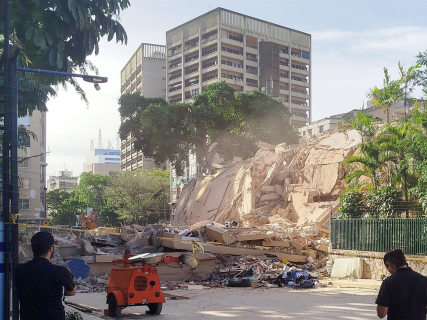
Earthquakes in Spain: which are the zones with the highest seismic risk and why it is not comparable to Venezuela

Can Spain suffer an earthquake like the devastating earthquake in Venezuela? Although experts consider the probability to be low, the country has several areas of high seismic activity.

5 minutes

fotonoticia 20260625184534 1920

fotonoticia 20260625184534 1920

Add DEMÓCRATA to Google

Ask FREN

Published

Last updated

5 minutes

Most read

Spain is not an earthquake-free country, but it is not in a geological zone comparable to Venezuela either. The devastation of the double seismic blow recorded in the South American country makes us wonder whether Spain could suffer an earthquake of similar magnitude and which territories are most exposed to a large ground movement.

The experts' answer is clear: Spain has relevant seismic activity, especially in the peninsular southeast, the Alboran Sea, the Gulf of Cadiz, the Pyrenees, and the Canary Islands, but the probability of an earthquake of magnitude greater than 8 near a large Spanish city is low. Not impossible, but much less likely than in regions located on more active plate boundaries.

Spain does have seismic risk, but not like Venezuela

The main difference lies in geology. Venezuela is in a contact zone between large tectonic plates, with faults capable of accumulating a lot of energy and releasing it in large magnitude earthquakes.

Spain, on the other hand, is affected by the interaction between the African and Eurasian plates, but this deformation is slower, more diffuse, and distributed in different zones. That is why the country registers earthquakes, some destructive, but it is not part of the regions of the planet with the highest frequency of large earthquakes.

The National Geographic Institute maintains seismicity and hazard maps that show that Spanish seismic activity is concentrated in specific areas, especially in the south and southeast of the Peninsula, in the vicinity of the Alboran Sea, in the Gulf of Cadiz, in the Pyrenees, and in the Canary Islands.

The most sensitive areas of Spain

The peninsular southeast is the most sensitive area of Spain to suffer destructive earthquakes. The area of Granada, Almería, Málaga, Murcia, and the Vega Baja del Segura, in Alicante, concentrates part of the greatest seismic hazard in the country.

The explanation lies in the contact between the African plate, the Iberian microplate, and the Alboran block. This tectonic context generates active faults in the Betic mountain ranges and in the vicinity of the Alboran Sea.

In this area, relevant historical earthquakes have occurred, as well as recent episodes, such as that of Lorca in 2011. Although that earthquake had a moderate magnitude, 5.1, it caused serious damage due to its shallow depth, its proximity to the city, and the vulnerability of some buildings.

Alboran Sea and eastern Andalusian coast

The Alboran Sea is another of the key points of seismic risk in Spain. It particularly affects the coast of Malaga, Granada, and Almeria.

Active tectonic structures linked to the convergence between Africa and Eurasia converge in this area. Earthquakes can occur under the sea and be felt strongly on the coast, especially if they are shallow and close.

Not all marine earthquakes imply a tsunami, but the risk associated with Alboran is not limited solely to ground shaking: it also requires monitoring possible secondary effects in coastal areas.

Gulf of Cadiz and Cape St. Vincent: the zone of great historical earthquakes

The Gulf of Cadiz and the surroundings of Cape St. Vincent are the most important area when talking about earthquakes of great magnitude that can affect Spain.

Some of the largest historical earthquakes related to the Iberian Peninsula are located there. The best known is the Lisbon earthquake of 1755, estimated at magnitude 8.5, which caused a tsunami and also caused casualties in Spain. Another notable precedent is the earthquake of 1969 southwest of Cape St. Vincent, magnitude 7.8.

The difference compared to the peninsular southeast is that many of these large events have a marine epicenter relatively far from the main Spanish cities. This does not eliminate the risk, but it changes the type of impact: it can be felt in wide areas and generate coastal risk, although it does not necessarily cause the same level of urban destruction as a shallow earthquake under a city.

Pyrenees: Navarre, Huesca, Lleida, and Girona

The Pyrenees are also a seismically active area. The risk is explained by the ancient collision between the Iberian plate and the Eurasian plate, which left geological structures capable of generating earthquakes.

Pyrenean activity particularly affects Navarre, Aragon, Catalonia, and southern France. It is not the Spanish area with the highest urban risk, but it does present historical seismicity and the capacity to produce damaging earthquakes.

Canary Islands: seismic risk linked to volcanism

The Canary Islands have a different reality. Their seismicity is not primarily explained by the direct collision between large plates as occurs in other regions of the world, but by their volcanic origin.

The archipelago registers earthquakes associated with volcanic activity and the movement of magma at depth. This means that the Canary Islands have permanent seismic monitoring, especially on volcanically active islands such as Tenerife, La Palma, or El Hierro.

Even so, an earthquake like the one in Venezuela is not the most likely scenario in the Canary Islands. The danger there is more linked to volcanic crises, seismic swarms, and ground deformations than to large faults capable of generating earthquakes of magnitude 7 or 8.

Galicia and the Iberian Northwest

Galicia and the Iberian Northwest also register earthquakes, although with generally lower risk than the southeast, the Alboran Sea, the Gulf of Cadiz, or the Pyrenees.

There are faults and intraplate activity, meaning earthquakes that occur far from major plate boundaries. They can be perceptible and cause alarm, but they do not constitute the main seismic risk zone in the country.

Can Spain suffer an earthquake like the one in Venezuela?

As we have seen, Spain can suffer significant earthquakes, but a scenario similar to Venezuela's is unlikely in most of the territory. The key is to distinguish between magnitude, location, and damage. A high-magnitude earthquake does not cause the same effects if it occurs far from the coast, at great depth, or under the sea, as it does if it occurs at shallow depth and near a city.

That is why an earthquake of magnitude 5 or 6 can be very destructive if it occurs under a vulnerable urban center, while an earthquake of magnitude 7 or 8 in the sea can be felt over a huge area but cause more limited damage on land, unless it generates a tsunami.

Map of seismic risk in Spain

If Spanish zones are ordered by seismic sensitivity, the map looks like this:

  1. Southeastern Iberian Peninsula: Granada, Almería, Málaga, Murcia, and Alicante.
  2. Alboran Sea and eastern Andalusian coast.
  3. Gulf of Cadiz and Cape St. Vincent.
  4. Pyrenees: Navarra, Huesca, Lleida, and Girona.
  5. Canary Islands, due to their volcanic seismicity.
  6. Galicia and the Iberian Northwest, with minor but existing activity.

Although the danger exists, it should not translate into generalized alarm. The key lies in prevention, monitoring by the IGN, emergency planning, and compliance with seismic-resistant regulations in the most exposed areas.

More key points, information and questions with FREN

AI-GENERATED CONTENT

What procedures are necessary to update the seismic-resistant regulations in Spain?

To update the seismic-resistant regulations in Spain, the specific procedures depend on the level of the regulation to be modified: law, royal decree/ministerial order, or technical documents of the Technical Building Code (CTE). In all cases, the ministry responsible for building and urban planning usually intervenes, the Council of Ministers when it comes to high-level regulatory norms, and participation mechanisms such as public consultation and hearings with affected sectors. Only when it is necessary to approve or amend a law do the Congress and the Senate come into play. Below is the typical process in each scenario, following the general procedure of the Spanish legal system.

a) When the update requires a new law or modification of an existing one

This scenario would occur if elements affecting basic principles of the system, the distribution of powers, the rights and duties of building agents, or obligations with significant economic impact that the legislator wants to "entrench" at the law level are to be introduced into the seismic-resistant regulations.

1. Initiative and drafting of the preliminary bill

The Government, through the competent ministry (usually housing/urban agenda or the one assigned construction technical standards), drafts a preliminary bill. Before finalizing it, a prior public consultation is opened on the Ministry's participation portal to gather opinions on the problems to be solved and possible regulatory alternatives.

After this initial phase, the draft text is prepared and submitted to hearing and public information procedures, so that professional associations, sector companies, Autonomous Communities, municipalities, scientific associations, and citizens can present technical objections regarding the new seismic-resistant requirements.

2. Reports and approval by the Council of Ministers

In parallel, the draft is sent to the affected ministries (economy, industry, ecological transition, civil defense, etc.) for reports, and to the Council of State for mandatory opinion when appropriate. With these reports, the text is reviewed and submitted to the Council of Ministers, which approves a bill and sends it to the Congress of Deputies.

3. Parliamentary processing

In Congress, the bill is assigned to the competent committee (usually housing or transport/infrastructure). Groups present amendments, it is debated in the working group and committee, and then voted on in the Plenary of Congress. The approved text goes to the Senate, which may introduce amendments or veto it. If there are changes, Congress has the final say. Finally, the law is sent to the King for sanction and promulgation and published in the Official State Gazette (BOE).

b) When it is enough to modify a royal decree or ministerial order

This is the most common case to adapt seismic-resistant technical requirements, because the detailed regulations are usually in regulations (for example, royal decrees that approve or modify the CTE). Since these are Government norms, the procedure is administrative and not parliamentary.

1. Initiative and public consultation

The competent ministry prepares a draft royal decree (or ministerial order, if it is a lower-level matter) with the new regulation. A prior public consultation is processed and, later, a hearing and public information on the text, complying with administrative procedure legislation and good regulation. Economic, safety, sustainability, and civil protection impacts are analyzed here.

2. Reports and approval

The draft is sent to other concerned ministries and, when appropriate, to the Council of State for opinion. In the case of a royal decree, the norm is submitted to the Council of Ministers, which formally approves it. In the case of a ministerial order, it is approved directly by the head of the department, once the necessary reports are obtained. In both cases, the norm is published in the BOE and sets an effective date, often with transitional periods for the sector to adapt.

c) Update of regulatory technical documents (for example, CTE Basic Documents)

Seismic-resistant requirements are also developed in basic documents or technical guides that detail calculation methods, hazard maps, coefficients, etc. Although technically very complex, their update usually has a more flexible channel.

Normally, the responsible ministry works with technical committees and expert groups (universities, geological institutes, standardization bodies) to review scientific evidence and applicable European standards. The resulting draft is submitted to sector consultation (professional associations, engineers and architects associations, construction companies) and may also be opened to public information.

Depending on how the CTE is configured, the approval or modification of these documents can be done by resolution or ministerial order, or by incorporating them as an annex to a royal decree modifying the CTE itself. Once approved, they are published in the BOE or the corresponding official journal and set mandatory application dates, sometimes recognizing a period in which the old and new versions coexist.

What are the competencies of the National Geographic Institute in seismic monitoring?

The National Geographic Institute (IGN) is, according to Spanish civil protection and administrative organization regulations, the state technical body responsible for the planning, management, and operation of seismic monitoring systems in Spain. Through the National Seismic Network, it calculates earthquake parameters, issues official seismic alerts, and prepares reports for civil protection authorities. Additionally, it coordinates the preparation of seismic hazard maps and contributes to seismic-resistant regulations and seismic risk planning. These functions are integrated into the national civil protection system and framed within the organizational structure of the Ministry to which the IGN is assigned.

Body responsible for detecting and communicating seismic movements

The State Civil Protection Plan against Seismic Risk, approved by Agreement of the Council of Ministers on March 26, 2010, and published by Resolution of March 29, 2010 (BOE-A-2010-5661), is the document that most clearly defines the operational competencies of the IGN in seismic monitoring. It establishes that:

• The observation and calculation of seismic parameters of earthquakes correspond to the National Seismic Network belonging to the IGN.
• The IGN is the competent governing body for the planning and management of detection and communication systems for seismic movements occurring in national territory and adjacent areas.
• It is also responsible for carrying out work and studies on seismicity and the coordination of seismic-resistant regulations.

The Plan emphasizes that the National Seismic Network depends on the General Directorate of the IGN, making the Institute the central technical node for detection, analysis, and dissemination of seismic information at the state level.

Issuance of seismic alerts and information to Civil Protection

The same State Plan details that the IGN is responsible for generating and disseminating the so-called Seismic Alert. This alert must include, at a minimum, parameters such as the event identifier, date, time, latitude, longitude, depth, and magnitude; and, for significant events, additional information about the potential fault responsible, probable rupture length, and a preliminary assessment of induced geological risks.

Regarding institutional communication, the Plan stipulates that the IGN must immediately transmit this information to the Directorate General of Civil Protection and Emergencies, the UME (Military Emergency Unit), Government Delegations, and competent autonomous bodies, incorporating when appropriate intensity maps and damage estimates. Additionally, it must prepare daily summaries of seismic activity and, in case of crises or seismic swarms, special reports directed to civil protection authorities.

Organizational framework and geophysical functions of the IGN

These technical competencies are reinforced in administrative organization regulations. Royal Decree 401/2020, of February 25, which regulates the Spanish Commission of Geodesy and Geophysics (BOE-A-2020-4913), assigns this Commission to the Ministry of Transport, Mobility, and Urban Agenda through the General Directorate of the IGN.

This royal decree recalls that among the functions of the General Directorate of the IGN are:

• The planning and management of detection and communication systems for seismic movements and their possible effects on coasts (linking seismic monitoring with the possible risk of tsunamis).
• The planning and management of monitoring systems for volcanic activity and other systems of geodynamic observation, gravimetry, and geomagnetism.

The Presidency of the Spanish Commission of Geodesy and Geophysics rests with the head of the General Directorate of the IGN, placing the Institute in a central position of scientific and technical coordination in seismology and geophysics at the state level.

On the other hand, Royal Decree 310/2021, of May 4, which approves the Statute of the Autonomous Body National Geographic Information Center (BOE-A-2021-8452), establishes the organizational framework of the body through which the IGN develops its functions, although the available extract does not specifically detail seismic tasks. This statute, along with ministerial structure royal decrees such as Royal Decree 308/2022 (BOE-A-2022-7187) and Royal Decree 495/2021 (BOE-A-2021-11242), configures the assignment, hierarchy, and general competencies of the General Directorate of the IGN in geodesy and geophysics.

Contribution to planning and seismic hazard maps

The IGN's competencies in seismic monitoring are complemented by its role in the long-term seismic hazard assessment. The modification of the Basic Guideline for Civil Protection Planning against Seismic Risk, published by Resolution of September 17, 2004 (BOE-A-2004-17005), incorporates in its annexes the seismic hazard map prepared by the IGN and states that catalogs of elements at risk must take these hazard studies as reference.

Additionally, the National Civil Protection Strategy, published by Order PCI/488/2019 (BOE-A-2019-6348), relies on these technical instruments for risk management, consolidating the IGN's role as the official provider of seismic information for emergency planning.

Overall, this regulatory framework positions the IGN as the national seismic service: it designs and operates the observation network, analyzes events, issues official alerts, supports civil protection response, and provides the scientific basis for regulations and planning against seismic risk in Spain.

How does the IGN's Seismic Alert system work in practice and within what timeframes are the first data issued after an earthquake? What is the relationship between the IGN's seismic hazard maps and the Technical Building Code and seismic-resistant regulations? How do the IGN and the autonomous communities coordinate in managing seismic information and activating emergency plans?

What requirements must a Spanish city meet to receive aid after an earthquake?

For a Spanish city to receive state aid after an earthquake, it is essential that the Government declares its municipal area as a "zone seriously affected by a civil protection emergency" (formerly "catastrophic zone"), a figure regulated in Law 17/2015. This declaration is made by Agreement of the Council of Ministers, delimiting which municipalities are included. From there, different aid packages (for individuals, companies, and the municipality itself) are activated, regulated by royal decree-laws and specific ministerial orders for each disaster. The specific requirements to be beneficiaries always depend on those development regulations and the calls published in the BOE.

1. Requirements for the declaration of a seriously affected zone

Law 17/2015 of the National Civil Protection System establishes that:

The Council of Ministers may declare a "zone seriously affected by a civil protection emergency" when:

• The earthquake has caused personal or material damage that seriously disrupts the living conditions of the population in a specific area.
• There has been total or partial paralysis of essential public services (water, electricity, health, transport, etc.).

The Agreement of the Council of Ministers expressly delimits the affected area (municipalities and, if applicable, specific nuclei). An example of how this declaration is materialized can be seen in Order PJC/1222/2024, which publishes the agreement declaring zones affected by the 2024 DANA.

2. Main aids and measures activated

Once the zone is declared, Law 17/2015 foresees a broad catalog of measures, which are then specified for each case by royal decree-laws and orders. Among the most common:

a) For individuals

• Aid for damage to primary residence and essential belongings.
• Aid for personal damages (death, disability), in the amounts and conditions set in the specific regulation.

b) For municipalities

• Compensation for unavoidable expenses arising from the emergency (relocations, urgent actions, cleaning, etc.).
• Subsidies for repair or reconstruction of municipal infrastructures and facilities, as well as provincial or island road networks.

c) For companies and self-employed

• Aid for damage to installations of industrial, commercial, tourist, or service establishments.
• Loss of activity, if applicable, and access to guarantee lines and preferential loans through the ICO.

d) Other measures

• Subsidies to the agricultural and livestock sector when appropriate.
• Tax benefits (possible exemptions from property tax, reductions in economic activities tax, and compensation to local entities).
• Labor and Social Security measures: recognition of force majeure, moratoriums or exemptions from contributions, special unemployment rules.

3. Role of the municipality and the autonomous community

Municipality

• Manages the immediate response: local civil protection, relocations, initial damage reports.
• Prepares a detailed inventory of damages to municipal assets and the city.
• Can formally request the Government to declare the seriously affected zone.
• Processes and justifies the aid it receives (for example, subsidies for infrastructures and expense compensation).

Autonomous community

• Participates in damage assessment and can propose or inform about the need for the state declaration.
• Approves its own regional aids and coordinates essential services (health, education, housing, etc.).
• Collaborates with the State and municipalities in information exchange and expert assessments.

4. Usual requirements for aid and who can apply

Once the declaration is published, the orders and calls set the specific requirements. The usual scheme, reflected in regulations such as Order INT/1265/2024, its amendment Order INT/1283/2024, and the new models of Order INT/1390/2024, is:

Basic requirements for applicants

• Be within the geographic scope declared in the Council of Ministers Agreement.
• Prove identity and, if applicable, representation (DNI/NIE, CIF, powers of attorney).
• Prove ownership of the damaged property (deed, rental contract, registry note).
• For individuals: habitual residence (registration) in the affected dwelling when it comes to aid for housing and belongings.
• For companies/self-employed: prove the economic activity carried out in the damaged property.

Documentation and proof of damages

• Technical or expert reports (sometimes from the municipality itself or the Insurance Compensation Consortium).
• Photographs, budgets, invoices, and receipts of repair or replacement expenses.
• In the agricultural sector: identification of the farm and certification of losses.

Deadlines and procedure

• Each order sets a specific deadline to submit applications, counted from its publication in the BOE.
• Standardized application forms are used, such as those approved by Order INT/1265/2024 and Order INT/1390/2024.
• Submission is usually made to the General State Administration (often through Government Delegations/Subdelegations) and electronically.

Insurance and compatibilities

• It is required to declare insurance indemnities; aids cannot duplicate what has already been indemnified.
• The Insurance Compensation Consortium can provide valuations that the Administration uses to set amounts.

In summary, for a city to receive state aid after an earthquake, it must be included in a declaration of "seriously affected zone," and then residents, companies, and the municipality itself must apply to specific calls, meeting the requirements of location, ownership, proof of damages, deadlines, and compatibility with insurance established in the regulations issued for that specific disaster.

What practical steps would my municipality have to take to request the declaration of a seriously affected zone after an earthquake? What are the differences between state, regional, and municipal aids in a specific earthquake? What type of documentation and proof of damages are usually accepted more easily in aid calls after an earthquake?

Play

Test your knowledge with FREN!

How much do you know about this topic? Answer the following 3 questions.

Which area of Spain is considered the most sensitive to suffering destructive earthquakes?

Question 1 of 3

Why does Spain not have the same level of seismic risk as Venezuela?

Question 2 of 3

What was the most well-known historical earthquake related to the Iberian Peninsula?

Question 3 of 3

Hola, soy Fren. ¿Cómo te ayudo?