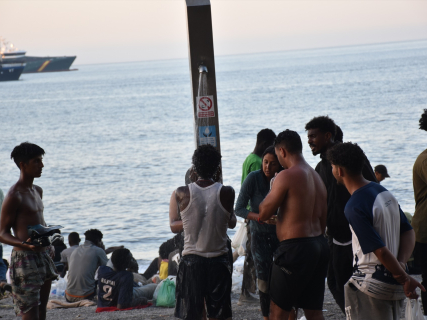
Spain secures Ceuta and Melilla ahead of the call on social media for a new massive entry of migrants on August 15.

Interior and the Civil Guard reinforce the surveillance of maritime borders while Morocco deploys forces to contain a call spread on social networks. The risk is considered real, although there is no confirmation that it will occur nor can its magnitude be anticipated.

6 minutes

EuropaPress 7705738 cientos personas migrantes reciben atencion sanitaria profesionales ingesa

EuropaPress 7705738 cientos personas migrantes reciben atencion sanitaria profesionales ingesa

Add DEMÓCRATA to Google

Ask FREN

Published

Last updated

6 minutes

Most read

Spain reinforces Ceuta and Melilla in the face of the risk of a new massive irregular entry of people into national territory on August 15. Morocco is also preparing border devices in anticipation of the possibility that this Saturday there will be a new attempt by migrants to arrive. There is a call for this that has been circulating since the beginning of the month through WhatsApp groups, Facebook, Instagram, and TikTok, although the authorities have not confirmed that it will materialize nor what its scope might be. Just in case, it is time to fortify.

The Spanish Government is monitoring publications, movements detected on the other side of the border, and possible routes used to access the autonomous cities. Morocco has reinforced police presence in the vicinity of Ceuta and Melilla and has warned that it will act against those who organize or participate in attempts at irregular crossing. At the same time, physical barriers are being installed, such as the one the Civil Guard is placing on the southern breakwater of Melilla.

The threat comes after the crisis recorded on July 30 and 31, when tens of thousands of people crossed the border into Ceuta. The precedent has led both countries to increase surveillance and adopt new physical and operational measures aimed at preventing another avalanche.

The call for August 15: real risk, but uncertain magnitude

The messages detected on social media mention Saturday, August 15 as the date to attempt to access Ceuta from Morocco. Some publications falsely present the border as vulnerable or suggest that those who manage to enter will be quickly transferred to the Peninsula.

This is not just an isolated rumor. Different verifications have confirmed the existence of groups in which dates, possible meeting points, and advice for crossing are shared.

The Minister of the Interior, Fernando Grande-Marlaska, has explained that the Information services are monitoring social media and exchanging data with Morocco to verify whether there is an effective mobilization of people within the neighboring country. The Government maintains that it has sufficient means and cooperation to prevent a repeat of the situation at the end of July.

The Moroccan authorities themselves have asked the population not to heed calls that they describe as misleading and dangerous. Rabat has also warned of possible legal actions against the promoters of the call.

The network that promoted the previous entry changes strategy

As DEMÓCRATA has reported, the possibility of a new entry on August 15 remains open, but the network that spread the messages linked to the previous assault would have modified its way of acting. The wide public dissemination of the date has eliminated the element of surprise and has allowed Spain and Morocco to reinforce their devices. Given this circumstance, conversations on networks are no longer concentrated exclusively on a single hour or access point: contradictory messages, changes of date, possible alternative routes, and calls to use less exposed communication channels appear.

This change makes it difficult to distinguish between an operational call, the rumors replicated by thousands of users and the disinformation aimed at confusing security forces. The authorities also do not rule out that the attempt could be advanced, postponed, or fragmented into smaller groups.

August 15 remains a date under special surveillance, but it does not constitute any certainty. The risk exists, although the volume of a possible mobilization and the real capacity of its promoters are uncertain.

New maritime barrier in Melilla

This Thursday, the Civil Guard has begun to place a maritime barrier on the southern breakwater of Melilla to reinforce the control of irregular access by sea. The device is similar to that installed on the El Tarajal jetty in Ceuta, after the massive entry at the end of July.

The new infrastructure requires several phases of installation and anchoring. The Civil Guard Command has not specified how long the work will last and maintains restricted access to the area, both on foot and by vehicle, for security reasons.

The Interior Ministry extended the installation of these elements to Melilla through the Instruction 9/2026 of the Secretary of State for Security, signed on August 1. The regulation sets the operational framework for using maritime barriers in Ceuta and Melilla and regulates the application of border refusals when a person tries to overcome those devices.

The measure is part of a broader strategy to reinforce the two Spanish maritime borders in North Africa and provide legal coverage for the actions of the National Police and the Civil Guard.

Why the barrier allows the application of border refusal

The Interior instruction adapts the action of the security forces to the interpretation established by the Supreme Court. The high court determined that the rejection at the border cannot be applied automatically to any person who has entered Spain irregularly.

This procedure is linked to the attempt to overcome the elements of border containment. The Supreme Court specified, however, that the Immigration Law does not limit those elements to the fences located on land. The placement of barriers at sea allows considering that anyone who surpasses them is attempting to breach a border element. The Interior seeks to provide legal security to the agents who intervene in cases of swimming entries by the maritime line of Ceuta or Melilla.

The application of rejection at the border must respect national and international regulations in any case, especially the guarantees corresponding to minors, possible asylum seekers, and vulnerable people.

Morocco again claims Ceuta and Melilla

The situation and the border reinforcement coincide, however, with a new Moroccan claim over the sovereignty of Ceuta and Melilla. The Minister of Justice of Morocco, Abdellatif Ouahbi, stated in an interview with Asharq News channel that the status of the two cities remains a "pending" issue.

Ouahbi assured that Rabat raises this matter in its contacts with Spain and placed it within a long-term diplomatic strategy. The minister defended that Morocco intends to resolve it through dialogue and stated that his country remains "clinging" to what it considers part of its territory.

The Spanish Ministry of Foreign Affairs responded that the territorial integrity of Spain has not been and will not be subject to negotiation. Madrid considers Ceuta and Melilla integral parts of national territory and rejects any bilateral discussion about its sovereignty.

The statements introduce an additional political element amid the border crisis. Spain maintains cooperation with Rabat to control migratory movements but denies that this collaboration can be linked to any territorial negotiation.

Robles: "Ceuta and Melilla are not to be touched"

The Minister of Defense, Margarita Robles, responded this Wednesday from Ceuta to the statements of the Moroccan official. "Ceuta and Melilla are not Spanish, they are very Spanish. "Ceuta and Melilla are not to be touched," she affirmed during her visit to the autonomous city.

Robles warned that "any aggression against Ceuta or Melilla is an aggression against all of Spain" and stated that what happened on July 30 "cannot happen again." He also demanded that "the full weight of the law" be applied to the networks that encourage people to cross the border, putting their lives at risk.

The minister guaranteed the continuity of the collaboration of the Armed Forces in Ceuta. The Army carries out support, presence, and deterrence tasks, although the ordinary control of the borders corresponds to the State Security Forces and Corps.

Robles also met with the Ceuta president, Juan Jesús Vivas, who has requested to increase the available resources and maintain state support while the city faces the consequences of the entry at the end of July.

Spain and Morocco reach Saturday with the border reinforced

The scenario prior to August 15 combines three elements: an accredited call on social media, the absence of confirmation about its realization, and a preventive deployment on both sides of the border. The date is marked in red by the authorities, but the available information does not allow for asserting that a new massive entry will occur. The loss of the element of surprise and the police reinforcement reduce the chances of a repeat of an episode of the magnitude recorded at the end of July, although they do not eliminate the risk of crossing attempts.

This time, the bandage is being put on before the wound, although the blow received at the end of July has shown that every precaution is little.

More key points, information and questions with FREN

AI-GENERATED CONTENT

What is the current status of the parliamentary processing of new laws or reforms on border control in Spain?

Currently, there is no “major border law” under processing, but rather several partial reforms affecting border control through the Immigration Law, regulations on migrant minors, proposals for delegation of powers, and adjustments linked to the Schengen framework. Some key initiatives are active (in the amendment phase or recently registered), while others, of a more restrictive nature, have been rejected in the Congress.

1. Draft law on migratory contingencies and minors

The most advanced instrument with a direct impact on entry management is the Draft Law derived from Royal Decree-Law 2/2025, “urgent measures to guarantee the best interests of children and adolescents in extraordinary migratory contingency situations” (file 121/000055):

  • The Royal Decree-Law was ratified by the Plenary of the Congress and its processing as a draft law was agreed upon, according to the Congress Bulletin of May 9, 2025 (publication of the draft).
  • The Board sent the text to the Youth and Childhood Commission and opened the amendment period, which has subsequently been extended; the latest agreement sets the deadline for amendments to the articles until September 2, 2026, so the initiative is still formally under processing (processing record).

Although its focus is on unaccompanied foreign minors, the statement of reasons emphasizes that it responds to an intensification of migratory flows at the southern EU borders and establishes a mandatory distribution mechanism among autonomous communities in situations of “extraordinary migratory contingency.” Demócrata summarizes this new model as a central piece of the “new migration management model” before summer 2025 (analysis of the Congress agenda).

2. Reforms of the Immigration Law linked to border control

2.1. Border rejection in Ceuta and Melilla

Following the Supreme Court ruling of July 8, 2026, which limits border rejection to those who surpass physical containment elements, a specific legislative front has opened:

  • The PP has registered a Bill to modify the tenth additional provision of Organic Law 4/2000 and allow rejections to also be applied to irregular entries by sea in Ceuta and Melilla. The initiative was publicly presented by deputy Sofía Acedo and is registered in Congress but still in a very initial phase: pending qualification and the Board's decision on its processing; the PP requests it to be processed by a single reading (Demócrata report and Feijóo's position).
  • The debate is directly connected to the July migration crisis in Ceuta, described by Demócrata as the largest since 2021 (report on Ceuta) and with various requests for Immigration Law reform from the autonomous city and police unions (demand from President Vivas, JUPOL's position).

For now, therefore, it is a recently registered proposal, with no record of a debate on its consideration yet.

2.2. Restrictive initiatives on regularization and settlement

In parallel, several bills have been discussed that, without focusing solely on the border line, do affect the entry and stay regime:

  • The Vox Organic Bill to restrict regularization by settlement was debated and rejected by the Plenary of Congress on September 16, 2025, with 169 votes in favor, 177 against, and 1 abstention (file 122/000191). Demócrata's summary records the rejection by PSOE and its partners and the support of the PP (parliamentary report).
  • Another similar initiative from the Mixed Group in the Senate (at Vox's request) to toughen the Immigration Law and the expulsion of convicted foreigners is still formally under processing in the Upper House, with the amended deadline extended until September 2, 2026 (file 622/000080), according to the Senate Bulletin (publication of the bill).

3. Delegation of powers and border security

3.1. PSOE–Junts bill on immigration in Catalonia

One of the politically most sensitive pieces is the Organic Bill for delegation of immigration powers to the Generalitat of Catalonia, the result of the agreement between PSOE and Junts:

  • According to the newspaper Demócrata, the initiative, registered in Congress, turns Catalonia into a “one-stop shop” for residence authorizations and grants the Mossos d’Esquadra a central role in the security of ports, airports, and “critical zones,” in coordination with the Civil Guard and National Police (analysis of the pact).
  • The Interior Minister, Fernando Grande-Marlaska, has publicly emphasized that the text “is registered as a bill” and must still go through the entire parliamentary process, in which modifications may be introduced, insisting that it does not cede border control nor irregular migratory flows to the Generalitat (Marlaska's statements).

The available sources do not yet detail the exact phase (consideration, amendments, etc.), so as of today, it should be considered in an initial and open stage of processing.

3.2. Delegation of border control in Catalonia: rejected initiatives

On the same competence axis, but with a more explicit scope on borders, two initiatives already stopped stand out:

  • In Congress, the Junts Organic Bill on full veils and delegation of state powers in security and identification of persons, which included delegation to the Generalitat of border control powers and issuance of ID cards and passports, was rejected on April 14, 2026, by 7 votes in favor, 327 against, and 13 abstentions (file 122/000256; rejection text).
  • An almost identical text is being processed in the Senate (file 622/000102), admitted and pending consideration, according to the Upper House Bulletin (publication of the bill).

4. General context: border and Schengen

Beyond these laws, much of the “border control” is being redefined through European regulations (Migration and Asylum Pact, Entry and Exit System –EES–) and executive decisions from the Interior Ministry. Demócrata has explained, for example, how Spain is preparing the implementation of the EES system and adjusting its air and sea controls to the Schengen Border Code (EES system, temporary reintroduction of internal controls).

In summary, Parliament is currently working on a mosaic of reforms: a draft law already in the amendment phase on migratory contingencies, several bills on Immigration Law linked to Ceuta and Melilla, and texts on delegation of powers that indirectly affect border control. None of these pieces has yet culminated in a comprehensive reform of the border regime, and several of the most controversial proposals have been rejected in Congress.

What exactly does the migrant minors distribution mechanism provided in Draft Law 121/000055 consist of, and what amendments have been proposed regarding it? What specific changes does the PP's bill on border rejection in Ceuta and Melilla intend to introduce, and what parliamentary support does it have? According to the PSOE–Junts bill, how would the coordination between Mossos, Civil Guard, and National Police operate in Catalan ports and airports?

What are the specific competencies of the Interior Minister, Fernando Grande-Marlaska, regarding border security according to Spanish legislation?

The competencies of the Interior Minister in border security mainly derive from his position as the highest political authority of the Ministry of the Interior and, through it, of the bodies responsible for entry control and surveillance of coasts, borders, ports, and airports. The key regulations are the Organic Immigration Law, the Organic Law of Security Forces and Corps, and sectoral provisions on maritime surveillance and irregular immigration. Fernando Grande-Marlaska does not have a “closed list” of personal acts at the border, but he does have the capacity to issue resolutions on immigration matters and to order, direct, and coordinate the National Police and Civil Guard in border protection. The main legal bases are summarized below.

1. Immigration and decisions at the border

The Organic Law 4/2000, on the rights and freedoms of foreigners in Spain and their social integration, with its reforms (LO 4/2000, LO 8/2000, LO 2/2009, and subsequent modifications such as RDL 11/2018 and Law 11/2023) assigns Interior a central role in entry control, inadmission, return, and expulsion at the border.

From the text it follows that:

  • The Ministry of the Interior is the authority controlling entry into national territory at authorized posts, requiring passport/travel document, visa when applicable, and proof of means of subsistence and purpose of stay (visa and entry regime developed in LO 4/2000).
  • When the foreigner does not meet entry requirements, the law provides for denial of entry by reasoned resolution, with the right to legal assistance and interpreter from the control at the border post.
  • Procedures for return and expulsion from Spanish territory and preferential processing of certain files are foreseen, in which immigration administrative resolutions are appealable but enforceable under general legislation terms.
  • LO 4/2000 expressly mentions the adoption of restrictive measures, such as border distancing, “by resolution of the Minister of the Interior, adopted in accordance with the legal guarantees of the sanctioning procedure provided by law.”

In summary, immigration legislation configures the minister as the ultimate decision-making authority in sanctioning and distancing measures linked to the border and as the political responsible for the regime of entries, inadmissions, returns, and expulsions.

2. Direction of National Police and Civil Guard at borders

The Organic Law 2/1986, on Security Forces and Corps (LO 2/1986) is the basic piece connecting the minister with the physical border control.

In its articles, distributing material competencies between National Police and Civil Guard, it establishes that:

  • The National Police Corps is responsible, among other functions, for “control of entry and exit of Spanish and foreign nationals” and functions provided in legislation on immigration, refuge and asylum, extradition, expulsion, emigration, and immigration.
  • The Civil Guard is responsible, among others, for “guarding land communication routes, coasts, borders, ports, airports and centers and facilities that require it due to their interest.”
  • The Ministry of the Interior may order that one of the bodies assume, in certain areas or nuclei, exclusive functions of the other, for better use of resources.
  • The Ministry of the Interior “will arrange everything concerning Civil Guard services related to citizen security and other competencies attributed by this Law,” which includes border surveillance devices.

In practice, this means that Grande-Marlaska politically directs the actions of the bodies that execute entry control and surveillance of land, maritime, and air borders.

3. Maritime surveillance, irregular immigration, and coordination

Alongside organic laws, several regulations reinforce Interior's competence in the border field:

  • The Order PRE/2523/2008, which creates Civil Guard Centers for maritime surveillance of coasts and borders ([link]), consolidates Interior as the authority over the maritime surveillance device on coasts and borders.
  • The Order PCI/842/2018, publishing the Council of Ministers Agreement on the Coordination Authority against irregular immigration in the Strait, Alboran Sea, and adjacent waters ([link]), shows the Government's capacity — through Interior — to create specific coordination structures in sensitive border areas.

4. National security and strategic framework

The Law 36/2015, on National Security (National Security Law) configures a system in which the Government directs national security policy, including protection of territory and borders in situations of “interest for national security.” Within this framework, the Interior Minister acts as the competent authority in his scope, integrating Police and Civil Guard devices in the response to threats affecting borders.

Other strategic instruments, such as the National Strategy against Terrorism 2019 and 2023, published through Order PCI/179/2019 and Order PJC/406/2024, also project over border security, although they do not add specific competencies to the minister beyond his role as interior public order responsible.

5. Organic structure of the Ministry of the Interior

The minister's competencies are concretely defined organically in royal decrees on the structure of ministerial departments, including those developing the Ministry of the Interior's structure (such as Royal Decree 734/2020 and its subsequent modifications, indirectly cited by Royal Decree 146/2021, and corrections like the 2024 error correction). These texts distribute functions among the State Secretariat for Security, the Directorate General of Police, and that of the Civil Guard, all under the minister's hierarchical dependence.

Overall, Spanish legislation configures the Interior Minister as the highest political responsible for entry and exit control of the territory, surveillance of coasts and borders, and execution of immigration policy at the border, mainly exercised through National Police and Civil Guard and coordination structures created by the Government.

[link] [link] [link] [link] [link] [link] [link] [link] [link] [link] [link] [link] [link] [link] [link] [link] [link] [link] [link] [link] [link] [link] [link] [link] [link] [link] [link] [link] [link]

Could you specify what discretion margin the Interior Minister has when issuing expulsion or border distancing resolutions? What exact role do the National Police and Civil Guard play in border controls at airports, ports, and land borders? How does the Ministry of the Interior coordinate with other countries and the European Union regarding border control and irregular immigration?

What legal requirements must be met to apply border rejection according to the Supreme Court's interpretation?

In the Spanish legal system, “border rejection” is based on immigration and citizen security regulations and has been subject to constitutional review, mainly by the Constitutional Court rather than the Supreme Court. The Constitutional Court rulings on Organic Law 4/2015, on citizen security protection, have declared the special border rejection regime for Ceuta and Melilla constitutional, but only if interpreted in conformity with the Constitution. Based on that jurisprudence, the application of border rejection requires, at least, coverage in organic law, respect for human dignity, legal certainty, and submission of administrative action to judicial control. According to the information available in the BOE, there are no specific rulings from the Third Chamber of the Supreme Court further detailing these requirements for border rejection, so the key framework today results from the combination of the Organic Law and the Constitutional Court's interpretation.

Basic regulatory framework

Border rejection is inserted in the general immigration regime of the Organic Law 4/2000, on the rights and freedoms of foreigners in Spain and their social integration. This law has been amended by several organic reforms (such as Organic Laws 8/2000, 2/2009, 10/2011), but in the excerpt consulted, the specific content of the additional provision regulating border rejection is not available, so the literal detail of that provision is not at hand.

In parallel, the special border rejection regime in Ceuta and Melilla is introduced through Organic Law 4/2015, on citizen security protection, whose general title is public security, but whose first final provision was challenged precisely for regulating that special regime. This connection between immigration and citizen security is what makes the constitutional review of border rejection pass through the revision of Organic Law 4/2015.

Constitutional Court interpretation

The central piece to understand the legal and guarantee requirements is the Constitutional Court's jurisprudence on Organic Law 4/2015:

  • STC 172/2020, of November 19 (appeal 2896-2015), published in the BOE as Judgment 172/2020. The ruling expressly refers to the “conforming interpretation of the provision establishing a special border rejection regime for Ceuta and Melilla.”
  • STC 13/2021, of January 28 (appeal 3848-2015), published as Judgment 13/2021, which again declares the constitutionality of various provisions of Organic Law 4/2015, “and of the special border rejection regime for Ceuta and Melilla,” always through an interpretation consistent with fundamental rights.

In both rulings, the Constitutional Court frames its analysis around human dignity, legal certainty, and submission of administrative action to judicial control, as reflected in the judgments' headings. This implies that border rejection is only constitutional if applied in a way that respects those principles and rights.

Scope regarding the Supreme Court

In the information published in the Official State Gazette that has been consulted, there are no rulings from the Third Chamber of the Supreme Court that, expressly and with that terminology (“border rejection”), systematize or develop the specific legal regime of these border actions, neither for Ceuta and Melilla nor for other border posts.

The Third Chamber rulings that do appear linked to Organic Law 4/2000 or its regulation (for example, the February 10, 2015 ruling, on foreign internment centers, or those from 2013 on the Immigration Regulation) address immigration guarantees in general but do not specifically mention border rejection in the terms posed in your question. Therefore, there is no “Supreme Court doctrine on border rejection” as clearly formulated as that of the Constitutional Court.

Practical requirements and guarantees

Based on the combination of organic regulations and constitutional interpretation, some minimum requirements can be abstracted that must be met to apply any border rejection measure:

  • Coverage in organic law: the measure must be expressly provided in a norm with the rank of Organic Law (Organic Law 4/2000 and development through Organic Law 4/2015 for the special regime of Ceuta and Melilla); regulatory norms alone are not enough.
  • Respect for dignity and fundamental rights: STCs 172/2020 and 13/2021 expressly link the entire citizen security regime (including border rejection) to human dignity, physical integrity, and judicial protection, so the material action at the border must be compatible with those rights.
  • Legal certainty and predictability: the Constitutional Court insists on the principle of legal certainty; this requires that the conditions and assumptions for applying border rejection be sufficiently determined in the law, avoiding arbitrary decisions.
  • Judicial control and possibility of appeal: the headings of the rulings on Organic Law 4/2015 emphasize the submission of administrative action to judicial control. Although border action is immediate, there must be a channel for the affected person to assert their rights before a judicial body.
  • Compatibility with international commitments: although not explicit in the consulted fragments, Organic Law 4/2000 itself generally refers to the application of international conventions to which Spain is a party; any border rejection must be compatible with those obligations, according to the immigration legal framework itself.

Beyond these elements, and lacking an accessible literal text of the specific immigration provision and detailed Supreme Court doctrine on “border rejection,” no further information is available in the consulted sources to specify other technical or procedural requirements.

Could you explain exactly what the provision of Organic Law 4/2000 regulating border rejection says? What nuances does the Constitutional Court add in STC 172/2020 about how border rejection in Ceuta and Melilla must be applied? How does border rejection legally differ from a return or expulsion in the Spanish immigration regime?

Play

Test your knowledge with FREN!

How much do you know about this topic? Answer the following 3 questions.

What is the main reason why Spain and Morocco have strengthened security in Ceuta and Melilla in August?

Question 1 of 3

What element has the Civil Guard started to install on the south breakwater of Melilla?

Question 2 of 3

What stance has the Spanish Government expressed regarding Morocco's claims over Ceuta and Melilla?

Question 3 of 3

Hola, soy Fren. ¿Cómo te ayudo?