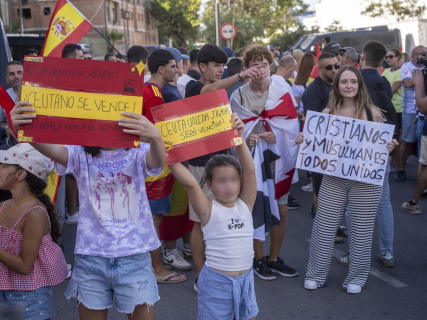

Around a hundred neighbors from Ceuta have gathered this afternoon in front of the Government Delegation carrying carnations and flags of Ceuta and Spain. With this action, they wanted to emphasize the peaceful nature of the citizen mobilizations that have been taking place in recent days due to the migratory crisis that the city is experiencing.
The gathering, organized through neighborhood groups and social media, brought together men, women, and entire families in the Plaza de los Reyes. From there, those present made a symbolic throwing of flowers towards the headquarters of the General State Administration, as a gesture of rejection against what they consider a lack of response from the Executive.
After the concentration in the square, the attendees began a march to join another citizen demonstration that had started at a different point in the city. Both mobilizations are expected to converge at Benítez beach, one of the places with the highest presence of migrant people, where this Thursday groups of protesters destroyed their settlements.
During the event in Plaza de los Reyes, several participants emphasized that the protests do not seek confrontation or violence. One of those present took the floor to clarify that the purpose of the concentration is to symbolically deliver the carnations to the Government Delegation as a form of protest and to make it clear that the citizen demands are being carried out peacefully.
"These are our weapons," he stated before those gathered while showing the flowers. Among the attendees was Rafael Hernández, a professor at the Ángel García Ruiz Professional Conservatory of Music, who explained that he participates in the mobilizations from the beginning because he cannot "sit on the couch watching what is happening."
Hernández indicated that the initiative arose as a reaction to the image that, in his opinion, is being presented of the protests in some national media. He pointed out that many neighbors feel that the protesters are portrayed as violent or radical groups when "the majority of the participants reject that type of behavior."
The professor has defended coexistence among the different communities of the city and has emphasized that Ceuta constitutes an example of cultural and religious diversity. "Here we all coexist together," he stated, while rejecting the accusations of racism directed against those who attend the mobilizations.
Likewise, he has asked to avoid any kind of provocation and has demanded that those present maintain the peaceful nature of the protests at all times.
The carnations as a symbol of protest
The origin of the choice of carnations, he explained, is found in the Carnation Revolution of Portugal. Hernández has recalled how that peaceful mobilization became a symbol of political change and has assured that the use of these flowers aims to send a similar message of protest without violence.
According to what he recounted, at first some participants considered more forceful actions or gatherings in other parts of the city, but they ultimately decided to go to the Government Delegation to direct their criticisms towards those they consider responsible for managing the crisis.
The attendees have demanded measures that allow putting an end to the situation arising from the massive arrival of migrants to Ceuta and have expressed their rejection of the use of public facilities for their temporary accommodation, an option that has provoked strong citizen backlash during this week.