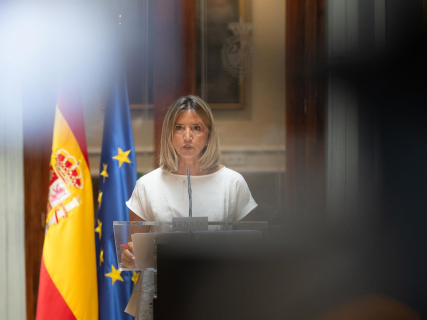

The spokesperson for the PP in the Senate, Alicia García, announced this Wednesday that the party will take advantage of the absolute majority it has in the Upper House to submit five members of the Government to censure for their actions during the migration crisis in Ceuta: Fernando Grande-Marlaska (Interior), José Manuel Albares (Foreign Affairs), Margarita Robles (Defense), Mónica García (Health), and Ana Redondo (Equality).
"If they do not leave, the PP will say it for them," proclaimed Alicia García at a press conference from the Senate, where she specified that the vote on these five ministers will take place in the first Plenary of September.
The 'popular' leader argued the new censure of Marlaska in the Upper House because, in her opinion, he has been responsible "for leaving the border of Ceuta without reinforcement despite the warnings of what was going to happen."
In relation to Albares, the PP maintains that citizens "still do not know what Morocco's role has been," while it will criticize Robles for having initially shown her willingness to attend the Senate in August and then having renounced to appear.
Regarding the head of Health, the 'popular' will censure Mónica García "for the collapse of the health system that she herself manages and for not reinforcing it when it was needed."
At this point, Alicia García accused the minister of having taken 17 days to travel to the city and of later denying that there was a "health collapse," despite the complaints made by health professionals themselves.
"Ceuta lacks resources, it lacks health professionals, and it lacks a Government," the 'popular' spokesperson emphasized.
As for Ana Redondo, the PP will also promote her censure and demand her resignation because, according to García, the minister of Equality "has not set foot in Ceuta for a single day" during the crisis. "And yet sexual assaults have multiplied by eight," she reproached.
In this line, the spokesperson emphasized that these five censures constitute the PP's response to the Government's "slight" to the Senate and to the repeated refusal of several ministers to submit to the control of the Upper House to explain what happened in Ceuta.
"Three ministers, three empty chairs"
The 'popular' leader has particularly attacked the decision of Grande-Marlaska, Albares, and Robles not to attend the hearings for which they had been summoned in the Senate and has reiterated her accusation against the Executive of having designed "a parallel calendar" in Congress with the aim of evading the PP majority in the Upper House.
"Three ministers, three empty chairs," the spokesperson summarized, accusing these three members of the Government of being in "democratic rebellion" and refusing to show their faces "for Ceuta, for the Spaniards, and for Spain."
Likewise, the 'popular' has emphasized that this is not "an invitation" nor "a courtesy," but an obligation derived from parliamentary control. "The Government cannot literally choose which Chamber controls it, when it appears, or under what conditions it does so," she stated.
Ceuta, "four simultaneous crises"
In this context, the PP spokesperson has intensified her criticism of the Executive's management in Ceuta, asserting that the autonomous city is simultaneously suffering a crisis "of migration, public health, public order, and security."
García has described what happened as a "premeditated occupation" of Spanish territory and has reproached the Government for not adopting the necessary decisions to reinforce the border, despite prior warnings and alerts from the president of Ceuta, Juan Vivas.
"Ceuta is Spain, Ceuta is the border of Spain, the southern border of Spain, and the southern border of Europe," she defended, before warning that "a border that is not defended is not a border, it is a door wide open."
Judicial offensive by the PP
Beyond the reproaches, the PP spokesperson has reiterated that her group is analyzing the possibility of taking legal action to clarify responsibilities for the Government's actions during the Ceuta crisis and for the refusal of several ministers to attend the Senate.
"All the instruments at our disposal to determine responsibilities for what happened in Ceuta and for the neglect of duties by the Government," she pointed out, specifying that the concrete measures will be made public "when appropriate."
At the same time, the 'popular' spokesperson has not closed the door to the creation of a specific investigative commission regarding the events in Ceuta, although she has clarified that, for now, this option is not formally on the table.