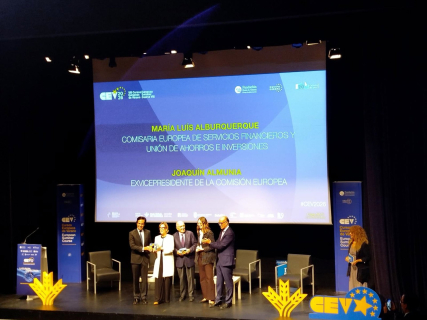

The former Vice President of the European Commission Joaquín Almunia warned this Friday in Pamplona, after being distinguished with the IV International Navarra Puerta de Europa Award, that "the quality of democracy in average European countries today is much worse than the quality of democracy of that European community in which we integrated" in 1986. He also pointed out that there are political forces that, although "do not want their country to leave" the European Union, "want to transform the EU from within into something much worse."
Almunia has been recognized with this award 'ex aequo' alongside the European Commissioner for Financial Services and the Union of Savings and Investment, Maria Luís Albuquerque, within the framework of the VIII European Summer Courses promoted by the Diario de Navarra Foundation and Team Europe.
During his speech, the former commissioner defended that Spain's incorporation into the EU "has been a success, without any doubt, without any 'but' to put, and a success for those who signed the accession treaty with us." He emphasized that "there is no other enlargement of the European community that is considered, both by those who opened the door and by those who entered through the door, as a success without any type of reproach."
He insisted that "our national interests as Spaniards have no fundamental obstacle with what has been required of us to be members of the European community." That "success," he added, "has allowed us to consolidate democracy, many economic, social, and civic advances, an expansion of our rights and freedoms as citizens of a democracy, and a role in the world that we could not have imagined being independent and not members of the current European Union." "Therefore, a success without qualifications that negotiation and what has come after," he stressed.
However, he admitted that, looking forward, "we do have some common problems among the member countries" of the EU. In his view, "if we look at Europe from here on out, the current European Union and the problems and risks that we all European countries have to face, the situation is more complex."
Among the pending challenges, he has claimed "more and better immigration policies on a European scale, which do not call into question our respect for human dignity, but rather take into consideration the necessary policies for social integration, of internal mobility of immigrants arriving," as well as "respect" towards these people.
Likewise, he has pointed out that the search for an "alternative consensus without new elections" between the European PP and the far right "is creating social and political problems in many countries" and affects the image that Europe projects externally. In his opinion, "this breakdown of the democratic consensus of European coalition, if it persists, will make it practically impossible for us to continue advancing in Europe," at a time when "advancing in Europe is essential."
He has also denounced the "double standard" of trying to achieve "the support of parties that do not believe in the same Europe enshrined in the foundational values of the treaty." In his view, this dynamic "can make it impossible for us to continue advancing in a world where the 'respect for international law and the universal values that our EU treaty speaks of' has been broken." "That is the task for the future," he concluded.
Among the risks and challenges that, in his opinion, must be prioritized, he mentioned climate change, which requires "European leadership" that "unfortunately" Europe "is renouncing"; the quality of democracy and social cohesion.
In relation to the 40th anniversary of the entry of Spain and Portugal into the European Union, Almunia has recalled that "it was a decisive step for those of us who considered that we did not have our democracy fully consolidated." He added that "Portugal had reached a democratic situation before us, which helped us a lot as Spanish democrats to push more for the possibilities that, after Franco, that would accelerate."
On the other hand, Pablo Zalba, commissioner of the European Summer Courses, has highlighted that the two awardees embody "the culture of consensus, dialogue, common building against polarization and radicalism." "Together you symbolize something that deserves to be claimed: that Europe advances when there is consensus, when there is dialogue, when there is vision and when there is capacity for agreement," he stated.
The European Summer Courses, organized by the Diario de Navarra Foundation and Team Europe with the collaboration of the European Commission Office in Spain, have celebrated their VIII edition in Pamplona from August 26 to 28, under the slogan 'Connected Europe' and with Ireland as the guest country.