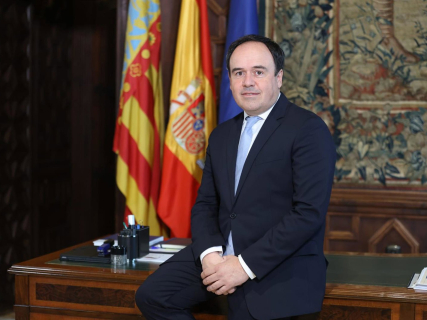

The 'president' of the Generalitat Valenciana, Juanfran Pérez Llorca, emphasizes on the 9th of October the importance of "defending the own voice of the three provinces," Castellón, Alicante, and Valencia; "a voice that does not need to shout, but must be heard." "It is not the voice of conflict. It is that of a hardworking and generous land that wants to participate in the common project of Spain from loyalty and from respect for itself," he states.
In his opinion article for the Day of the Comunitat Valenciana, titled this year "A legacy for the future" and coinciding with his first 9th of October as 'president', he argues that the "best way" to commemorate the date is "to ask ourselves what Comunitat Valenciana we want to leave to future generations," linking that reflection with the 750th anniversary of the death of Jaume I and with the "collective identity" of the Valencians as "an infinite legacy."
The head of the Consell emphasizes that the 9th of October "is not just another anniversary," but "a living reality" that endures in institutions, culture, traditions, languages, symbols, and, "above all, in our way of understanding coexistence." In his opinion, "the Valencian identity never needed to be built against anyone. It did not need conflict to assert itself nor grievance to recognize itself. It has been forged with the contributions of generations that have built our way of seeing life. We are a diverse land that knows its history, values its personality, and does not need to renounce either of the two things to be, at the same time, part and whole of the idea of Spain and the dream of Europe."
In this line, he insists that "our self-government is the contemporary expression of that collective will. It is not the memory of what we were, but the tool with which we decide what we want to be. It allows us to manage our public services, defend our interests, and face our challenges. And it is also the guarantee that our signs of identity belong to everyone. The Senyera, our institutions, our traditions, and the Valencian language have neither owners nor need guardians. They are the heritage of the Valencians and must continue to be spaces for meeting and not instruments for division."
For this reason, Llorca emphasizes that "feeling pride for what we have received also implies assuming a responsibility": "Each generation receives a legacy and decides what to do with it. It can preserve it or enrich it before handing it over to those who come after."
Five shared goals for the future
In his reflection, he proposes "five objectives that we all must share" in response to "what Comunitat do we want" in the coming decades. The first, he points out, is to raise "a Comunitat that cares better for and more people": "A land where our public services meet the needs of the people. Where healthcare, education, and social policies accompany us when we need them most. Where our elders, after a lifetime of work, receive the attention they deserve and those who need help find an administration that responds."
The second objective is oriented towards "a Comunitat that opens opportunities to build life projects": "A place where young people can train, find work, develop their talent, become independent, create a business, or start a family." "We must not settle for telling them that they are the future --Llorca emphasizes--. We have to offer them options in the present so that traveling the world is a choice and not an obligation. That they leave to learn and grow, but return because there are opportunities here."
As a third axis, he demands "a land that produces to compete" understanding that "there is no well-being without prosperity, nor strong public services without an economy capable of sustaining them." He recalls that "the Comunitat has always been a land of entrepreneurs, self-employed, farmers, merchants, workers, industrialists, and companies. People who wake up early, take risks, innovate, and generate opportunities," and states that the Generalitat works "to promote that energy, facilitate investment and work, turn good ideas into projects, and help our companies compete in Spain, Europe, and the world."
The fourth objective focuses on being "an increasingly better protected Comunitat," linking it to security and prevention against emergencies. The 'president' recalls the dana of October 29, 2024, which caused 233 deaths, "whose victims and families will always be in our memory": "It hit us with particular cruelty and the bitter lesson learned forces us to build a safer and more resilient land, with better means, infrastructure, and coordination. A Comunitat capable of protecting its territory and, above all, the people who live in it."
Finally, it places as the fifth goal the one that "gives meaning to all the previous ones": "defending the own voice of the three provinces." It reiterates that "the Comunitat Valenciana does not want to be more than anyone. But it should not accept to be less than anyone either," and encourages to "defend our interests with serenity and determination."
"Dialogue, rigor, and institutional firmness"
For Llorca, this implies demanding adequate funding, water, infrastructure, and the essential resources to "grow and guarantee our public services." He claims to do it "from dialogue, rigor, and institutional firmness because people from Alicante, Castellón, and Valencia have an identity that does not need to confront anyone, but will not remain silent before anyone either."
"Seven hundred fifty years after the death of Jaume I, perhaps that is the best meaning we can give to the word legacy, because a legacy is not only what we receive. It is also what we decide to leave," he states, recalling that "we have received a land with history, institutions, culture, language, and its own personality": "Now we have the responsibility to add our page to that history and deliver to those who come after a more prosperous, safe, open Comunitat with more opportunities."
He concludes with a look to the future: "We have reasons to feel proud of our past. We have determination to face our present. But, above all, we have the right to look with hope towards the future. Our best time does not have to be the one we remember. It has to be the one we still have time to build together. That will mean that we were up to the task of what we received. That we knew how to turn the inheritance into opportunity, the identity into coexistence, and the pride into future. And then we can say that, 750 years later, the infinite legacy of October 9th is a legacy of the future."