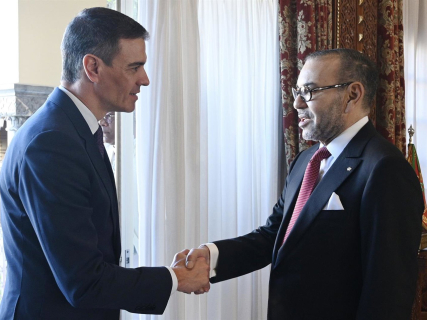

The massive arrival at the end of July of about 80,000 migrants to Ceuta, mostly Moroccan citizens, has served Rabat to once again bring to light its historical claim over this autonomous city and over Melilla. However, the consulted specialists believe that the Moroccan Government has no intention of going beyond the rhetorical level, given that its priorities lie in Western Sahara and in the joint organization with Spain and Portugal of the 2030 World Cup.
"It's nothing new: Morocco's position has always been that Ceuta and Melilla are occupied territories and that their status must be resolved through negotiations," explains to Europa Press the director for North Africa of the 'think-tank' Crisis Group, Riccardo Fabiani. Until now, he points out, Rabat "did not have much capacity to focus" on these two Spanish enclaves, as "its attention was completely centered on Western Sahara."
In his analysis, "with the current Administration in Washington encouraging Morocco" after Donald Trump's recognition in December 2020 of Moroccan sovereignty over the former Spanish colony and "with Rabat feeling more confident about the future of Western Sahara, the kingdom feels that this is the right moment to resume discussions about Ceuta and Melilla."
Fabiani admits that the current context "represents an opportunity for Rabat to advance its claims," especially after the entry of thousands of people from Moroccan territory into Ceuta has evidenced "the vulnerability and dependence on Morocco's cooperation for its own security." Therefore, he insists, "Morocco is taking advantage of the moment to reiterate its traditional demand."
This stance has broad internal support, as "all the major parties agree that Western Sahara, Ceuta, and Melilla are Moroccan," emphasizes the head of Crisis Group. In this framework, he places the recent interventions of the Minister of Justice, Abdellatif Ouahbi, calling for a dialogue with Spain about these cities, which he interprets as "a way to open a sensitive but inevitable conversation about these two territories."
Political use and internal calculation in Rabat
From another perspective, Irene Fernández Molina, professor of International Relations at the University of Exeter (United Kingdom), considers that "certain actors are opportunistically exploiting" what happened in Ceuta to insist again on territorial claims. In her opinion, Ouahbi, leader of the Authenticity and Modernity Party (PAM), could be seeking "greater visibility" and even securing "a seat" in the Executive that will emerge from the polls on September 23.
The PAM, created by Fuad Alí el Himma, a close friend and one of the main advisors of the Alaouite monarch, is part of the governing coalition led by Aziz Ajanuch, leader of the National Rally of Independents (RNI). With an eye on the upcoming elections, the party has included in its lists the president of the Moroccan Football Federation, Fouzi Lekjaa, about whom there is speculation that he could become the next head of government.
According to Fernández Molina, "it is logical to think that in the coming weeks this type of statement about Ceuta and Melilla will escalate," which, she recalls in statements to Europa Press, have allowed the Royal Palace on other occasions to "assume the role of referee and moderate act in front of the outside world."
Responsibility in the migration crisis, but without a prior plan
Despite the tension generated by the avalanche at the end of July, both Fabiani and Fernández Molina agree that the episode did not have the direct objective of reopening the territorial dispute with Spain. Nevertheless, they point out that, although there was no strategy designed from the top of power, there is indeed responsibility on the part of the Moroccan security forces for not having reacted quickly to stop the entries.
Fernández Molina admits that, without a thorough investigation, it cannot be stated that there was "an organization or machination" on the part of the Moroccan authorities, but she maintains that they have an "undeniable responsibility" for not having prevented the increase in access to Ceuta. Nevertheless, she emphasizes that "it is not the same as being the origin of the crisis."
In this line, she suggests that behind what happened there could be a specific sector of the security services and questions whether everything responded to a direct order from Mohamed VI, who hours earlier, on July 29, in his speech for the Throne Day, had highlighted the stability and development achieved by the country. "It's hard to think what interest the king could have in giving the world such a negative image," she emphasizes.
Fabiani also leans towards a spontaneous phenomenon, amplified by social networks, although he points out that "the Moroccan security forces probably underestimated or facilitated this flow, thinking it would be more manageable than it turned out to be." "As soon as they realized, they acted to contain the damage done, but it was already too late," he recounts.
In his opinion, "the authorities can do little to erase the images and the perception that Morocco is less stable and reliable than previously thought." Furthermore, he believes that the crisis constitutes "a cause for embarrassment" on the eve of elections, as it could worsen the already low public trust in institutions and has "increased suspicions of the instrumentalization of migration."
Fundamental claim, but patient strategy
Despite the hardening of the discourse, the two experts agree that Rabat does not plan to intensify its claims over Ceuta and Melilla for now. "The issue has always been there and will continue to be," summarizes the academic from the University of Exeter, who does not consider it likely that "active measures will be taken to change the 'statu quo'."
"I don't think Morocco is in a hurry to resolve the status of these two cities," says Fabiani, who defines the Moroccan stance as a long-term bet and emphasizes that the kingdom "is willing to pursue a cautious and patient strategy that will eventually lead to their 'return'." For now, the country "has enough" with the Western Sahara dossier and the preparation for the 2030 World Cup and "does not have much capacity to accelerate this issue."
For Rabat, Fernández Molina points out, "the Sahara is the true priority in foreign policy" and Morocco "has much more to gain from a good relationship with Spain," especially after the support of the President of the Government, Pedro Sánchez, in 2022 for the Moroccan autonomy plan for the Sahrawi territory.
The joint celebration of the football World Cup also weighs in the calculations. "It is not a secondary or decorative issue," admits the researcher, who emphasizes that the tournament "has become a strategic policy" for the Alaouite kingdom, which is allocating millions in investments to infrastructure and aims to leverage it for a "face wash."
Fabiani agrees that the championship, whose final Rabat has already expressed its desire to host, "is a significant reason why it is unlikely that Morocco will go further in this matter." In his opinion, the country sees the World Cup "as a unique opportunity to promote itself to the world and for which it needs the cooperation of Spain."
"Ceuta and Melilla are an issue that Morocco wants to keep alive but is willing to wait a long time to see it resolved," concludes the Crisis Group analyst, who does not completely rule out that a similar episode could occur in Melilla, although he does not believe that "it is in Morocco's interest at this time."