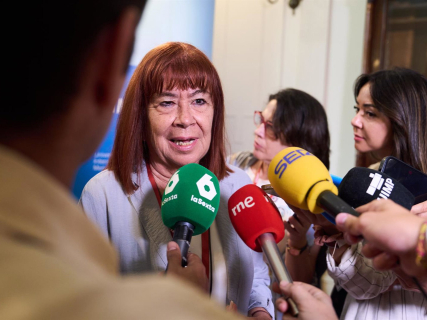

The president of the PSOE, Cristina Narbona, has responded to the words of the president of Castilla-La Mancha, Emiliano García-Page, who had demanded from Moncloa "to fulfill the word given" and "to return all those who have entered illegally." Narbona has specified that "all those who, in accordance with European and Spanish legislation, can be returned will return."
As she recalled, "President Page knows that returns must, in any case, comply with current legality," and emphasized that the regulations require, for example, to take into account the situation of unaccompanied minors and the specific treatment they require.
The socialist leader has also pointed out that among the people who entered irregularly in Ceuta there are migrants from Sub-Saharan Africa who "may benefit from asylum legislation," so not all are in the same legal situation.
In statements to the media in Santander, the president of the PSOE has stressed that the "priority" of the Government is now focused on the single command "to coordinate as best as possible all the aid that must be given to the Ceuta population and, of course, to guarantee the rights of the people who have arrived under very exceptional conditions."
Versions of the ministers and action of the CNI
Narbona considers the explanations offered by the ministers Margarita Robles (Defense) and Fernando Grande-Marlaska (Interior) regarding the reports of the National Intelligence Center (CNI) prior to the massive arrival of migrants in Ceuta to be "compatible."
When asked about the differences between the versions of Robles and Marlaska on whether or not there were CNI reports that anticipated a massive entry like the one that ultimately occurred, the president of the PSOE understands that it "can be considered that both statements of the ministers are compatible."
In this regard, she clarified that "Certainly, one thing is to say 'more people are entering' --in summer there is always a greater entry because the sea conditions favor it-- and another thing is that in that information that reached the Government there was no greater detail that could alarm more closely to what then happened."
For the former minister, the "fundamental" thing at this moment is that the investigation into the origin of the massive entry of irregular migrants that occurred on July 30 and 31 is completed, in order to clarify "who has been behind it; how it has happened and how it could have affected so many thousands of people so that reasonable consequences can be drawn."
Relationship with Morocco and Government Strategy
Regarding the relationship with Rabat, and when asked if she perceives the Government of Pedro Sánchez's stance towards Morocco as "soft," Narbona defended that the Executive "is trying to ensure that the collaboration" of the neighboring country is "as maximum as possible, precisely so that what has happened in Ceuta in a few months is a bad dream and we can get out of the current situation" derived from these events.
She recalled that Morocco "is a neighbor with whom we need to be able to understand each other on many issues, not only on this one, but on many other issues" and emphasized that "It is a strategic relationship of long reach" that requires keeping the channels of dialogue open.
Narbona's statements took place at the Universidad Internacional Menéndez Pelayo (UIMP), where she spoke to the press after participating in the course '¿Quo vadis Europa?' directed by the former minister and former High Representative of the EU for Foreign Affairs and Security Policy, Josep Borrell.