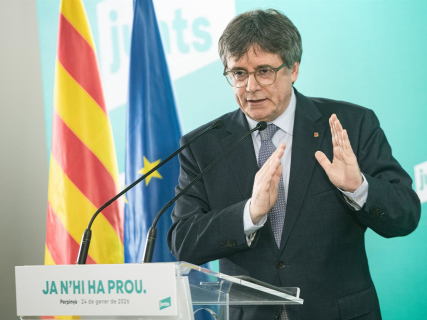
Puigdemont accuses the Government of incompetence in Ceuta and warns of a risk for Schengen

Puigdemont accuses the Government of mismanagement in Ceuta, warns of European concern, and rejects that the Catalans assume the political cost.

1 minute

fotonoticia 20260731135954 1920

fotonoticia 20260731135954 1920

Add DEMÓCRATA to Google

Ask FREN

Published

Last updated

1 minute

Most read

The leader of Junts, Carles Puigdemont, considers that the management of the Government in the migratory crisis of Ceuta demonstrates a clear "incompetence" of the Executive, and argues that the actions of Pedro Sánchez's cabinet have raised alarms in Europe, reopening the debate on the solidity of the Schengen agreement.

This is stated in an article published this Friday on X titled "The Spanish failure in migration policy worries Europe. Catalans cannot pay the bill," where he assures that he has been surprised that "the Spanish State has allowed itself to be caught off guard and has not been up to the level" in the face of the situation.

Puigdemont maintains that Europe "will charge" the Spanish Government for the regularization of migrants, considering that numerous European executives believe it has been carried out poorly and without the necessary control, and emphasizes that, in his opinion, Catalans should not bear the political cost of these decisions.

(THERE WILL BE EXPANSION)

More key points, information and questions with FREN

AI-GENERATED CONTENT

What is the current status of the parliamentary processing of the reform of the Schengen agreement in the European Union?

The reform of the Schengen Borders Code is still under processing in the European Union, and there is no record in the available sources that the amending regulation has been definitively approved and published in the Official Journal of the EU. The Commission maintains its proposal as a working basis, the European Parliament has already set a political position, and the Council has been shaping its own line within the Justice and Home Affairs Council framework. With these elements, the file would be in an advanced phase of interinstitutional negotiation (trilogues), but without formal closure. Meanwhile, Spain is preparing to apply the future reinforced Schengen framework and links it to its own internal debates on migration and border control.

1. What reform is being processed

The reform is structured around a proposed Regulation that modifies the current Schengen Borders Code (Regulation (EU) 2016/399) to clarify and update the rules on:

  • Reintroduction of controls at internal Schengen borders for security or migration reasons.
  • Management of emergency situations, especially health-related.
  • Greater use of police measures as alternatives to border controls.
  • Management of irregular movements within the Schengen area.

Although the official COM number does not appear in the trace, the Commission itself has continued acting based on the current Code, for example by issuing opinions on prolonged controls at the internal borders of several states, where it recalls the limits and proportionality criteria provided in the Code (Commission press release).

2. Position and role of the European Commission

The Commission promotes this reform in parallel with other Schengen initiatives (digital entry/exit systems, annual reports, recommendations). In its communication on the state of Schengen 2026, scheduled on the agenda of the JHA Council of June 2026 (Council media advisory), the Commission places the revision of the rules among the “ongoing legislative proposals” to continue discussing with the Member States.

Additionally, in its opinions on internal controls of Austria, Denmark, France, Germany, Italy, the Netherlands, Norway, Slovenia, and Sweden, it emphasizes that controls can only be maintained temporarily and justified, urging to “gradually eliminate” these controls by resorting to police alternatives and cross-border cooperation (Commission opinions). This approach is consistent with the spirit of the reform, which seeks to prevent internal controls from becoming de facto permanent.

3. Status in the European Parliament

Fine details (rapporteur name, exact voting date, etc.) do not appear in the consulted sources, but it can be deduced that the European Parliament has developed its own political line on Schengen and border controls:

  • Concerns about the future of the Schengen area and internal controls have been debated in plenary, for example in sessions on the reintroduction of controls by Germany and other partners.
  • The Committee on Civil Liberties (LIBE) has been working in parallel on other pieces of the migration and border management package (returns, Eurodac, identity checks), as reflected in Demócrata’s coverage of the Migration and Asylum Pact and its border and return regulations (interview with Jorge Buxadé).

In the absence of an explicit mention in news and official notes to the “definitive approval” of the Borders Code reform, the most consistent with the available information is that Parliament has set a first reading position that currently serves as a basis for trilogues with the Council.

4. Status in the Council and joint negotiations

In the Council, the debate is channeled in the Interior formation (JHA) and the Schengen Mixed Committee. The JHA agenda of 4–5 June 2026 includes, alongside the report on the state of Schengen and system interoperability, a specific point on “Ongoing legislative proposals,” where the Code reform fits (JHA Council 4–5 June 2026).

In parallel, the Council has adopted political declarations on the 40th anniversary of Schengen committing to “preserve and consolidate” the area, which implies closing ongoing legislative negotiations on the Code and other border control instruments, and has been closing positions on border and migration funding until 2034 (Council declaration for the 40th anniversary, analysis in Demócrata).

This combination of technical work and political commitments indicates that Member States already have a negotiation mandate (general orientation) to dialogue with the European Parliament, but the final text has not yet been closed.

5. Role and position of Spain

Spain has used this reform as a political framework to defend a strict—but balanced—application of the future Code. On the 40th anniversary of Schengen, the Interior Minister, Fernando Grande-Marlaska, called to “recover the essence of Schengen” and ensure that the new Code is correctly applied, “especially regarding the notification and motivation of the reestablishment or extension of controls at internal borders,” so as not to harm freedom of movement (Moncloa note, Interior note).

At the national parliamentary level, the Socialist Group has asked Congress to support a strengthening of Schengen based on advanced digitalization, police cooperation, and better governance, aligned with the Commission’s priorities (Demócrata information). This shows that, even without a closed reform in Brussels, the debate on its future application is already on the Spanish political agenda.

In summary, with the available information, the reform of the Schengen Borders Code remains ongoing in the ordinary legislative procedure, in an advanced phase of negotiation between Parliament and Council, but without yet culminating in a new fully in-force regulation.

What specific changes does the European Parliament propose regarding controls at internal borders in this Schengen Code reform? To what extent does the future reform of the Schengen Borders Code condition the migration and border policy that the Spanish Government is defending? What positions are the main Spanish political groups defending in the European Parliament regarding this Borders Code reform?

What are the competencies of the Spanish Prime Minister in migration policy according to current legislation?

The competencies of the Prime Minister in migration policy do not appear as a specific “block” in a single law but derive from his general functions as head of the Executive and director of internal and external policy. Law 50/1997 on the Government and Organic Law 4/2000 on foreigners place the definition of migration policy within the Government as a whole, while the Prime Minister sets the guidelines, coordinates the involved ministries, and presides over the body that adopts the main decisions (the Council of Ministers). In migration, therefore, the Prime Minister acts as the highest political authority and coordinator rather than as a direct administrative manager.

General framework: Government and Prime Minister

Law 50/1997, on the Government specifies Article 97 of the Constitution and establishes that the Government directs internal and external policy and exercises regulatory power. On this basis, Law 50/1997 defines the so-called “principle of presidential direction”: the Prime Minister has the competence to determine the guidelines of internal and external policy that the entire Executive must follow.

Expressly, Law 50/1997 provides that:

  • The Government is composed of the Prime Minister, the Vice Presidents (if any), and the ministers, who meet in the Council of Ministers.
  • The Prime Minister directs the Government’s action and coordinates the functions of the other members, “without prejudice to the direct competence and responsibility of the Ministers in their management.”
  • In any case, it corresponds to the Prime Minister, among other functions, to “establish the Government’s political program and determine the guidelines of internal and external policy and ensure their compliance.”

Applied to migration policy, this means that the general orientation (reception model, approach to regular and irregular immigration, coordination with the EU and countries of origin, etc.) is framed within the internal and external policy whose direction corresponds to the Prime Minister.

Immigration policy according to the Aliens Law

Organic Law 4/2000, on the rights and freedoms of foreigners in Spain and their social integration, specifically regulates immigration policy. The text (amended by Organic Law 2/2009) establishes that:

  • “It corresponds to the Government […] the definition, planning, regulation, and development of immigration policy,” without prejudice to regional and local competencies.
  • It sets the principles that all administrations must respect (coordination with the EU, management of labor migration flows, social integration, fight against irregular immigration and trafficking, cooperation with countries of origin and transit, etc.).

Again, the ownership of immigration policy is attributed to the Government as a whole, but according to Law 50/1997, the one who sets the guidelines and coordinates the Executive’s action is the Prime Minister. This Organic Law does not attribute specific competencies to the Prime Minister different from those he already has as head of Government.

Specific functions of the Prime Minister in this area

From the combination of both laws, the functions of the Prime Minister in migration matters can be summarized as follows:

  • Political direction: sets the broad lines of migration policy as part of the Government’s internal and external policy (orientation on labor immigration, asylum and refuge, integration, cooperation with third countries, etc.).
  • Interministerial coordination: coordinates the ministers with material competencies (Interior, Inclusion/Social Security/Migrations, Foreign Affairs, among others), ensuring that administrative action aligns with approved political guidelines.
  • Presidency of the Council of Ministers: according to Law 50/1997, the Prime Minister convenes and presides over the Council of Ministers and sets its agenda. Thus, he decides which migration-related bills, royal decrees, and strategic plans are brought to debate and, if applicable, approval.
  • Organization of the Government itself: Law 50/1997 foresees that the Government is governed, among other norms, by Royal Decrees of the Prime Minister on the composition and organization of the Government. This allows the Prime Minister to assign and reorder portfolios (for example, create or suppress a ministry competent in migrations) and redefine the internal distribution of political responsibilities.
  • Normative and political impulse: although regulatory power corresponds to the Government as a collegiate body, the Prime Minister promotes the approval of bills and regulatory provisions on migration, directs their processing in the Council of Ministers, and assumes the highest political responsibility before the General Courts.

Role of ministries and absence of direct management

The ordinary management of migration policy (foreigners’ files, reception, integration, consular cooperation, etc.) corresponds to the ministries and their administrative bodies, according to their basic organic structure royal decrees, which are modified, among others, by provisions such as Royal Decree 311/2021 or Royal Decree 125/2022. The Prime Minister does not resolve individual files nor issues administrative acts in foreigners’ matters; his intervention is strategic, normative, and of political coordination.

No further information is available in the consulted sources attributing specific additional competencies in migration to the Prime Minister other than those derived from his general position as head of Government and director of internal and external policy.

What exact role do the Ministries of Interior and Inclusion have in executing the migration policy directed by the Prime Minister? How is the parliamentary control of the Prime Minister’s actions in immigration and foreigners’ matters carried out? What coordination mechanisms exist between the central Government and the autonomous communities in migration policy, and who leads them politically?

Which political formation is currently led by Carles Puigdemont and what has been his most relevant political trajectory?

Carles Puigdemont currently leads the Catalan independence formation Junts per Catalunya, of which he is president and main political reference. Trained as a journalist, he was mayor of Girona and later president of the Generalitat, a position from which he promoted the referendum of October 1, 2017, and the subsequent unilateral declaration of independence. After the application of Article 155 and his departure to Belgium, he has become the axis of the post-convergent space and a key actor in Spanish politics, especially through the negotiation of the Amnesty Law and the investiture agreements with the PSOE. His judicial situation continues to condition Catalan and state politics, as explained by various analyses from Demócrata and other media.

Political formation currently led

According to the consulted political actors’ profile, Puigdemont is President of Junts per Catalunya, and is linked to the Junts per Catalunya Parliamentary Group and the political aggregation Junts per Catalunya as his reference formation. Various political chronicles describe him as the “current leader of Junts” when convening the party leadership both in Brussels and Waterloo to set the strategy against the central Government, as reflected in several reports from Demócrata, [link], [link] or [link].

His leadership is also recognized by other political actors: for example, at the ‘Fórum Europa. Tribuna Catalunya’, Junts’ secretary general, Jordi Turull, presents him as “the best possible candidate in terms of accredited leadership,” according to chronicles from Nueva Economía Fórum. Other analyses, such as voting intention barometers in Catalonia, continue identifying Junts as “Carles Puigdemont’s party,” even when noting its electoral decline, as reported by Demócrata.

Most relevant political trajectory

From journalist to president of the Generalitat

The available summarized biography presents him as a Catalan journalist and politician born in Amer in 1962. He began his career in journalism before moving into municipal politics, culminating as mayor of Girona. Later, he was invested president of the Generalitat of Catalonia, a stage marked by organizing the October 1, 2017 referendum and the attempt to complete the sovereignty process with a unilateral declaration of independence. This cycle ended with the application of Article 155 of the Constitution and his departure to Belgium, which various media describe as political exile.

Exile in Belgium, MEP, and leadership of Junts

Since 2017, Puigdemont has been based in Belgium (Waterloo), where he maintains the political leadership of the post-convergent space. Sources from Junts and the formation itself highlight his role as a reference of the independence movement and his European projection: in 2019 he entered the European Parliament as an MEP, alongside other leaders such as Toni Comín, as the organization itself recalls in a Junts note.

Internally, various congresses and organic movements culminate in his formal return to the party presidency and the will to “lead the country alternative,” as stated in communications such as Puigdemont and Turull present the candidacy… and [link]. In the 2024 Catalan campaign, his figure headlines Junts’ proposals, which even rebrands its candidacy as “Junts+ Puigdemont per Catalunya,” as detailed by Gaceta Médica and other pieces like ConSalud.

Role in state politics and the Amnesty Law

In recent Spanish politics, his central milestone is the decisive role in Pedro Sánchez’s investiture and in negotiating the Amnesty Law. Various analyses from Demócrata emphasize that talks in Brussels with the then PSOE Organization Secretary, Santos Cerdán, were a turning point both for the PSOE and for Puigdemont himself. The same outlet details how the legislature in Congress is conditioned by the fulfillment (or not) of commitments made with Junts, highlighting moments of maximum tension such as the Perpignan conclave, where the leadership chaired by Puigdemont debates breaking the agreement with the Government ([link], [link], [link]).

At the same time, Puigdemont’s judicial situation remains open. Analyses from Demócrata, [link] and [link] explain that the Court of Justice of the EU has endorsed the compatibility of the Amnesty Law with European law, but the final decision on its concrete application to Puigdemont’s case remains with the Supreme Court and Constitutional Court, which maintain arrest warrants and discuss the fit of the crime of embezzlement ([link], [link], [link], [link]). This litigation explains why, as of July 2026, his definitive return to Spain remains a factor of high political tension.

Other mentioned references
How has Puigdemont’s leadership influenced Junts’ negotiating strategy with Pedro Sánchez’s Government? What concrete implications does the CJEU ruling on the Amnesty Law have for Puigdemont and what scenarios are considered for his return? How has the electoral weight of Junts per Catalunya evolved since Puigdemont assumed its leadership until today?

Play

Test your knowledge with FREN!

How much do you know about this topic? Answer the following 3 questions.

Who does Carles Puigdemont accuse of incompetence in managing the Ceuta migration crisis?

Question 1 of 3

Which European agreement does Puigdemont mention when warning about the consequences of migration management?

Question 2 of 3

Where did Carles Puigdemont publish his critical article about Spanish migration policy?

Question 3 of 3

Hola, soy Fren. ¿Cómo te ayudo?