Sánchez acknowledges a "broken trust" in high-speed rail after the Urda accident and promises solutions

The President of the Government admits that Spain cannot suffer two railway tragedies of this magnitude in one year and commits to strengthening the safety of the network. García-Page confirms 69 deaths and announces that the emergency is lowered to level 1, while the identification of human remains continues

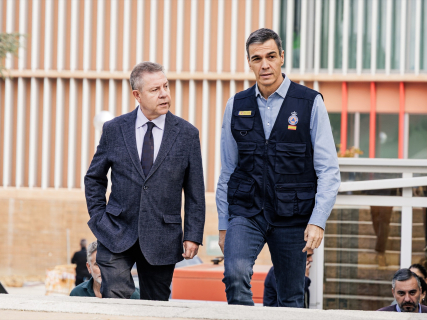
EuropaPress 7878631 presidente gobierno pedro sanchez presidente castilla la mancha emiliano

EuropaPress 7878631 presidente gobierno pedro sanchez presidente castilla la mancha emiliano

Add DEMÓCRATA to Google

Ask FREN

Published

Last updated

4 minutes

Most read

Elecciones 29N · Encuestas

La media de las encuestas

Media a 27 de octubre de 2026 · 15 institutos

  • PP31,0 %
  • PSOE27,3 %
  • Vox18,9 %
  • Frente Amplio6,3 %
  • Podemos2,9 %
  • ERC2,3 %
010203040ene 2024jul 2024ene 2025jul 2025ene 2026jul 2026

Media del último estudio de cada instituto en 30 días y su evolución semanal desde el 23J. Partidos con al menos un 2 %.

Todas las encuestas

Elecciones generales del 29 de noviembre · Demócrata

The President of the Government, Pedro Sánchez, acknowledged this Friday that there is a "broken trust" in the Spanish high-speed system after the Urda (Toledo) railway accident and assured that the Executive will not limit itself to investigating the causes of the disaster, but will adopt solutions to strengthen the safety of the network. The head of the Executive admitted that the succession of two railway tragedies in less than a year requires a response that makes it possible to recover citizens' trust.

"It is not acceptable for a country like Spain, with such a powerful high-speed system as the one we have, to suffer two accidents of these characteristics and of this magnitude in a year," Sánchez stated during a press appearance alongside the president of Castilla-La Mancha, Emiliano García-Page, in which both updated the situation of the emergency and the identification work of the victims.

The president insisted that the investigation must be accompanied by measures to prevent a similar tragedy from happening again, although he has not yet specified what actions the Government is considering.

"There is broken trust in the high-speed system of our country and the Government's job is not only to make the diagnosis, to know what the causes are, but to offer solutions so that a tragedy of this magnitude, as the Head of State, King Felipe VI, said yesterday, does not happen again," he declared.

García-Page confirms 69 dead and the identification of human remains

During the press appearance, the president of Castilla-La Mancha updated the death toll from the accident, which stands at 69 confirmed dead, although a complex process of identification of human remains is still ongoing.

"There are 68 complete bodies, plus the person who died in the hospital and the data I was giving you about remains that are in a very complex process of identification," García-Page explained.

The regional leader detailed that the emergency teams completed during Thursday one of the most delicate operations of the rescue device, consisting of turning over one of the derailed carriages to check whether there were more victims trapped inside.

Firefighters, members of the Military Emergency Unit (UME) and private crane operators took part in the work, whose intervention he described as "impeccable" and "enormously delicate".

"You will remember that we had a certain fear that there might be fatalities. That has not been the case and we are all very pleased about that", he noted.

Although García-Page has not completely ruled out the possibility of new findings, he considered the most critical phase of the operation to have been overcome and announced that the emergency moves to level 1.

From now on, the pending actions will be mainly under the direction of the judicial authority, in charge of supervising the protocols for identifying the deceased and the communications to their relatives.

Victims of up to 27 nationalities and families waiting for news

Sánchez has devoted a good part of his speech to the situation of the families who still do not know the whereabouts of their loved ones, to whom he has conveyed the Government's commitment to speeding up identifications without compromising the guarantees of the procedure.

The president has acknowledged the "extraordinary anxiety" experienced by those who remain waiting for information and has assured that the administrations are working to provide verified answers as soon as possible.

"We are working tirelessly all the powers of the State, all the public servants and public servant women to try to provide and shed the greatest amount of information as soon as possible in a reliable manner to the relatives of the victims", he stated.

The head of the Executive has also explained that among the victims of the accident there could be people of up to 27 nationalities, which is why the Government maintains contacts with the corresponding consulates to facilitate information about their citizens.

Sánchez has underlined that the families have material, social and psychological support during the identification process and notification of the deaths, a task that will continue under the protocols established by the judicial authorities.

Sánchez thanks the response of the emergency services and the solidarity of Castilla-La Mancha

The president of the Government has also highlighted the coordination between administrations during the rescue and care work for the victims, with an express mention of the professionals of the Junta de Comunidades de Castilla-La Mancha, the provincial councils, the town councils and the Civil Protection services.

Sánchez has praised the professionalism of the public employees who have participated in the operation and the solidarity shown by the citizens of the autonomous community with the victims and their families.

For his part, García-Page has thanked the collaboration of the different organizations that have intervened since Wednesday and has explained that, once the main rescue phase has been overcome, efforts are concentrated on judicial and identification tasks.

The appearance thus concludes with the reduction of the emergency level, but with the investigation into the causes of the accident still open and with families who continue waiting for the definitive identification of their relatives.

More key points, information and questions with FREN

AI-GENERATED CONTENT

What are the next steps in processing the railway safety reinforcement measures announced by the Government?

The next steps do not consist of a single parliamentary vote: the reinforcement of railway safety combines regulatory changes, financing, hiring personnel, and operational procedures. As of October 30, 2026, it is necessary to distinguish the commitment announced after the Urda accident from the package agreed upon in February, which already had specific actions and a regulatory reform initiated.

1. Specify the most recent announcement

On October 28, Pedro Sánchez announced that the necessary measures would be adopted to reinforce safety and restore confidence in high-speed rail. However, in that Moncloa statement, no new regulatory text, its legal instrument, or approval dates are specified. Therefore, the next identifiable milestone is for the Government to detail the actions and determine which require regulations and which can be executed through administrative decisions.

2. Resolve the reform on driving and inspections

The previous package, agreed with the unions in February, included modifying Royal Decree 929/2020, on operational safety and railway interoperability. According to Demócrata, the project was submitted for public consultation and the deadline for submitting allegations ended on May 18, 2026. The draft proposed two changes:

  • Counting as driving time the intermediate periods shorter than 45 minutes, even if the driver is not in direct command of the train.
  • Explicitly expanding the access of the State Railway Safety Agency to facilities, trains, and equipment when the inspection affects another entity.

There is no record in the consulted sources of a subsequent approval of that modification. The point to follow now is the resolution of its processing and the publication of the final text; the closure of the consultation does not equate to its entry into force.

3. Attend to another open deadline: the railway regulation

There is also a different procedure: the draft regulation of the railway sector, whose public consultation is open from September 25 until November 12, 2026. That is the next specific participation deadline identified. It should not be confused with the specific modification on rest periods and inspections: they are different projects, although both affect the railway framework.

4. Execute financing and hiring

The agreement published by Transport foresees an additional 1.8 billion euros for maintenance and 3,650 jobs: 2,400 positions at Adif during 2026-2030, 1,200 additional contracts at Renfe, and 50 structural positions at the State Railway Safety Agency.

Its execution requires processing two financing agreements, one with Adif and another with Adif Alta Velocidad, for 2026-2030. The first contemplated 861 million for maintenance in 2026, reaching 1,179 million in 2030; the second, a 44% growth between 2025 and 2030. It was also agreed to incorporate into upcoming budget laws a replacement rate not less than 115%. These are commitments that require financial and personnel decisions, not a comprehensive safety law.

5. Develop monitoring mechanisms

The agreement foresaw establishing a safety coordination committee within a month and convening a joint monitoring commission, as well as creating groups on temporary speed limitations and weather alerts. That deadline was an initial commitment, not a future expiration. According to Demócrata, on October 29, Semaf denounced postponements since April and lack of convening the commission. Reactivating that monitoring is, therefore, another pending practical milestone according to the union.

What are the powers and attributions of the President of the Government regarding railway safety according to Spanish legislation?

The President of the Government has functions of political direction and coordination in railway safety matters, but does not ordinarily exercise technical supervision nor manage circulation. His powers derive from the Constitution, the Government Law, and, in certain crises, the National Security Law; these must be distinguished from the competencies of the Council of Ministers, the competent ministry, and the State Railway Safety Agency.

1. Political direction and ministerial coordination

Article 98.2 of the Constitution establishes that the president "directs the action of the Government and coordinates the functions of the other members thereof," without prejudice to his direct competence and responsibility. Article 97 attributes to the Government the direction of domestic policy, the Administration, and regulatory power.

Article 2 of Law 50/1997, of the Government specifies powers that can be projected over railway safety:

  • Determine political guidelines and ensure their compliance.
  • Give instructions to ministers and resolve conflicts of competencies between ministries.
  • Convene and preside over the Council of Ministers and set its agenda.
  • Propose the appointment or dismissal of ministers and organize ministerial departments within the legal framework.

Therefore, he can promote regulatory improvements and coordinate Transport, Interior, and other departments, but that direction does not make him the holder of all their competencies.

2. Decisions that correspond to the Government collegially

According to article 5 of the Government Law, it corresponds to the Council of Ministers to approve bills, regulations, and binding plans for the state Administration. The president can promote these decisions but cannot adopt them unilaterally when the competence belongs to the collegiate body.

Law 38/2015, of the railway sector allows the Government to assume, exceptionally and temporarily, the management of certain services or the operation of infrastructures "to guarantee public safety and national defense." This is an extraordinary governmental power, not a presidential power of daily intervention.

3. Powers in the face of a serious railway crisis

Articles 15 and 20 of Law 36/2015, of National Security attribute to the president the direction of that policy and its system, assisted by the National Security Council.

If a railway crisis meets the conditions of seriousness, urgency, and transversality of article 23, he can declare by royal decree a state of interest for National Security. According to articles 24 and 25, he must delimit the crisis, territory, duration, and resources; can appoint a functional coordination authority and must convene the National Security Council. The Government will immediately inform Congress.

This declaration is not automatic in any accident: it strengthens coordination through ordinary powers and does not allow suspending fundamental rights. Nor does it by itself alter the distribution of competencies, as clarified by Judgment 184/2016.

4. Limits: technical supervision and protection

The Railway Sector Law and Royal Decree 929/2020 place supervision, inspection, authorizations, and certifications in the competent authorities, especially the AESF; administrators and companies maintain their own safety obligations. The president does not replace these procedures nor directs the technical investigation of accidents.

Furthermore, protection against deliberate attacks differs from operational safety: Law 8/2011 assigns responsibility for the critical infrastructure protection system to the Secretary of State for Security. In summary, presidential direction does not equate to technical railway management.

What legal requirements must be met for the judicial investigation of railway accidents in Spain?

In Spain, the judicial investigation of a railway accident requires facts with possible criminal relevance, a competent judicial body, and respect for procedural guarantees. It must be distinguished from the technical safety investigation: the former determines possible crimes and responsibilities; the latter clarifies causes and proposes preventive measures, without assigning guilt.

1. Opening and judicial competence

The procedure can be initiated by complaint, accusation, police report, or judicial knowledge of facts that could constitute a crime, such as homicide or injuries by negligence. It is not necessary to know the responsible party beforehand: precisely, the investigation aims to clarify what happened.

The territorial criminal body with jurisdiction, usually that of the accident location, instructs the case, with intervention of the Public Prosecutor and support from judicial police. Legal rules of competence and the right to a judge predetermined by law must be respected. The basic procedural framework is the Criminal Procedure Law.

2. Protection of the scene and evidence

Articles 21 and 22 of Law 2/2024, of August 1, establish specific obligations:

  • Do not alter the scene: before the technical investigators arrive, its conditions cannot be modified nor samples or remains removed, except for essential actions for safety or to assist the injured. These must be communicated to the investigators.
  • Judicial custody: "The seizure and custody of the material remains of the accident or incident in question correspond to the judicial authority."
  • Authorized removal: once a judicial investigation is opened, recovering recorders or components for technical investigation requires prior judicial authorization.
  • Traceability: components collected must be identified and their custody guaranteed. The chain of custody allows verifying who collected, transported, preserved, and analyzed them.
  • Tests that alter evidence: the judge must rule within fifteen days from the Authority's request on uses that imply modification, alteration, or destruction.

3. Proceedings and guarantees of the parties

Depending on circumstances, inspections, identification and forensic medical examination of victims, autopsies when appropriate, statements, and expert reports must be carried out. It is essential to preserve recorders, communications, recordings, maintenance documentation, and signaling data. There is no identical list of mandatory proceedings for every accident: they must be justified by their usefulness to clarify the facts.

Investigated persons have the right to know the attributed facts, legal assistance, remain silent, not self-incriminate, propose proceedings, and appeal. Measures restricting fundamental rights require legal coverage, proportionality, and judicial authorization when appropriate.

Victims and affected parties may receive information, appear, request proceedings, appeal, and claim compensation according to procedural rules. Their right to participate does not equate to a right to obtain a conviction, as recalled by STC 215/1999.

4. Coordination and confidentiality

Article 20 of Law 2/2024 requires coordinating judicial and technical investigations, safeguarding their different purposes. The technical investigation cannot interfere with the judicial one. The Authority must immediately communicate possible criminal offenses and accidents with fatalities; access to the scene, evidence, and information exchange must also be coordinated.

The instruction is not public like the oral trial. Secrecy towards the parties requires justification and must respect the defense; STC 83/2019 specifies its limits. Finally, the technical report does not replace judicial assessment nor automatically prove guilt: evidence must be incorporated and contrasted with the guarantees of the criminal process.

Play

Test your knowledge with FREN!

How much do you know about this topic? Answer the following 3 questions.

What did the Prime Minister, Pedro Sánchez, acknowledge after the Urda train accident?

Question 1 of 3

How many confirmed deaths did García-Page report after the Urda train accident?

Question 2 of 3

How many different nationalities could be represented among the victims of the Urda accident?

Question 3 of 3