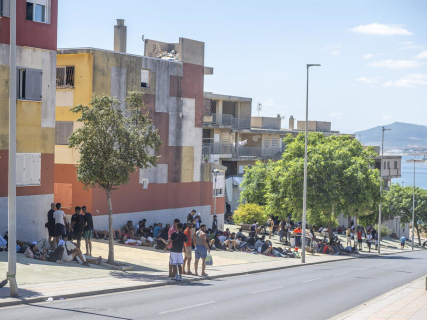
Hundreds of Ceutíes march to the Government Delegation against the possible accommodation of migrants in the Fiscer barracks.

The protest has begun in the surroundings of the barracks and has advanced towards the center of Ceuta to demand explanations about the possible use of these facilities.

2 minutes

fotonoticia 20260824190236 1920

fotonoticia 20260824190236 1920

Add DEMÓCRATA to Google

Ask FREN

Published

Last updated

2 minutes

Most read

Hundreds of people have mobilized this Tuesday in Ceuta against the possible use of the Coronel Fiscer facilities to temporarily house migrants. The concentration, which began in the vicinity of the barracks, has ended up becoming a march towards the Delegation of the Government.

The protest started among local residents, who gathered to show their rejection of the possible use of the facilities and demand information about the authorities' plans. During the mobilization, traffic was cut off in the vicinity of Coronel Fiscer.

As the hours passed, more people joined the protest and the participants decided to continue towards the city center. The march advanced to the vicinity of the Delegation of the Government, where the protesters gathered.

Rejection of the use of facilities to house migrants

The origin of the mobilization lies in the possibility that Coronel Fiscer could be used to expand the available housing resources in light of the migratory situation that Ceuta is experiencing.

The attendees have demanded explanations about the destination of these facilities and have expressed their rejection of certain city equipment potentially becoming temporary reception spaces.

The protest coincides with the criticisms arising from the possible use of other facilities. The Royal Football Federation of Ceuta has also rejected this Tuesday that sports spaces be allocated for the housing of migrants, considering that they are necessary to maintain the city's sports activity.

The protest comes on the day the Government activates the single command

The mobilization occurs on the same day that the Government has taken a new step in managing the migratory crisis. The Council of Ministers approved this Tuesday the implementation of a single command under the coordination of the Minister of Territorial Policy, Ángel Víctor Torres, following the extraordinary meeting of the National Security Council.

The housing situation continues to be one of the main open fronts in Ceuta. The Government delegate, Miguel Ángel Pérez Triano, acknowledged this Monday that the city remains "very far" from recovering normality, while the administrations seek new resources to assist the people who remain in the city.

The protest this Tuesday has been reported by several local media. Ceuta Ahora estimates the participants in the hundreds and notes that the gathering began among neighbors near Coronel Fiscer before heading towards the Government Delegation. Ceuta Actualidad also reports on the gathering and the traffic disruption recorded during the protest.

More key points, information and questions with FREN

AI-GENERATED CONTENT

What are the competencies of the Minister of Territorial Policy according to Spanish legislation?

The Minister of Territorial Policy (currently Minister of Territorial Policy and Democratic Memory) is the Government member responsible for designing and executing the State's territorial policy and for steering the Government's relations with the autonomous communities and local entities. Their competencies derive, on the one hand, from the general regime of ministers and, on the other, from the specific regulations that configure the ministerial departments.

Basic regulatory framework

The minister's functions are supported by two main types of regulations:

  • General rules on the Government, especially Law 50/1997, of November 27, on the Government, which establishes the common statute of ministers: department management, normative initiative within their scope, proposal of agreements to the Council of Ministers, power to issue ministerial orders, etc.
  • Government organization rules, among which stands out the Royal Decree 829/2023, of November 20, restructuring the ministerial departments (BOE-A-2023-23537), modified by Royal Decree 1230/2023, of December 29 (BOE-A-2023-26727), which defines the purpose of each ministry.

Within this framework, the corresponding article of Royal Decree 829/2023 (in its current wording) provides that:

  • The Ministry of Territorial Policy and Democratic Memory is responsible for proposing and executing the Government's policy regarding territorial policy, territorial organization of the State, and relations with the autonomous communities and entities that make up local administration.
  • It is also responsible for proposing and executing the Government's policy on historical and democratic memory.
  • The Ministry is structured, at least, into the State Secretariat for Territorial Policy and the State Secretariat for Democratic Memory, of which the minister is the hierarchical superior.

Main material competencies

Based on this framework, the minister's material competencies can be summarized in the following blocks:

  • Design and execution of the State's territorial policy: defines, proposes to the Council of Ministers, and applies the Government's position on how public power is territorially articulated (role of the State, autonomous communities, and local entities, principles of cooperation and coordination, etc.).
  • Relations with the autonomous communities: is the Government's ordinary political interlocutor with the autonomous governments. This includes participation in bilateral cooperation commissions, preparation of sectoral territorial conferences, and, in general, negotiation and monitoring of State–autonomous community agreements.
  • Relations with local entities: promotes the Government's policy towards town councils, provincial councils, island councils, and participates in multilateral cooperation bodies such as the National Commission of Local Administration.
  • Territorial organization of the General State Administration: politically directs the network of Government Delegations, Subdelegations, and Island Directorates, and the policy of presence of the General State Administration in the territory, in accordance with the basic organic structure regulations.
  • Participation in transfer and competence adjustment processes: the ministry intervenes in procedures for transferring services and functions to autonomous communities, formalized through transfer royal decrees published in the BOE (for example, the transfer Royal Decrees to the Basque Autonomous Community in 2026 cited in the database).
  • Democratic memory: designs the Government's policy on recognition and reparation of victims of the dictatorship, re-signification of memory sites, and, in general, compliance with democratic memory legislation, in coordination with other competent departments.

Competencies as head of department

In addition to these material functions, the minister exercises the general powers typical of any department head, provided for in the Government Law and organizational regulations:

  • Senior management of the Ministry: sets objectives, approves the department's action plans, distributes functions among senior and management bodies (state secretariats, undersecretariat, general directorates), and evaluates their fulfillment.
  • Normative initiative within their scope: proposes to the Council of Ministers draft laws and royal decrees affecting territorial organization, relations with autonomous communities and local entities, or democratic memory, and may issue ministerial orders within their competencies.
  • Appointment proposals: submits to the Council of Ministers proposals for appointment and dismissal of senior officials of their department (state secretaries, undersecretary, general secretaries, general directors), in accordance with general rules.
  • Institutional representation: represents the department domestically and in international forums when issues of territorial organization, multilevel governance, or democratic memory are addressed.
  • Management of personal and material resources: through the undersecretariat and other bodies, is politically responsible for managing the ministry's budget and human resources assigned to it and to the General State Administration in the territory, without prejudice to the transversal competencies of other ministries (such as Finance or Public Administration).

The detailed specification of these competencies (which units assume each task, which collegiate bodies depend on the Ministry, etc.) is detailed in the basic organic structure royal decree specific to the Ministry of Territorial Policy and Democratic Memory and in subsequent delegation and deconcentration orders, but the core material is defined by the aforementioned Royal Decree 829/2023 and the general regime of ministers.

What is Ángel Víctor Torres's political trajectory and which party does he belong to?

Ángel Víctor Torres Pérez is a Canarian socialist politician with a long trajectory in the municipal, regional, and state spheres. He belongs to the Spanish Socialist Workers' Party (PSOE), of which he is the secretary general in the Canary Islands, and has been president of the Government of the Canary Islands and Minister of Territorial Policy and Democratic Memory in the Government of Spain.

Origins and education

Born in 1966 in Arucas (Gran Canaria), Torres holds a degree in Hispanic Philology. Before fully dedicating himself to politics, he worked as a high school teacher and writer, a facet that has shaped his public profile as a politician with a humanistic education and ties to the educational world. This teaching career was his main activity until the late 1990s.

Early steps in politics: local and island level

His political career began in the municipal sphere of Arucas, always under the PSOE banner. There he was a councilor and later mayor of Arucas between 2003 and 2007, in a municipality of just under 40,000 inhabitants in northern Gran Canaria. From this position, he consolidated a profile as a manager close to the territory, with special attention to social policies and urban planning.

After his term as mayor, he moved to the island level, holding various positions in the Gran Canaria Island Council. In those years, he strengthened his influence within Canarian socialism, combining executive responsibilities with his role in the party organization on the island. He also served in the General Courts as a deputy in the Congress, which gave him direct experience in national politics.

Leadership in the Canarian PSOE and presidency of the Canary Islands

The turning point in his internal career came in 2017, when he was elected secretary general of the PSOE of the Canary Islands. Since then, he has become the visible face of socialism in the archipelago and the main territorial reference of Pedro Sánchez in the islands. This organic leadership was the basis for his leap to regional power.

In the 2019 regional elections, the PSOE won in the Canary Islands and Torres managed to articulate the so-called “flower pact”, a coalition with Podemos, Nueva Canarias, and the Gomera Socialist Group. Thanks to this agreement, he became president of the Government of the Canary Islands (2019‑2023), the first non-nationalist after decades of hegemony by Coalición Canaria.

His regional mandate was marked by a succession of crises: the COVID‑19 pandemic, severe forest fires, the La Palma volcano, and high migratory pressure on the islands. At the same time, his government was tainted by the political fallout from the so-called Mediator case and later by investigations into mask contracts during the pandemic (a plot linked to the so-called Koldo case), which conditioned part of the public debate about his management.

In the 2023 elections, the PSOE again obtained a good result, but the sum of forces changed: the collapse of Podemos and the agreement between Coalición Canaria and the Popular Party returned Torres to the regional opposition despite having led the outgoing government.

Leap to the central Government: Minister of Territorial Policy

After the 2023 general elections, Pedro Sánchez incorporated Torres into the Executive as Minister of Territorial Policy and Democratic Memory, a position he assumed in November 2023. From this post, in addition to institutional coordination with autonomous communities and local entities, he became one of the visible faces of the Government's migration policy, especially regarding the situation in the Canary Islands and, more recently, the migration crisis in Ceuta, whose governmental coordination has been entrusted to him.

As minister, he has frequently appeared before the Congress and the Senate to explain his role in the contracts for sanitary material during the pandemic when he presided over the Canary Islands. Various reports from the Central Operative Unit of the Civil Guard (UCO) have been used both to politically question him and for him to claim that no crimes of bribery or illegal commissions have been proven in his actions.

Recent situation and ties to the PSOE

Torres's own institutional profile and press information coincide in presenting him as an active minister and secretary general of the PSOE Canary Islands. In March 2025, he publicly announced he was suffering from cancer and announced a “pause” after surgery, although his political circle emphasized his intention to remain active. In any case, his entire institutional trajectory is closely linked to the PSOE, the party he has belonged to for decades and to which he attributes both his political projection and the legitimacy base he claims against his critics.

What legal requirements must be met to allocate military facilities to uses other than those originally intended?

To allocate military facilities (barracks, bases, shooting ranges, etc.) to uses other than those originally intended, a dual framework must be articulated: on the one hand, within the framework of national defense and, on the other, within the general regime of public assets (public domain and assets of the administrations). This requires combining defense regulations with Law 33/2003, on the Assets of Public Administrations, and its regulation approved by Royal Decree 1373/2009.

1. Constitutional and defense framework

The Constitution assigns exclusive competence to the State in matters of defense and Armed Forces and reserves basic regulation of national defense to organic law. Organic Law 5/2005, on National Defense, defines defense policy as a Government function aimed at guaranteeing the protection of Spain, its territorial integrity, and its institutions.

From this derives a key principle: any relevant change of destination or use of a military facility must be compatible with defense planning, and therefore requires, at minimum, a report and decision from the Ministry of Defense and, in the most significant cases, from the Government itself (Council of Ministers), which directs defense policy.

2. Legal nature of military facilities

Military facilities are typically public domain assets (demanial), as they are allocated to a state public service (defense). Law 33/2003 establishes that:

  • Public domain assets are inalienable, unseizable, and imprescriptible.
  • They must be effectively applied to the public service to which they are allocated, except for exceptions justified by public interest.
  • Their management must guarantee their conservation, integrity, and suitability for the purpose they serve.

While a property is allocated to defense, it cannot be freely sold or allocated to uses incompatible with that service, unless a formal change of its legal status is processed.

3. Change of use: allocation, demanial mutation, and disaffection

Law 33/2003 and its regulation provide several instruments to modify the destination of public assets:

  • Demanial mutation: change of allocation within the public domain, for example, from "defense use" to "administrative use" or another public service. It maintains the demanial character but modifies the service it serves. It requires a formal agreement by the competent body (usually the Council of Ministers or authorized body) and coordination between Defense, Finance, and, if applicable, the receiving entity.
  • Disaffection: the asset ceases to be allocated to a public use or service and becomes an asset of the Administration's patrimony. It is an express act, also usually adopted by the Government at the proposal of the competent ministry and with a report from Finance. Only after disaffection can ordinary patrimonial exploitation (sale, lease, etc.) be discussed.

The patrimony regulation develops the procedures and requires an administrative file justifying the public interest, identifying the asset, accrediting that it is no longer necessary for defense service, and determining the new destination or, at least, its availability for other uses.

4. Use transfer, disposal, and transfer to other administrations

Once the demanial mutation or disaffection has occurred, if applicable, several options open:

  • Use transfer to another Administration: Law 33/2003 and its regulation contemplate free use or ownership transfers to other administrations for purposes of public interest (facilities, public housing, etc.). They require:
    • Agreement of the competent body (often the Council of Ministers).
    • Conditions on the specific destination and deadlines.
    • Control mechanisms and possible reversion if the agreed use is not met.
  • Disposal (sale): only possible if the asset is already patrimonial, never while it remains demanial allocated to defense. It is subject to the principles of publicity, competition, and obtaining the best return for public patrimony, with intervention by the Directorate General of State Patrimony.

5. Urban and environmental compatibility

In addition to defense and patrimony requirements, any effective change of use must respect:

  • The applicable urban planning, which must admit the new use or be modified by the competent autonomous community or municipality.
  • Environmental regulations, including the possible need for environmental assessment, soil restoration, waste management, or decontamination, especially in lands with intensive uses (shooting ranges, fuel deposits, etc.).

These actions require coordination between Defense, territorial administrations, and, occasionally, other ministerial departments.

In summary, a generic political decision is not enough: a formal file is required to prove that the facility is no longer necessary for defense or that the new use is compatible with it, followed by the corresponding demanial mutation or disaffection acts, and transfers or disposals adjusted to Law 33/2003, always under the umbrella of defense planning and urban and environmental regulations.

Play

Test your knowledge with FREN!

How much do you know about this topic? Answer the following 3 questions.

What was the main reason for the protest in Ceuta mentioned in the news?

Question 1 of 3

Which sports entity expressed its rejection of the use of facilities to house migrants?

Question 2 of 3

Who was appointed to coordinate the unified command in managing the migration crisis in Ceuta?

Question 3 of 3

Hola, soy Fren. ¿Cómo te ayudo?