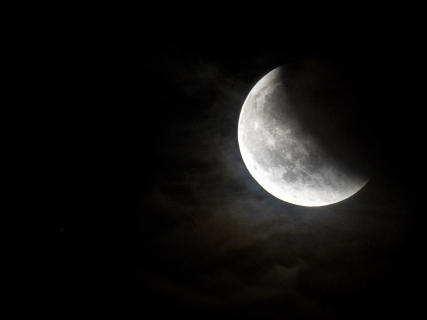

The partial lunar eclipse of today, August 28, 2026, has already reached its peak, which occurred at 06:12, but the phenomenon can still be observed from some areas of Spain. At 06:31, the partial phase continues to be visible in the western peninsula, Canary Islands, and Ceuta.
Visibility depends on the position of the Moon on the horizon and the moment when dawn begins in each territory. In much of Spain, the setting of the Moon or the arrival of daylight prevents continued observation of the eclipse throughout its evolution.
The peak of the eclipse occurred at 06:12
The moment of greatest obscuration of the Moon took place at 06:12. From that instant, the satellite began to progressively emerge from the shadow cast by the Earth.
The phenomenon does not end immediately after reaching its peak. The partial phase continues while a part of the Moon remains within the shadow zone, although observation from Spain is conditioned by the sunrise and the horizon of each point.
The areas of Spain where it can still be seen
At 06:31, the eclipse remains observable from the west of the Peninsula, Canary Islands, and Ceuta. These areas have a more favorable observation window due to the position of the Moon at that moment.
In the center, the eastern peninsula, Balearic Islands, and Melilla, the Moon sets before the entire final evolution of the phenomenon can be followed.
When the partial lunar eclipse ends
The partial phase will continue after the peak, although the time available to observe it from Spain will vary depending on the locality. The progressive emergence of the Moon from the Earth's shadow also coincides with dawn in much of the country.
Therefore, the lunar eclipse of today can still be seen in the western peninsula, Canary Islands, and Ceuta, while in other areas of Spain, observation is limited because the Moon disappears below the horizon before the phenomenon ends.