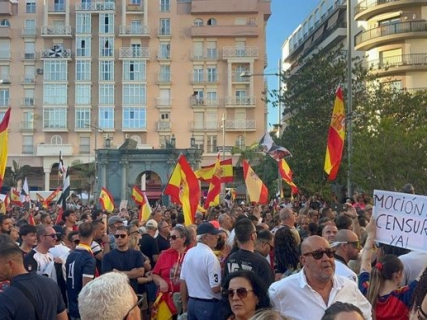
More than 2,000 Ceutíes protest in front of the Government Delegation against the management of the migration crisis.

The mobilization has traversed the city while Torres presided over the first meeting of the unified command and the attendees have demanded the resignations of Pedro Sánchez and the Government delegate.

3 minutes

Add DEMÓCRATA to Google

Ask FREN

Published

Last updated

3 minutes

Most read

WhatsApp Image 2026 08 26 at 21.31.03

More than 2,000 people have gathered this Wednesday in front of the Government Delegation in Ceuta to protest against the management of the migration crisis and to denounce what they consider the "inaction" of the central Executive. The mobilization, the second in two days, coincided with the first meeting of the unified command responsible for coordinating the response to the situation facing the city.

The protest began at 6:00 PM in front of the Military Hospital, in the O'Donnell neighborhood, and has been gaining participants during its route. The demonstrators later moved towards Puertas del Campo and from there continued to the Plaza de los Reyes, where the Government Delegation is located.

The attendees carried flags of Spain and Ceuta and chanted slogans such as "Ceuta is not for sale, Ceuta defends itself" and "Ceuta is not a CETI." They also demanded the resignations of the President of the Government, Pedro Sánchez, and the Government Delegate in the city, Miguel Ángel Pérez Triano.

The protest starts from the Military Hospital

The chosen location to start the mobilization is directly related to one of the reasons for the protests in recent days. The Military Hospital is among the sites considered within the device designed to manage the situation of migrant people who remain in Ceuta after the massive entry recorded at the end of July.

The demonstrators have expressed their rejection of the use of this type of facility and other public spaces in the city to temporarily house migrants.

The march this Wednesday continues the mobilization from Tuesday, when hundreds of residents toured different areas of Ceuta after learning about the spaces that the Government planned to make available for the device.

The previous protest had as one of its main focuses the possible use of several sports complexes, a measure that had also faced rejection from the Government of Juan Vivas.

More than 2,000 people in front of the Government Delegation

The mobilization has increased in size during its route. More than 2,000 people were finally concentrated in front of the Government Delegation, according to Europa Press.

The National Police has deployed a security device at the entrances to the building in light of the concentration of demonstrators. The agents have controlled the entrances while the meeting convened to address the crisis was taking place inside.

The attendees have maintained the protests during the meeting and have requested that a solution be expedited for the people who still remain in the city.

The protest coincides with the meeting of Torres and Vivas

The concentration has developed while Ángel Víctor Torres presided over the first meeting of the body responsible for coordinating the response to the crisis in Ceuta.

In the meeting, ten ministers participated, as Torres later explained, along with the president of the Autonomous City, Juan Vivas, and representatives of the involved administrations. The Minister of Inclusion, Social Security, and Migration, Elma Saiz, was also present.

The meeting served to address, among other issues, the necessary resources to carry out the tasks of triage, identification, and subsequent individual processing of the files of the people who remain in Ceuta.

Torres announced that the unified command will hold weekly meetings and that a new meeting presided over by Pedro Sánchez will take place this Friday.

The sports centers are removed from the device

One of the main changes known this Wednesday specifically affects the facilities that had caused part of the protests.

After the meeting, Torres announced that the sports centers in Ceuta initially contemplated will no longer be part of the spaces planned to assist migrants. The unified command will study other alternatives proposed by the Government of the Autonomous City.

The decision goes beyond the position that the minister had expressed hours earlier. After his first meeting with Vivas, Torres had defined the list of facilities as a "modifiable and flexible maximum proposal" and had assured that the sports centers would only be used in an extreme situation.

The Government must now determine what alternative locations can be used to carry out the necessary grouping, identification, and triage tasks before deciding what procedure corresponds to each person.

The withdrawal of the sports centers, however, has not prevented the second consecutive day of protests in Ceuta, which this Wednesday gathered more than 2,000 people in front of the representation of the central Government.

More key points, information and questions with FREN

AI-GENERATED CONTENT

What is the parliamentary status of the regulations governing the management of migration crises in Ceuta?

The management of migration crises in Ceuta is not articulated through a single “Ceuta law,” but rather through a set of state regulations. Among them, the most specific and recent piece for extraordinary migration contingency situations is Royal Decree-Law 2/2025, of March 18, which is precisely applied in scenarios like those in Ceuta. This royal decree-law is currently under parliamentary processing as a bill in the Congress of Deputies.

1. Central regulation on extraordinary migration contingencies

Institutional information shows that:

  • The Government approved Royal Decree-Law 2/2025, of March 18, "which approves urgent measures to guarantee the best interests of children and adolescents in extraordinary migration contingency situations."
  • The text was published in the Official State Gazette (BOE) on March 19, 2025 (reference in BOE of 03-19-2025).
  • This royal decree-law establishes the State's response framework to mass arrivals of migrant persons, with special attention to unaccompanied foreign minors and the distribution and shared responsibility among autonomous communities and cities.

In this regard, Royal Decree-Law 2/2025 is the reference regulation for the management of extraordinary migration crises and serves as the legal basis for measures that directly affect Ceuta, both in terms of reception and the distribution of migrant minors with other autonomous communities.

2. Parliamentary status of Royal Decree-Law 2/2025

After its approval by the Government and publication in the BOE, Royal Decree-Law 2/2025 was ratified in the Congress and its processing as a bill was agreed:

  • Initiative in the Cortes: "Which approves urgent measures to guarantee the best interests of children and adolescents in extraordinary migration contingency situations (originating from Royal Decree-Law 2/2025, of March 18)."
  • Type and chamber: Bill from the Government of Spain, in the Congress of Deputies.
  • Identifiers:
    • As decree-law: 130/000016.
    • As bill: 121/000055.
  • Current status: still under processing in the Congress. Parliamentary records indicate that the deadline for submitting amendments has been extended until September 2, 2026.
  • Official tracking link: initiative file 121/000055 on the Congress website: File 121/000055 .

While the bill is in this amendment phase, the content of Royal Decree-Law 2/2025 remains in force as a ratified decree-law. Parliamentary processing may introduce changes, but until the resulting law is approved, the applicable regulation is that of the decree-law.

3. Specific connection with Ceuta

The regulation on extraordinary migration contingencies applies to the entire territory affected by these crises, but Ceuta appears prominently in several instruments:

  • The general framework of immigration and protection of foreigners, whose key piece is the Organic Law 4/2000, includes a special regime for Ceuta and Melilla in its tenth additional provision, introduced by the Organic Law 4/2015 on citizen security. This provision regulates border rejection on the border line of both cities and has been subject to interpretation by the Constitutional Court (SSTC 172/2020 and 13/2021), which have clarified its limits and the need to respect fundamental rights and international regulations.
  • There are also development regulations and government agreements specifically linked to the reception of migrant minors from Ceuta, such as Royal Decree 881/2021, on subsidies for their relocation to other autonomous communities, and various agreements on territorial distribution of resources and reception places.
  • More recently, Royal Decree 681/2026, of August 25, was issued, declaring a state of interest for national security in the city of Ceuta, precisely due to the presence of a large number of irregular migrants following a massive influx. This royal decree is an Executive decision, not a law, so it does not have its own parliamentary processing, but it is based on the general framework described.

4. Summary

In strictly parliamentary terms, the key regulation governing the management of extraordinary migration crises, with direct impact on Ceuta (particularly for the redistribution of unaccompanied migrant minors and coordination between administrations), is Royal Decree-Law 2/2025, which:

  • Is ratified and in force as a decree-law.
  • Is being processed as bill 121/000055 in the Congress.
  • Is currently in the amendment phase, with the deadline extended until September 2, 2026, so the initiative remains open and under processing.

All this combines with the special regime of Ceuta and Melilla in the Organic Immigration Law and with Government decisions such as the declaration of a state of interest for national security in Ceuta, which activate and apply this regulatory framework in migration crisis contexts.

What are the competencies of the President of the Autonomous City of Ceuta according to the Statute of Autonomy?

The Statute of Autonomy of Ceuta, approved by Organic Law 1/1995, configures the figure of the President of the City as the highest political authority of the autonomous city and concentrates in him representative functions, government leadership, and relations with the Assembly. From the statutory articles, his main competencies can be systematized as follows.

1. Institutional representation of the City

The Statute attributes to the President the supreme representation of the City of Ceuta. This means that:

  • He is the first authority of the City in its relations with the State and other public institutions.
  • He acts as the highest political representative of Ceuta in official acts, protocols, and negotiations.
  • He leads the institutional projection of the City, both internally (residents, local entities) and externally.

This supreme representation is combined with his status as Mayor, which the Statute itself recognizes, so he accumulates both the headship of the autonomous government and that of the local entity.

2. Presidency of the Assembly and the Government Council

The Statute establishes that the President of the city of Ceuta:

  • Presides over the Assembly of Ceuta, the highest representative body of the City.
  • Presides over the Government Council, a collegiate body that exercises executive and administrative functions.
  • Directs and coordinates the activity of the Government Council, setting and guiding the general policy of the City.

Additionally, as President of the Assembly:

  • He convenes the ordinary sessions of the Assembly, with the frequency determined by its Regulations.
  • He may convene extraordinary sessions on his own decision, and these must also be held when requested by at least one quarter of the Assembly members.
  • He presides over the Assembly Board, of which he is a member as its President.

The Statute also provides that the elected Assembly be convened by the outgoing president within twenty days from the elections, thus ensuring institutional continuity.

3. Appointment, dismissal, and delegation of functions

The President has direct powers over the composition of the Government Council:

  • Freely appoints and dismisses the Councilors who make up the Government Council.
  • May temporarily delegate his own executive functions to some members of the Council.

These competencies reinforce his position as the political leadership center of the Ceuta executive, as he can configure his team and internally distribute responsibilities.

4. Election and confidence relationship with the Assembly

The Statute designs a system of parliamentary election of the President and political responsibility before the Assembly:

  • The President is elected by the Assembly of Ceuta from among its members and subsequently appointed by the King.
  • The election must be among those heading electoral lists with representation and is initially by absolute majority.
  • If no candidate obtains that majority, the head of the list with the highest number of votes in the elections is designated President.

The confidence relationship with the Assembly is articulated through two statutory mechanisms:

  • The President may raise a vote of confidence on his program or on a general policy declaration, after deliberation of the Government Council. If a simple majority of the Assembly does not grant it, he must resign.
  • The Assembly may demand the responsibility of the President through a motion of censure, which must include an alternative candidate for the Presidency. If approved by absolute majority, the included candidate is understood to be invested and is appointed new President of the City.

The Statute adds that the President cannot raise a vote of confidence while a motion of censure is pending, to avoid interference between both instruments.

5. General fit within the institutional system

Overall, the Statute configures the President of the Autonomous City of Ceuta as:

  • Head of the executive and highest responsible for government action.
  • President of the Assembly and key figure in its ordinary and extraordinary functioning.
  • Highest institutional representative of the City, also in its municipal dimension as Mayor.
  • Politically responsible authority before the Assembly, subject to the parliamentary logic of confidence, vote of confidence, and motion of censure.

All these competencies are exercised, moreover, without prejudice to other functions that the Statute of Autonomy itself, basic local regime legislation, and State laws attribute to the President as the central body of Ceuta's self-government.

What results did the Popular Party obtain in the last autonomous elections of Ceuta?

Based on the information available in the sources consulted this session, it can be stated that the Popular Party currently holds nine deputies in the Assembly of Ceuta as a result of the last autonomous elections held in the city. These nine seats position the PP as the central force of the center-right bloc in the Assembly, although the accessible sources do not directly and verifiably provide the exact number of votes or the percentage of the vote it obtained in those elections.

The figure of nine deputies appears explicitly in one of the recent news articles analyzed, published by the newspaper Demócrata regarding the migration crisis in the city. That text states that, in the Assembly of Ceuta, there is an “alternative absolute majority” if the nine PP deputies and the four from Vox are added, as an argument used by the Ceuta leader of Vox to demand entry into the local Government. This data allows us to infer with considerable certainty that the current representation of the PP in the Assembly after the last autonomous elections is nine seats.

However, the reviewed documents do not include the detailed scrutiny of those elections: neither the number of votes cast for the PP candidacy in Ceuta nor the exact percentage of valid votes or total ballots. The search in the press and electoral analysis databases linked to Demócrata focused on:

  • Locating specific pieces about “Ceuta autonomous election results 2023” mentioning the PP, its votes, and its percentage.
  • Tracking balance or historical articles where the complete distribution of seats by party in the Assembly was detailed.
  • Verifying if any contextual information about the current political crisis in Ceuta included tables with official results.

None of these searches returned, in the accessible texts, a results table or a narrative specifying vote figures for the Popular Party in the last autonomous elections of the city. That is, we can document with journalistic support that the PP holds nine seats in the Assembly of Ceuta, but we cannot, without introducing unverified data in this session, offer the results in terms of votes or percentages.

What the consulted news does allow is to outline the political fit of that result. On one hand, the President of the Autonomous City, Juan Jesús Vivas, belongs to the Popular Party and is recurrently featured as an interlocutor of the central Government in Ceuta. Various articles describe how the Ceuta PP supports the city Government and how its group in the Assembly has backed key initiatives, for example joint resolutions of all groups to demand a unified command in the recent migration crisis.

On the other hand, the Assembly's own composition — with nine PP deputies and four from Vox — is used in journalistic texts as a basis to propose possible government alternatives in a right-wing coalition key. The Vox leader in Ceuta, cited in Demócrata, argues that this sum would configure an “alternative absolute majority” and demands that the PP break agreements with other forces to form a joint Executive. This confirms that the Popular Party's representation, while not sufficient alone to concentrate all institutional power, is clearly decisive in the balance of forces in the Assembly.

If what is sought are the exact scrutiny data (votes and percentages), the most reliable place to obtain them is not so much the press as the official electoral sources:

  • The Central Electoral Board and the Ceuta Electoral Board, which publish the official results of local and autonomous elections.
  • The Official State Gazette and the Official Gazette of the Autonomous City of Ceuta, where official summaries of proclaimed results are inserted.
  • The electoral results portal of the Ministry of the Interior, which usually offers historical series with votes and percentages by candidacy in each constituency.

In summary: with the information available in the sources consulted this session, it can be answered that in the last autonomous elections of Ceuta the Popular Party obtained nine seats in the Assembly, making it the main right-wing group and the axis of the current city Government. However, the concrete data of votes and percentages do not appear in the analyzed texts, so it is not possible to offer them here without directly consulting the official records mentioned.

Play

Test your knowledge with FREN!

How much do you know about this topic? Answer the following 3 questions.

Approximately how many people participated in the protest in front of the Government Delegation in Ceuta?

Question 1 of 3

Which facilities will no longer be part of the planned device to assist migrants in Ceuta after the single command meeting?

Question 2 of 3

Who chaired the first meeting of the single command in charge of coordinating the migration crisis in Ceuta?

Question 3 of 3

Hola, soy Fren. ¿Cómo te ayudo?