Princess of Asturias Awards 2026: all the winners, ceremony schedule, and activities in Oviedo

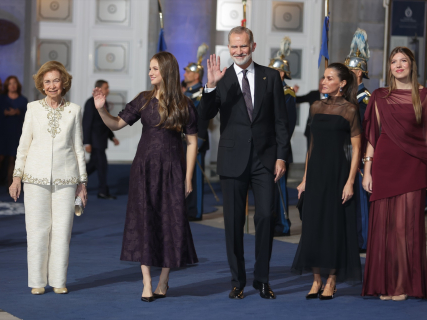
The 46th edition of the awards brings together Leo Messi, Patti Smith, Julian Barnes, and Christina Koch, among other awardees. The ceremony takes place this Friday, October 23, at the Teatro Campoamor, with the presence of the Kings, Princess Leonor, and Infanta Sofía.

EuropaPress 7053628 reina sofia princesa leonor rey felipe vi reina letizia infanta sofia salen

EuropaPress 7053628 reina sofia princesa leonor rey felipe vi reina letizia infanta sofia salen

Add DEMÓCRATA to Google

Ask FREN

Published

4 minutes

Most read

Elecciones 29N · Encuestas

La media de las encuestas

Media a 21 de octubre de 2026 · 15 institutos

  • PP31,6 %
  • PSOE26,9 %
  • Vox18,7 %
  • Sumar6,3 %
  • Podemos3,1 %
  • ERC2,2 %
010203040ene 2024jul 2024ene 2025jul 2025ene 2026jul 2026

Media del último estudio de cada instituto en 30 días y su evolución semanal desde el 23J. Partidos con al menos un 2 %.

Todas las encuestas

Elecciones generales del 29 de noviembre · Demócrata

The Princess of Asturias Awards 2026 celebrate this Friday, October 23, their 46th edition at the Campoamor Theatre in Oviedo, with a ceremony that will begin at 18:30 hours. The Asturian capital once again becomes the stage for one of the main cultural and institutional events of the year, which will have the participation of the Kings, Princess Leonor and Infanta Sofía.

The footballer Leo Messi, singer Patti Smith, writer Julian Barnes, and astronaut Christina Koch are among the awardees of an edition that also recognizes the Japanese animation studio Studio Ghibli, historian Timothy Garton Ash, three scientific researchers, and the Global Seed Vault of Svalbard.

When and where are the Princess of Asturias Awards 2026 held

The award ceremony will take place on Friday, October 23, starting at 18:30 hours, at the Campoamor Theatre in Oviedo. The event will be presided over by Felipe VI and Letizia, accompanied by Princess Leonor and Infanta Sofía.

As usual, the ceremony will include speeches from representatives of the awardees and institutional speeches. This year, it is expected that Julian Barnes, Christina Koch, Timothy Garton Ash, and Patti Smith will speak, in addition to Princess Leonor and Felipe VI.

The day will begin several hours earlier at the Hotel de la Reconquista, where the official audiences will be held. One of the main novelties will be the prominence of Leonor, who will receive the awardees of this edition for the first time alone at 12:30 hours, in the Covadonga Hall.

Who are the winners of the Princess of Asturias Awards 2026

The Princess of Asturias Foundation has awarded this year eight prizes, corresponding to the different categories of the awards.

Category Awardees
Arts Patti Smith
Communication and Humanities Studio Ghibli
Social Sciences Timothy Garton Ash
Letters Julian Barnes
Sports Leo Messi
Scientific and Technical Research David Klenerman, Shankar Balasubramanian, and Pascal Mayer
International Cooperation Global Seed Vault of Svalbard
Concordia Christina Koch

Among the most well-known names is Leo Messi, one of the most awarded footballers in history, recognized in the Sports category. The Argentine also features in one of the most anticipated meetings of the week, with students and young people at the Palacio de los Deportes in Oviedo.

In the cultural sphere, Patti Smith stands out, a fundamental reference of rock and contemporary poetry, alongside Studio Ghibli, the Japanese studio responsible for films like Spirited Away, My Neighbor Totoro, and The Boy and the Heron. The literary recognition falls on the British novelist Julian Barnes, while the historian Timothy Garton Ash receives the award for Social Sciences.

The scientific research is represented by David Klenerman, Shankar Balasubramanian, and Pascal Mayer, whose work has contributed to the development of genetic sequencing technologies. For its part, the Svalbard Global Seed Vault receives the recognition for International Cooperation for its work in conserving agricultural diversity, while the American astronaut Christina Koch receives the Prize for Concord.

Schedules of the Princess of Asturias Awards 2026

The official agenda of the Royal Family is concentrated between Thursday, October 22, and Saturday, October 24:

Date and time Event
Thursday 22, 19:00 Awards Concert at the Príncipe Felipe Auditorium
Friday 23, 11:20 Audience of Leonor and Sofía with the awardees of the Degree Completion of the University of Oviedo
Friday 23, 11:40 Audience with the awardees of the Asturias distinctions
Friday 23, 12:30 Leonor receives the awardees alone
Friday 23, 12:50 Audience of the Royal Family with jurors and patrons
Friday 23, 18:30 Award ceremony at the Teatro Campoamor
Saturday 24, 12:00 Delivery of the Award to the Exemplary People of Asturias in Llanes

Where to watch the Princess of Asturias Awards 2026

RTVE will be responsible for producing the institutional signal of the ceremony, which will begin on Friday at 18:30 hours. Televisión Española will distribute the images of the event, while Radio Nacional de España will provide the audio signal.

Images of the audience of Princess Leonor with the awardees, scheduled for 12:30 hours, will also be offered. The Princess of Asturias Foundation will also broadcast the press conferences of the awardees through its website.

The role of Princess Leonor in the 2026 awards

This year's ceremony will have a special meaning for Princess Leonor, who will assume new institutional responsibilities during her visit to Asturias.

The heir to the Crown will preside for the first time alone over the audience for the awardees, a meeting that until now was held with the participation of the Kings. The reception will take place on Friday, October 23 at 12:30 PM at the Hotel de la Reconquista.

Leonor will also deliver a speech during the ceremony at the Teatro Campoamor and will participate, along with her parents and her sister, in the presentation of the Exemplary People of Asturias Award on Saturday. There she will again speak before the neighbors and representatives of the awarded locality.

The increase in her prominence responds to the process of the princess's gradual incorporation into the institutional representation functions of the Crown.

Exemplary People of Asturias Award 2026

The Cofradía de Pescadores Santa Ana, from Llanes, has been distinguished with the Exemplary People of Asturias Award 2026.

The recognition is part of the distinctions granted by the Princess of Asturias Foundation to communities and groups that stand out for their contribution to the conservation of heritage, the care of the environment, and the social and economic life of their localities.

The presentation will take place on Saturday, October 24 at 12:00 PM, with the attendance of the Kings, Princess Leonor, and Infanta Sofía. The visit will include an intervention by the heir to the Crown and will provide the institutional closure to the events of this edition.

More key points, information and questions with FREN

AI-GENERATED CONTENT

What are the institutional competencies and functions assigned to the Princess of Asturias according to Spanish legislation?

In Spanish legislation, the Princess of Asturias does not have her own catalog of material competencies, as a minister or a constitutional body might have. Her functions derive from three legal elements: her status as heir to the throne, her membership in the Royal Family, and the possibility of assuming, under certain circumstances, the Regency or guardianship of the King. All this is mainly regulated in the 1978 Spanish Constitution and Royal Decree 1368/1987, without there being a "Princess of Asturias law" with detailed functions.

From a constitutional point of view, the key piece is the status of heir to the Crown:

  • The Constitution (art. 57) establishes the order of succession. The Princess of Asturias is first in the line of succession and, therefore, holds the title as heir.
  • No political decision-making powers are attributed to her: the exercise of the constitutional functions of the Crown corresponds to the reigning King, not the heir.
  • Her position is mainly institutional and symbolic: she personifies the continuity of the Crown and the stability of the system, but without executive or legislative powers.

Regarding formal acts, there are two particularly relevant moments provided for in the Constitution:

  • Oath before the Cortes Generales: when the King dies or abdicates, the heir becomes King or Queen; at that moment, they must swear to faithfully perform their duties, uphold and enforce the Constitution, and respect the rights of citizens and Autonomous Communities (art. 61.1 CE). Before becoming monarch, the heir also takes a similar oath upon reaching the age of majority before the Cortes (art. 61.2 CE), but that oath does not confer new material competencies: it is a solemn formalization of their status as constitutional heir.
  • Age of majority: upon reaching 18 years, the heir is in a position to assume, if necessary, the responsibilities of King or Regent. Until then, their role is fundamentally preparatory and representative.

The other major source of possible institutional functions is the figure of the regency and guardianship of the King, regulated in articles 59 and 60 of the Constitution:

  • Regency: if the King is underage or incapacitated to exercise his functions, a regency would be established. The Constitution provides that it be exercised by the heir to the Crown if of age; if not, the regency may correspond to one or more regents appointed by the Cortes. In that scenario, the Princess of Asturias could become Regent, assuming then, on behalf of the King, all the constitutional functions of the Crown (sanctioning laws, proposing a candidate for the Presidency of the Government, dissolving the Cortes, etc.), but those powers would be as Regent, not as Princess of Asturias per se.
  • Guardianship of the underage King: if the King is underage, the Constitution also regulates his guardianship (art. 60 CE). Again, the heir could play a role depending on the composition determined by the Cortes, but these are extraordinary and conditional cases.

Outside those exceptional scenarios, the activity of the Princess of Asturias is supported more by infra-constitutional norms on titles and honors, and constitutional practice:

  • Royal Decree 1368/1987 regulates the use of the title Princess of Asturias, her treatment, precedences, and protocol representation, as well as other associated historical titles (for example, Princess of Girona, Princess of Viana). From this derives her place in official acts and order of precedence, but not decision-making powers.
  • In practice, the King may entrust her with institutional representations (speeches, official trips, presiding over events) on behalf of the Crown. These are representative functions, not political leadership: she acts as a member of the Royal Family, always under the authority of the King.
  • She has no command over the Armed Forces, no capacity to sanction laws, nor arbitration or moderation functions over the functioning of institutions, which the Constitution reserves for the King as Head of State.

In summary, Spanish legislation defines the Princess of Asturias as heir to the Crown, sets her protocol position, and foresees that she may become Regent under certain circumstances. But while the King reigns and she does not assume the Crown or regency, her "functions" are basically representative, formative, and symbolic, and depend on the delegation made by the King himself, rather than a closed list of her own legal competencies.

Could you detail exactly what the Constitution says about succession and the title of Prince or Princess of Asturias? How do the King's functions legally differ from those of the heir when the latter acts in official representations? What implications would it have if the Princess of Asturias assumed a regency according to the Constitution and Spanish historical practice?

What requirements and procedure does the Princess of Asturias Foundation follow to select the awardees in each category?

The Princess of Asturias Foundation selects awardees through nominations submitted by third parties and the decision of a jury specific to each category. The procedure is governed by its Statutes and the Awards Regulations: the Foundation verifies the admissibility of proposals and the juries evaluate their merits and choose by majority.

What merits are required in each category

The awards may recognize individuals, groups of people, or institutions whose work contributes in an extraordinary and exemplary way to progress and social welfare. The nomination must fit within the scope of the corresponding award:

  • Arts: creation and improvement of artistic expressions, such as architecture, cinema, dance, sculpture, photography, music, painting, or theater.
  • Letters: merits in the field of literary creation.
  • Communication and Humanities: contributions in these cultural fields and knowledge transmission.
  • Social Sciences: contributions in disciplines included in this area.
  • Sports: careers that, through promotion, development, and improvement of sport and its social dimension, exemplify the benefits of sports practice.
  • Scientific and Technical Research: scientific and technical contributions.
  • Concord: merits related to coexistence and humanitarian contribution.
  • International Cooperation: contributions in this field of international collaboration.

The assessment of the suitability of each proposal to the regulatory requirements corresponds to the Foundation. The subsequent choice corresponds to the jury, based on the accredited merits, according to the Awards Regulations.

Who can submit a nomination

Previous awardees; jury members, except for the category they judge; Spanish embassies and diplomatic representations accredited in Spain; persons and institutions of recognized prestige; and those who receive an express invitation from the Foundation can submit nominations.

Self-nominations and posthumous nominations are not accepted. There are also exclusions related to certain persons, positions, and institutions linked to the Foundation, including patrons or sponsors, under the terms of the Regulations. The official frequently asked questions explain the submission conditions.

How to submit and admit the proposal

The official form must be used, available after registering and requesting credentials. It may be accompanied by supporting documents, bibliography, reports, references, or audiovisual material that prove the trajectory and contributions of the nomination.

Submission is made through the Foundation's platform, by email to fpa@fpa.es, or by postal mail or courier to its headquarters: calle Plácido Arango Arias, 2, 33004 Oviedo. The Foundation reviews compliance with requirements and decides on admission. Nominations are confidential: their list is not published, although the number admitted may be communicated.

For the 2026 edition, the general deadline ended on March 5 at 23:59, Spanish time GMT+1, and the endorsement deadline on March 26. Former awardees and jury members have an exception: they can submit proposals or endorsements up to six calendar days before the corresponding jury meeting. The nomination submission can be consulted.

How the jury decides

Juries are appointed annually and gather specialists from each field, according to the Foundation's Statutes. They examine admitted proposals and deliberate on their merits.

Only those who have attended all deliberative meetings from the start to the final vote may vote. Votes are non-delegable and are cast positively: preferred candidacies by the majority are successively promoted. Each award is granted to a single candidacy by majority vote; in case of a tie, the president's casting vote decides.

Which political parties form the current government of the Principality of Asturias and what was the resulting composition in the last regional elections?

The current Government of the Principality of Asturias is formed by a coalition between the Asturian Socialist Federation-PSOE and United Left, within Convocatoria por Asturies, and is presided over by the socialist Adrián Barbón. The last regional elections were held on May 28, 2023 and distributed the 45 seats of the General Junta among six candidacies. The two government partners totaled 22 deputies, one less than an absolute majority.

Which parties make up the Government

The two formations sharing the Executive are the PSOE and Convocatoria por Asturies-IU. This composition remained in force as of September 2026, as reflected in Demócrata's information about the 2027 regional budget negotiation (Government and budget negotiation).

Adrián Barbón, from PSOE, holds the presidency of the Principality. On behalf of IU-Convocatoria, Ovidio Zapico is the councilor for Territorial Planning, Urbanism, Housing, and Citizen Rights. His presence in the Government Council expresses this formation's participation in the Executive, not merely a support agreement from Parliament (Composition of the Asturian Government).

It is also important to distinguish between IU as a party and Convocatoria por Asturies as an electoral candidacy. In the 2023 elections, the latter brought together United Left, Más País, and Asturian Left. Therefore, references to the PSOE partner use both the IU denomination and Convocatoria por Asturies or Convocatoria-IU (Government coalition in Asturias).

How the Parliament was composed after the elections

The resulting distribution from the May 28, 2023 regional elections was as follows. These are the seats obtained by each candidacy in those elections, not an update of the subsequent personal affiliations of their deputies (Asturias electoral results):

  • FSA-PSOE: 19 seats. It was the most voted candidacy and obtained the highest number of representatives.
  • People's Party: 17 seats. It was the second parliamentary force, two deputies behind PSOE.
  • Vox: 4 seats. It was the third candidacy by number of representatives.
  • Convocatoria por Asturies: 3 seats. It is the candidacy that later shared Government with PSOE.
  • Podemos Asturies: 1 seat. The seat corresponded to Covadonga Tomé.
  • Foro Asturias: 1 seat. Completed the representation of the six candidacies that entered the Chamber.

What majority supports the Executive

The key to interpreting this result is to separate being part of the Government from supporting it in a vote. PSOE and Convocatoria totaled 22 of the 45 seats. Therefore, their coalition did not reach the 23 deputies that constitute an absolute majority by itself. Barbón's investiture also had the support of Covadonga Tomé, elected in the Podemos Asturies candidacy (Legislature background).

That external support did not make Podemos part of the Executive. Subsequently, Tomé became a deputy of the Mixed Group and spokesperson for Somos Asturies. Her backing of the 2026 budget project allowed adding 23 votes to the 22 of PSOE and Convocatoria-IU, as reported by Demócrata (Tomé's support for the budget).

In short, PSOE and IU-Convocatoria por Asturies govern; the electoral result gave representation to six candidacies. The seat obtained by Podemos must be maintained in the 2023 election balance, although the political affiliation of its deputy changed later.

Play

Test your knowledge with FREN!

How much do you know about this topic? Answer the following 3 questions.

Where and when will the 2026 Princess of Asturias Awards ceremony be held?

Question 1 of 3

What special institutional role will Princess Leonor assume in the 2026 edition of the awards?

Question 2 of 3

Who has been honored with the Exemplary Town of Asturias Award 2026?

Question 3 of 3