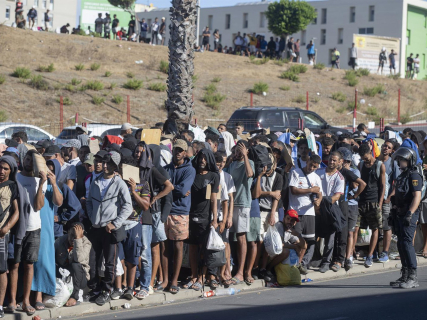
The Government proposes to requisition all the sports centers in Ceuta to attend to the migrants.

1 minute

fotonoticia 20260824212054 1920

fotonoticia 20260824212054 1920

Add DEMÓCRATA to Google

Ask FREN

Published

Last updated

1 minute

Most read

The single command to manage the migration crisis in Ceuta faces its first clash between administrations just after being launched. The draft of the Royal Decree prepared by the Government includes among the mobilizable resources practically all the covered sports centers in the city, according to sources from the Government of the Autonomous City confirmed to DEMÓCRATA. A proposal that the Executive of Juan Vivas opposes due to the consequences it would have for sports activity and the daily life of the people of Ceuta.

More key points, information and questions with FREN

AI-GENERATED CONTENT

What are the parliamentary procedures required to approve a Royal Decree in emergency situations in Spain?

In Spain, when talking about emergency measures with legal rank, the key figure is not the ordinary Royal Decree, but the Royal Decree-law. The Royal Decree-law is a norm with the rank of law that the Government can issue only in cases of extraordinary and urgent necessity, and which comes into force immediately, but is subject to a specific and very rapid parliamentary control.

1. Initial approval by the Government

The procedure begins outside Parliament:

  • The Council of Ministers approves the Royal Decree-law, expressly invoking the existence of a situation of extraordinary and urgent necessity.
  • The text is published in the Official State Gazette (BOE) and enters into force immediately on the date indicated (usually the same day of publication or the following day).

At this moment it already produces legal effects, but its validity is conditioned on what the Congress of Deputies does afterwards.

2. Control by the Congress: validation or repeal

The Constitution establishes that the Royal Decree-law must be submitted to the Congress of Deputies within a maximum period of 30 days from its promulgation so that it decides whether to validate or repeal it.

  • The Board of the Congress qualifies the Royal Decree-law upon arrival and sends it to the Plenary for debate.
  • A validation debate is held in the Plenary. Usually, a Government member intervenes to defend the text and then the spokespersons of the parliamentary groups.
  • Amendments are not processed at this stage: the decision is limited to validating (keeping in force) or repealing (nullifying) the Royal Decree-law.

The validation or repeal is decided by simple majority of the Congress Plenary (more votes in favor than against).

What happens if it is not validated?
  • If the Congress does not validate the Royal Decree-law (either because it votes against it or because the period passes without pronouncement), the norm is repealed.
  • However, the acts carried out under the Royal Decree-law while it was in force are not automatically reviewed; general principles of legal certainty apply.

3. Possible processing as a bill

In the validation debate itself, the Congress may decide that the Royal Decree-law be processed as a bill. This decision:

  • Is adopted by the Congress Plenary, usually at the request of a group.
  • Does not affect the validation: the Royal Decree-law has already been validated and remains in force.
  • Opens a complete legislative procedure to be able to modify the content through amendments.
Parliamentary processing as a bill

Once agreed to be processed as a bill, the text follows, with nuances, the ordinary phases of a law:

  • A period opens to submit amendments to the articles by the groups.
  • The initiative is sent to the competent committee of the Congress, where it is studied in detail, negotiated, and amendments are voted on. The committee prepares a report with a revised text.
  • That report goes to the Congress Plenary, which holds a debate and votes on the final text and the reserved amendments for defense.
  • Approved in the Congress, the bill is sent to the Senate, which can:
    • approve it as is,
    • introduce amendments, or
    • raise a veto.
  • The Congress can override a Senate veto (with the corresponding majority) or accept or reject its amendments.

This whole process can be carried out by the urgency procedure, shortening deadlines in committees and amendments to suit the extraordinary nature of the matter.

4. Role of the Senate in the emergency phase

In the strictly validation phase of the Royal Decree-law, the Senate does not intervene: control corresponds only to the Congress of Deputies. The Senate only comes into play if the Royal Decree-law, already validated, is processed as a bill, participating in the ordinary legislative phase.

5. Material limits and subsequent control

Although oriented to emergencies, the Royal Decree-law has material limits: it cannot affect matters reserved for organic law, the general electoral regime, nor core aspects of the regime of the autonomous communities. Besides the political control of the Congress, it can always be subjected to constitutional control before the Constitutional Court through appeal or question of unconstitutionality.

What are the powers of the President of the Autonomous City of Ceuta according to the Statute of Autonomy?

The Statute of Autonomy of Ceuta, approved by Organic Law 1/1995, configures the President of the Autonomous City of Ceuta as the central piece of the Ceutan institutional system. His powers are collected in the statutory provisions dedicated to the governing bodies of the City (Assembly, President, and Government Council) and affect both institutional representation and political and executive direction.

Bodies presided over and institutional representation

The Statute establishes that the President of the city of Ceuta:

  • Presides over the Assembly of Ceuta, the representative body of the City. The Board of the Assembly is composed of the President of the City, who presides over it, and two vice presidents elected by the Assembly itself.
  • Presides over the Government Council, a collegiate body that holds the executive and administrative functions of the City. The President directs and coordinates the activity of this Council.
  • Holds the supreme representation of the City, acting as the highest institutional authority of the Autonomous City of Ceuta in its relations with the State and other institutions.
  • The Statute adds that the President also holds the status of Mayor, which reinforces his role as head of local and autonomous government at the same time, given the singular nature of Ceuta.

Executive and appointment powers

In government and administration matters, the Statute attributes to the President a series of decisive executive faculties:

  • Appointment and dismissal of the Councillors who make up the Government Council. The members of the Council are freely appointed and removed by the President, who must report to the Assembly.
  • Possibility to temporarily delegate his own executive functions to some members of the Government Council, which allows him to modulate the internal distribution of responsibilities within the Executive.
  • Participates in the direction of the general policy of the City, insofar as the Government Council, which he presides over, exercises political direction and executive and administrative functions, without prejudice to the powers of the Assembly.

Role in the functioning of the Assembly

As President of the Assembly, the Statute also assigns him functions of promotion and organization of parliamentary work:

  • Calls the ordinary sessions of the Assembly under the terms and with the periodicity established by the Regulations. At least one ordinary session must be held each month.
  • May call extraordinary sessions when he decides, and must also do so when requested by at least one quarter of the members of the Assembly, in which case it must be held within a maximum period of two months.
  • He is responsible for the calling of the constitutive session of the new Assembly after the elections, within twenty days following their holding, in his capacity as outgoing President of the City.

Relationship of confidence with the Assembly

The Statute also regulates political responsibility mechanisms that directly affect the President:

  • The President, after deliberation of the Government Council, may raise before the Assembly of Ceuta a vote of confidence on his program or on a declaration of general policy. Confidence is understood to be granted if a simple majority of the members of the Assembly vote in favor.
  • If the Assembly denies confidence, the President must resign and the procedure for the election of a new President by the Assembly begins.
  • The Assembly may require the responsibility of the President through a motion of censure, which must include an alternative candidate for the Presidency of the City. If the motion is approved by an absolute majority, the proposed candidate is understood to be invested and is appointed new President.
  • While a motion of censure is pending, the President cannot raise a vote of confidence, which limits his capacity for political initiative in that context.

Election and nature of the office

Although his election is not strictly a “power” of the President, the Statute defines essential features of the office that condition his institutional position:

  • He is elected by the Assembly of Ceuta from among its members who have headed electoral lists with representation, by absolute majority; if no one reaches that majority, the one who heads the most voted list is designated.
  • Once elected by the Assembly, he is appointed by the King, which underlines his fit within the constitutional structure of the State.

Overall, the Statute of Autonomy thus configures a President who concentrates the presidency of the representative body, the headship of the Executive, and the highest institutional representation, with broad powers of political direction, government organization, and articulation of responsibility before the Assembly.

What results did the Popular Party obtain in the last regional elections of Ceuta?

I have not been able to locate in the sources consulted, in this same search, the specific numerical data (vote percentage and number of seats) of the Popular Party in the last elections to the Assembly of Ceuta. The research trail you have seen has focused on other informational pieces about Ceuta, the Senate, or the PP, but has not returned the official summary of results we need to answer precisely and without inventing figures.

That said, we can clarify with certainty the institutional framework and guide you precisely to the sources where you will find those results officially and broken down. Ceuta has its own Assembly, which acts as the representative chamber of the Autonomous City and which, together with the Government Council, constitutes the core of its institutional bodies. According to a note from the Senate about the city, these two bodies —Assembly and Government Council— are the main self-government institutions of Ceuta, and their composition is determined by periodic universal suffrage elections.

The elections to the Assembly of Ceuta are held, as a general rule, coinciding with municipal elections in the rest of Spain (for example, those of May 28, 2023). In that event, the deputies of the Assembly are elected; the Popular Party runs with its own candidacy and, based on the distribution of seats, the majority that supports the president of the Autonomous City is configured.

Politically, it is known that the PP has historically been the hegemonic force in Ceuta, with Juan Jesús Vivas at the head of the city for several legislatures. This continuity in local government is mentioned in various institutional documents, such as the Senate communication about the Ceuta Day celebration, where his role as president in the current legislature is recalled. However, that contextual information does not replace the specific quantitative data of the last election, which are what you request.

To securely obtain the vote percentage, the number of seats, and, if you wish, the comparison with the previous election, I recommend going to the following official sources, which are the ones that usually publish and keep these results:

  • Ministry of the Interior – Electoral results: the Ministry of the Interior's results portal offers, election by election, the detail of votes, percentages, and seats for all constituencies, including the autonomous cities. From its main page you can select the electoral process (local/autonomous elections of May 28, 2023, for example) and then filter by Ceuta and by the type of election (Assembly of Ceuta). There the exact data of the Popular Party and the rest of the candidacies will appear.
  • Central Electoral Board (JEC) and Official State Gazette (BOE): the JEC publishes in the BOE agreements and summaries of results of the different electoral processes. Although the research trail we have seen refers mainly to European elections and corrections of local election results in peninsular municipalities, it is normal that there is an agreement where Ceuta's breakdown also appears, with the official figures by candidacy.
  • Institutional portal of the Autonomous City of Ceuta: the city's website or that of the Assembly itself usually includes a section of “elections” or “electoral results” where the most recent results are collected, sometimes accompanied by press releases and comparative graphics between calls. There the evolution of each party's vote is usually reflected, in addition to the percentage and seats.
  • Local and national press: generalist or specialized media usually offer, on election night and in the following days, specific pieces about the results in Ceuta. Although these reports do not replace official data, they can serve you for a quick reading of what the PP won, with how many seats, and what variation there was compared to the previous election.

For rigor, and since in this specific query those statistical summaries have not yet appeared, it would be speculative to offer you concrete figures now. If you want, in a next question I can help you interpret the data once you have them in front of you (for example, to analyze the magnitude of the PP's advance or setback, possible majorities, or the role of other parties in the Assembly of Ceuta).

Play

Test your knowledge with FREN!

How much do you know about this topic? Answer the following 3 questions.

What measure does the draft Royal Decree prepared by the central Government for Ceuta contemplate?

Question 1 of 3

Who currently leads the Government of the Autonomous City of Ceuta?

Question 2 of 3

What does the Government of the Autonomous City of Ceuta oppose regarding the draft Royal Decree?

Question 3 of 3

Hola, soy Fren. ¿Cómo te ayudo?