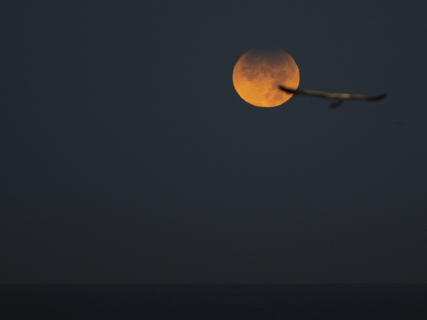

The partial lunar eclipse on Friday, August 28, will reach its maximum at 06:12 hours in the Peninsula and Balearic Islands, when our satellite will already be descending towards the western horizon.
There lies the main territorial difference. The eclipse is the same from all of Spain, but the Moon sets earlier the further east the observer is.
The National Geographic Institute actually divides Spain into two major situations: in the central and eastern peninsula, Balearic Islands, and Melilla, the Moon will disappear before the partiality ends. In the rest of the Peninsula, Canary Islands, and Ceuta, the setting will occur later.
The west of Spain will have the best position
Galicia, Extremadura, and a good part of western Andalusia are among the best-placed areas to follow the final stretch of the phenomenon.
The reason is not that the eclipse is more intense there. Its magnitude is the same. The advantage comes from the time of the Moon's setting.
In A Coruña, for example, the Moon will remain above the horizon until around 08:02 hours. Since the partial phase ends at 07:51, it will be possible to see practically all that stretch of the eclipse if the horizon and weather conditions allow it.
A similar situation will occur in much of the southwest. In Cádiz, the lunar setting is expected around 08:01. In Sevilla, approximately at 07:59.
In these places, there will still be Moon above the horizon when the partial phase ends.
Salamanca and the west of Castilla y León, almost at the limit
The transition zone will cross part of the interior peninsula.
In Salamanca, for example, the end of the partial phase will occur at 07:51 and the Moon will set just a few minutes later, around 07:54.
To the east, those minutes disappear quickly. Valladolid will be practically at the limit: the lunar setting is around 07:49, just a couple of minutes before the astronomical end of the partiality.
This means that small differences in position, relief, and horizon are important during the last minutes.
Madrid will not reach the end of the partial phase
In Madrid, the eclipse can be clearly seen in its main moments, including the maximum at 06:12 hours.
However, the Moon will set at approximately 07:46, a few minutes before the partial phase ends at 07:51.
The loss will be small regarding the whole phenomenon, but it will prevent observing from the capital the complete end of the Moon's exit from the Earth's shadow.
Barcelona, Valencia, and Zaragoza will lose more eclipse
The difference increases in the east.
In Barcelona, the lunar setting will occur approximately at 07:21 hours. Therefore, there will be around half an hour of partial phase when the Moon disappears below the horizon.
In Valencia and Zaragoza, the setting will occur approximately at 07:33. They will also not be able to follow the final minutes of the partiality from these capitals.
Alicante presents a similar situation, with the Moon disappearing approximately at 07:35.
The IGN also includes the Balearic Islands among the territories where the lunar setting will occur before the end of the partial phase.
Canarias plays with another schedule
Canarias has a peculiarity: the eclipse occurs exactly at the same time as in the rest of the world, but the clocks of the archipelago mark one hour less than on the Peninsula.
The partial phase will begin there at 03:33 hours and the maximum will arrive at 05:12.
The IGN places the archipelago among the territories where the Moon's setting occurs after the partial phase ends, making it one of the Spanish locations with the best geometric conditions to observe its complete evolution.
A clear western horizon will be decisive
Being located in the west does not guarantee good observation by itself.
During the last part of the eclipse, the Moon will be very low on the west-southwest horizon. A building, a mountain, or even a line of trees can prevent seeing it before the astronomical setting occurs.
High places with a wide view towards the west will have an advantage, especially for those who intend to follow the eclipse until its last minutes.
The other factor will be the weather. A layer of low clouds located precisely over the horizon could hide the Moon even if the rest of the sky remains clear.