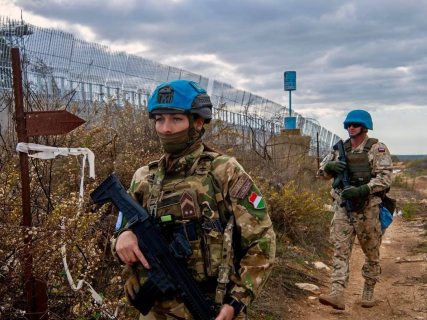

The United Nations Interim Force in Lebanon (UNIFIL) reiterated this Monday that any deployment or presence of Israeli forces north of the Blue Line, which marks the separation between Israel and Lebanon, violates the provisions of Security Council Resolution 1701 of the UN and, consequently, lacks legality.
"Any Israeli military presence north of the Blue Line constitutes a violation of Security Council Resolution 1701 and UNIFIL will monitor and report on it," the UN mission highlighted in a statement released after the latest tensions in the border area.
With this pronouncement, UNIFIL rejects the positions and areas controlled by Israel in Lebanese territory. "There has been much talk of lines, zones, and other terms related to southern Lebanon. For the United Nations and for UNIFIL, there is only one relevant line, the Blue Line," the peacekeeping force argued, reminding that it does not recognize other delimitations on the ground.
The UN mission has emphasized that the Blue Line was established in 2000 as a "withdrawal line" to certify the exit of Israeli troops from southern Lebanon. "UNIFIL monitors the Blue Line and reports on events in accordance with its mandate," it added, referring to its function of observation and incident reporting.
Furthermore, the international force has stressed that "the 'blue helmets' also monitor and report on the relevant activities of non-state armed actors within the mission's area of operations," referring to the militias of Hezbollah and other groups present in the south of the country.
In parallel to these warnings, Israeli military operations in Lebanese territory continue despite the declared ceasefire. Among them are bombings on the towns of Mansuri (Tyre), Taibé, and Hula (Marjayoun), which, according to initial reports, would not have caused casualties.
Additionally, Israeli forces have launched a stun grenade against a rescue team in Dohat Kfar Remán and have carried out new attacks. Demolitions of houses have also been reported in Zautar el Charkiyé (Nabatiyé) and in the towns of Hula and Meis al Yabal (Marjayoun), as well as bombings with phosphorus munitions, a weapon whose use is prohibited by international law.
Israel seems to have increased the destruction of buildings and infrastructure on the Lebanese side of the border, with excavators operating in Haris and Hadaza (Bint Yebeil). In that same strip, there have been explosions from suicide drones and artillery attacks at points like Wadi Sluqi, aggravating the material damages.
In Meis el Yabal (Marjayún), Israeli heavy machinery has demolished some improvised school classrooms that had just been erected with Iraqi support for the minors in the area. In the town of Jiam, also in the Marjayún district, there have been reports of several houses being set on fire.
At the same time, debris removal tasks continue. In Dohat Kefarremán, in the Nabatiyé district, rescue teams have located two bodies buried among the rubble of the destroyed buildings, which were buried on Sunday after the attack of an Israeli drone. The deceased have been identified as Hasán Choker and Ahmad Rumani.
Displaced by the Israeli offensive
The Lebanese Prime Minister, Nawaf Salam, received on Monday in Beirut a delegation from the border town of Dhaira, whose inhabitants have been forced to leave their homes due to the Israeli offensive. During the meeting, Salam reiterated that the Government continues to work to achieve a total withdrawal of Israeli forces and create the necessary conditions for the safe return of the population.
"The State will not abandon the inhabitants of Dhaira nor other residents of the south in the face of the consequences of displacement," pointed out the head of Government, trying to reassure those affected by the destruction and forced exodus.
"We are studying different options to solve the housing problem, including compensation for rent to the displaced families," he explained, referring to possible economic support measures and housing solutions for those who have lost their homes.