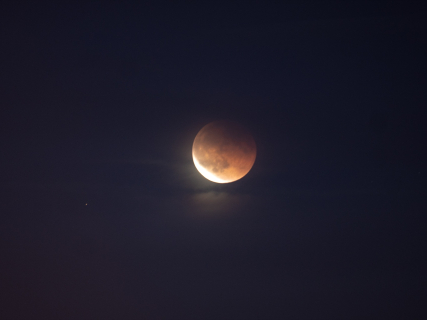

The Moon could acquire reddish tones during the partial eclipse on August 28, especially around its maximum, expected at 06:12 hours in mainland Spain. It will not be a total eclipse, but it will be deep enough for a good part of the lunar disk to be submerged in the shadow of the Earth.
Why the Moon can turn red during the eclipse on August 28
The early morning of August 28 will offer a very different image from a conventional full Moon.
When the eclipse reaches its maximum, the magnitude will be 0.93 and approximately 96% of the surface of the lunar disk will be darkened by the Earth's umbra. Only a small area will remain outside the darkest part of the shadow.
This degree of obscuration explains that, despite being officially a partial eclipse, its appearance may visually approach that of a total eclipse during its central moments.
Why the shadow of the Earth does not leave the Moon completely black
At first glance, it might seem that the Moon should disappear when entering the Earth's shadow.
This does not happen because part of the sunlight passes through the Earth's atmosphere before reaching the lunar surface.
The atmosphere acts as a filter. Blue light scatters more easily, while a greater proportion of reddish wavelengths manages to pass through and bend into the Earth's shadow.
It is, essentially, a process related to that which causes sunrises and sunsets to present red and orange colors.
In a lunar eclipse, that light filtered by the atmosphere of the entire terrestrial perimeter ends up indirectly illuminating the Moon.
Will the Moon really look red on August 28?
It is possible that a significant part of the disk will adopt reddish, coppery, or orange tones, especially near the maximum.
But there is an important difference compared to total lunar eclipses.
The eclipse on August 28 will be partial. A small fraction of the Moon will remain outside the Earth's umbra, so it will continue to receive direct sunlight and will appear much brighter.
This contrast may make it difficult to perceive the darker colors in the eclipsed part at first glance.
The intensity of the red cannot be predicted solely based on the magnitude of the eclipse. The final appearance also depends on the conditions of the Earth's atmosphere.
It will not technically be a "blood Moon"
The expression "Blood Moon" is popularly used to describe the reddish tone that the Moon can present during a lunar eclipse, especially when the eclipse is total.
The one on August 28 will not reach totality.
The IGN expressly classifies it as a partial lunar eclipse, with a magnitude of 0.93. At no time will the lunar disk be completely within the Earth's umbra.
For this reason, it is more accurate to speak of a partially eclipsed Moon with possible reddish tones than to present the phenomenon as a complete Blood Moon.
What happens during a lunar eclipse
A lunar eclipse occurs when the Earth is positioned between the Sun and the Moon and the Moon passes through the shadow projected by our planet.
This shadow has two main regions.
The penumbra is the area where the Earth blocks only part of the solar radiation. When the Moon enters it, its surface experiences a soft darkening that can be difficult to appreciate.
The umbra is the central and darkest part of the shadow, where no direct sunlight reaches.
If the entire Moon enters the umbra, the eclipse is total. If only part of it does, as will happen on August 28, it is partial. If the satellite only passes through the penumbra, it is classified as penumbral.
The maximum will be at 06:12 hours
The Moon will start to penetrate the penumbra at 03:23 hours in the Peninsula and Balearic Islands.
The partial phase will begin at 04:33 and the eclipse will progressively increase until it reaches its maximum at 06:12.
It will be around that time when the lunar surface will show its greatest darkening and when the possible reddish tones may become more evident.
Afterwards, the Moon will begin to leave the umbra. The partial phase will conclude at 07:51 hours, although from much of central and eastern Spain the satellite will have set earlier.
Unlike what happens with a solar eclipse, the phenomenon can be observed with the naked eye and without special glasses, since directly observing the Moon does not pose the eye risk associated with looking at the Sun.