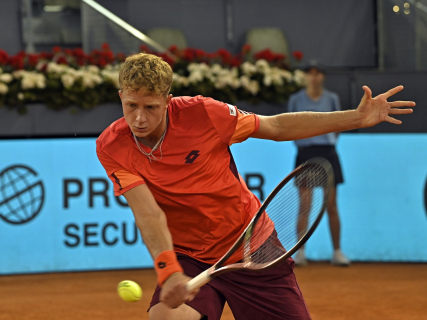
Martín Landaluce - Thiago Tirante: schedule and where to watch today's match of Cincinnati

The Madrid tennis player is seeking a spot in the fourth round after eliminating Jack Draper and Matteo Arnaldi. The Argentine arrives after starring in the big surprise of the tournament against Novak Djokovic.

4 minutes

EuropaPress 5151083 martin landaluce partido contra richard gasquet mutua madrid open celebrado

EuropaPress 5151083 martin landaluce partido contra richard gasquet mutua madrid open celebrado

Add DEMÓCRATA to Google

Ask FREN

Published

Last updated

4 minutes

Most read

Martín Landaluce and Thiago Agustín Tirante face each other this Monday, August 17, in the third round of the Cincinnati Masters 1000. The match started at 5:00 PM, according to Spanish mainland time, and was still ongoing at the close of this information.

The match is played on the Champions' Court of the Cincinnati complex and features two players who have achieved some of the most notable victories in the early rounds. Landaluce eliminated the British player Jack Draper and the Italian Matteo Arnaldi, while Tirante knocked out Novak Djokovic.

The winner will qualify for the fourth round of the tournament, one of the main events of tennis in the calendar leading up to the US Open.

What time is the match between Landaluce and Tirante

The match between Martín Landaluce and Thiago Tirante was scheduled for this Monday, August 17, in the first shift of the Champions' Court, according to the order of play published by the ATP.

These are the main details of the match:

  • Match: Martín Landaluce - Thiago Agustín Tirante.
  • Date: Monday, August 17, 2026.
  • Time: 5:00 PM in mainland Spain.
  • Local time: 11:00 AM in Cincinnati.
  • Court: Champions' Court.
  • Round: third round of the men's singles draw.
  • Tournament: Cincinnati Masters 1000.

Being scheduled in the first shift of the court, its start did not depend on the duration of any previous match. The organization set the start of the daytime session at 11:00 AM local time.

Where to watch Landaluce - Tirante on television and online

The match can be watched in Spain through Movistar Plus+, a platform that offers coverage of the Cincinnati Masters 1000. The match is included in the sports programming of Movistar Plus+.

It is also available via Tennis TV, the official live and on-demand broadcasting service of the men's circuit. To access this platform, an active subscription is required.

The options to follow the match are:

  • Movistar Plus+, through its sports channels and its application.
  • Tennis TV, via its website and applications for compatible devices.
  • The official scoreboard of the ATP, to check the result and live statistics.

The specific availability within Movistar Plus+ may depend on the package contracted by each user. Tennis TV allows following the match from computers, mobile phones, tablets, and compatible televisions.

How Martín Landaluce arrives at the Cincinnati match

Landaluce began his participation in Cincinnati with one of the most relevant victories of his season. The Madrid native defeated Jack Draper 6-3 and 7-5 in the first round, after coming back in a second set where the Brit had a lead of 5-2.

The Spaniard had suffered six defeats before competing in the American tournament. His victory against Draper, former world number four and semifinalist of the US Open in 2024, allowed him to end that negative streak.

In the second round, Landaluce overcame the Italian Matteo Arnaldi 6-4, 4-6 and 6-4. The match lasted over two hours and forced the Spaniard to resolve the classification in the third set.

The two victories have placed the Madrid native in the position to reach the final rounds of a Masters 1000 again during a season in which he already managed to reach the fourth round of Miami and the quarterfinals of Rome.

Tirante arrives after eliminating Novak Djokovic

Thiago Agustín Tirante was the main surprise of the men's draw by defeating Novak Djokovic 2-6, 6-4 and 6-4 in the second round.

The Argentine clearly lost the first set but reacted against a Djokovic who began to suffer physically due to the heat and humidity conditions. Tirante ended up winning after two hours and 44 minutes, according to the official ATP report.

It was the most important victory of his career and the first against the Serbian. Tirante arrived in Cincinnati ranked number 50 in the world, his best position up to that moment.

Before eliminating Djokovic, he had needed three tiebreaks to defeat the Briton Jan Choinski 7-6(9), 6-7(7) and 7-6(4). The Argentine, therefore, had spent five hours and 40 minutes of competition in his first two matches of the tournament.

The precedent between Landaluce and Tirante

Landaluce and Tirante had faced each other once before the Cincinnati match, although that encounter took place in the qualifying round of the Masters 1000 in Miami and is not counted as a match in the main draw of the ATP circuit.

The Spaniard won that match 3-6, 7-5 and 6-4 after coming back in the first set. The match was played in March 2026, also on hard court.

The precedent gave Landaluce a 1-0 advantage in their encounters, although the Cincinnati match constitutes his first duel in a main draw of the ATP circuit.

What Landaluce is playing for in Cincinnati

A victory would allow Landaluce to advance to the fourth round and maintain his progression in the last Masters 1000 prior to the US Open. Cincinnati is played on hard court and represents one of the main preparation tests before the fourth Grand Slam of the season.

The tournament began on August 13 and will conclude on the 23rd. The men's draw brings together a good part of the main players on the circuit, although Carlos Alcaraz and Jannik Sinner are not participating in this edition.

Landaluce seeks to consolidate his presence in the highest category tournaments, while Tirante tries to continue the most important victory of his career. The matchup also features two players who arrive with confidence after overcoming rivals with more experience and better ranking.

More key points, information and questions with FREN

AI-GENERATED CONTENT

At what stage of parliamentary processing is the Spanish regulation governing the broadcasting of international sporting events?

At this moment, there is no “law on the broadcasting of international sporting events” being processed as such in the Spanish Parliament. The applicable legal framework is mainly structured through the Law 13/2022, of July 7, General Audiovisual Communication Law, which is fully in force and not undergoing parliamentary reform, and specific regulations such as Royal Decree-Law 5/2015 on audiovisual rights of professional football. The only current state initiative in process with an indirect connection is a bill to amend the RTVE Law, which is at the stage of submitting amendments in the Congress.

1. Related (indirect) initiatives in process

Parliamentary search has only identified one open state initiative touching the audiovisual field, although its main object is public broadcasting and not specifically international sports broadcasts:

  • Bill amending Law 17/2006, on state-owned radio and television, to adopt urgent measures related to the legal regime applicable to the RTVE Corporation.
    • Chamber: Congress of Deputies.
    • Origin: Government (originating from Royal Decree-Law).
    • File number: 121/000037 (as a bill, following ratification of Royal Decree-Law 130/000008).
    • Current stage: bill in Congress, with the deadline for submitting amendments to the articles extended until September 2, 2026. That is, it is still in an initial processing phase, focused on the formulation of amendments by the groups.
    • Latest action: agreement to extend the deadline for amendments; the committee has not yet been formed nor has there been a commission or Plenary debate on the text.
    • Official reference: initiative file in Congress (initiative 121/000037).

This initiative may affect how RTVE participates in the audiovisual offer — including sports broadcasts — but it does not constitute a fundamental reform of the general regime of broadcasting rights for international sporting events.

2. Basic current regulation on sporting events of general interest

The core of the regulation currently applicable to the broadcasting of major sporting events, including many of an international nature, is found in the Law 13/2022, General Audiovisual Communication Law (BOE-A-2022-11311). This law:

  • Regulates the catalogue of “events of general interest to society” that must be broadcast free-to-air throughout the national territory.
  • Includes, among others, the Olympic and Paralympic Games, matches of the Spanish national teams, final phases of European Championships and World Cups in football, major motor racing and motorcycle Grand Prix held in Spain, the Vuelta a España cycling race, and world and European championships in various disciplines.
  • Establishes the conditions under which holders of exclusive rights must allow free-to-air broadcasting or the sale of those rights to a free-to-air operator.

This law is complemented by sectoral regulations such as Royal Decree-Law 5/2015, of April 30, on the commercialization of audiovisual rights of professional football (BOE-A-2015-4780), and Constitutional Court doctrine, such as the Ruling 7/2023, which declares constitutional the compensation scheme for access to stadiums for broadcasts (BOE-A-2023-8214).

According to the information consulted, there is currently no parliamentary reform of Law 13/2022 on this aspect underway; the basic regulation on broadcasting sporting events of general interest — many of them international — is therefore considered valid and stable legislation.

3. Conclusion on the processing stage

In summary:

  • The Spanish regulation directly governing the broadcasting of major international sporting events (mainly Law 13/2022 and related regulations) is not currently undergoing parliamentary reform; it is in force without a specific amendment project in process.
  • The only ongoing initiative with indirect impact on the audiovisual ecosystem is the Bill to amend the RTVE Law (file 121/000037), which is in the Congress of Deputies at the stage of amendments to the articles, with the deadline still open and not yet passed to committee or subcommittee.

From a strictly procedural point of view, therefore, there is no “new specific regulation” on the broadcasting of international sporting events in an advanced stage of processing; the operational framework rests on already approved legislation, while the RTVE-related project remains in an early phase of the ordinary legislative procedure.

What are the functions and powers of the ATP president in organizing Masters 1000 tournaments?

I cannot answer your question in detail because I specialize in Spanish politics and public institutions, not in the internal structure or governance of international sports organizations such as the ATP nor in the specific regulation of the professional tennis circuit.

My field of knowledge and the tools I have access to are oriented towards:

  • Parliament and Government in Spain: Congress of Deputies, Senate, regional parliaments, regional governments, and the central Government.
  • Laws, decrees, and other regulations: processing of bills and legislative proposals, royal decree-laws, ministerial orders, parliamentary control initiatives (questions, interpellations, motions), as well as their processing status and content.
  • Political actors and senior officials: profiles of deputies, senators, government members, public administration officials and their institutional and media activity (parliamentary interventions, public statements, etc.).
  • Political and regulatory current affairs: political context, parliamentary debates, ministry and public agency plans, sectoral policies (energy, housing, transport, digital, etc.) always in their public and institutional aspect.

Regarding the ATP and Masters 1000 tournaments, to obtain a precise and updated answer about the functions and powers of the ATP president (or the top executive, such as the chairman or CEO, depending on the current structure), I recommend:

  • Consulting the official ATP statutes and regulations, which are usually available on the organization’s official website, in sections like “About,” “Governance,” or “Rulebook.”
  • Reviewing corporate governance communications or documents where decision-making bodies (Board, Council, President/Chairman, CEO) and their powers over:
    • Assignment of venues and calendars for Masters 1000 tournaments.
    • Relations with local organizers and sponsors.
    • Sporting and commercial rules of the circuit.
    • Distribution of points and prizes.
  • Consulting analyses in specialized tennis and sports business media, which often explain in an accessible way the real influence of the ATP president or top executive in negotiations with players, organizers, and federations.

If you want, I can help you interpret this issue from an institutional or comparative perspective, for example:

  • Explaining how governance is usually organized in regulatory bodies or public sports federations in Spain, and comparing that general scheme with what is known about the ATP.
  • Conceptually commenting on what it means, in any organization, for the president to have executive, representative, or supervisory powers, and how that translates into organizing major events (although not going into ATP-specific detail).

If you reformulate the question towards aspects linked to public sports institutions in Spain (for example, the Higher Sports Council, Spanish federations, or public regulation of major sporting events in Spanish territory), I could offer you a detailed and well-founded analysis.

What has been Martín Landaluce's professional career before his participation in the Cincinnati Masters 1000?

I cannot provide you with a detailed professional career of Martín Landaluce before his participation in the Cincinnati Masters 1000 because my area of expertise does not cover biographical or statistical sports information about tennis players, ATP or WTA competitions, nor the tracking of individual sports careers outside their possible political-institutional dimension. I am specifically designed to work with information related to Spanish politics, its institutions, and public regulatory debate, not with athletes’ professional histories.

In other words, I do not have structured access or specialized tools to rigorously reconstruct how many ITF or Challenger titles a player has won, on what dates they achieved certain victories, their exact ranking at different points in their career, or details of their participation in junior and professional tournaments. Such data is normally supported by sports results databases (such as those of the ATP, ITF, the relevant national federation, or specialized tennis portals) which are not part of the resources I handle.

My main function is different: to help understand and analyze the functioning of the Spanish political and institutional system, as well as applicable regulations, initiatives processed in legislative chambers, and the context of public debate. For example, I work with:

  • Congress of Deputies and Senate: composition of parliamentary groups, initiatives presented (bills, royal decree-laws, non-legislative motions, written and oral questions, etc.), processing status and, when appropriate, voting results.
  • Government of Spain and regional administrations: formal agreements, publication of regulations in the Official State Gazette and regional bulletins, prior public consultations, hearings, and information on draft bills or regulations.
  • Political actors: profiles of public officials (ministers, secretaries of state, regional deputies, etc.), as well as their parliamentary interventions and, in some cases, their presence in public debate in the press and social media.
  • Regulatory and sectoral debate: identification of relevant regulations on housing, energy, digitalization, education, health, transport, agriculture, data protection, consumer affairs, and other areas where regulation and public policy are central.

If you want to relate tennis or sport to the Spanish institutional sphere — for example, asking about the sports policy of the Higher Sports Council, public subsidies to federations, or regulations on major sporting events in Spain — I could help you. In those cases, it would be possible to explore:

  • Which laws or royal decree-laws regulate the organization of sports competitions in Spanish territory.
  • Which parliamentary initiatives have addressed grassroots sport, high performance, doping, or equality in sport.
  • How sports policy is institutionally structured (competent ministries, autonomous agencies, recognized federations, etc.).

For the specific information you are seeking about Martín Landaluce — his career prior to a specific Masters 1000 circuit tournament — the most appropriate is to consult specialized tennis sources. Usually, the most reliable and structured information is found in:

  • The player’s profile on the official ATP website, which usually includes ranking, record, seasonal results, and basic biographical data.
  • The ITF website and, where applicable, records of junior or lower-level professional tournaments, which include Futures, Challengers, and junior competition results.
  • The national tennis federation concerned (in this case, the Royal Spanish Tennis Federation), which often publishes news and profiles about emerging players, their results in national and international championships, and career milestones.
  • Specialized sports media (tennis portals, sports sections in general press, tournament reports), where contextual reports on young prospects before their appearance in high-level tournaments are often made.

If you reformulate your interest towards some aspect connected with the political or institutional dimension of sport in Spain — for example, public support for elite tennis, regulation of federations, or policies promoting grassroots sport — I can help you in much more detail, working with regulations, parliamentary initiatives, and updated political context.

Play

Test your knowledge with FREN!

How much do you know about this topic? Answer the following 3 questions.

On which court is the match between Martín Landaluce and Thiago Tirante being played in Cincinnati?

Question 1 of 3

Which player eliminated Novak Djokovic in the second round of the Cincinnati Masters 1000?

Question 2 of 3

Which platform offers the broadcast of the match between Landaluce and Tirante in Spain?

Question 3 of 3

Hola, soy Fren. ¿Cómo te ayudo?