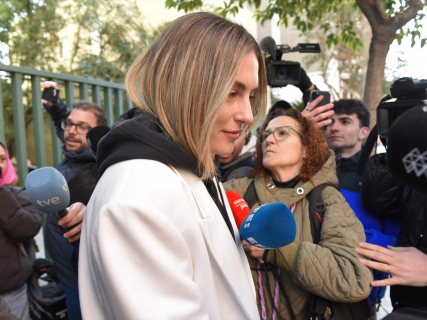
The Federation is preparing an agreement for the female soccer players of the national team to be able to freeze eggs.

The CSD already has specific aids for maternity and reconciliation of high-level athletes.

2 minutes

seleccion ovulos federacion

seleccion ovulos federacion

Add DEMÓCRATA to Google

Ask FREN

Published

Last updated

2 minutes

Most read

The Royal Spanish Football Federation (RFEF) is finalizing an agreement with a fertility clinic to facilitate Spanish national team footballers the freezing of their eggs, according to El País. The initiative seeks to offer international players a tool to reconcile their sports career with the possibility of becoming mothers later on. The details of the agreement, including the players who could benefit and the expenses that the Federation would cover, are yet to be finalized. 

The proposal is said to have arisen from a concern raised by the footballers themselves and conveyed by Alexia Putellas. The player has publicly defended the need to advance in measures that allow athletes not to have to choose between their career and motherhood. The RFEF agreement is still in the preparation phase, and its conditions are expected to be known in September. 

Elite sports and reconciliation

The initiative is part of a broader debate on reconciliation in high-level sports. The Higher Sports Council (CSD) already has specific programs to support athletes facing motherhood and facilitate their continuity in competition. Among these measures is the Maternity Scholarship, incorporated into the CSD Team Spain-ADO program for the 2025-2028 Olympic cycle. 

In 2025, the Higher Sports Council called for aid worth 450,000 euros for high-level and high-performance female athletes, with specific lines aimed at motherhood, family reconciliation, and academic training. 

The regulatory framework has also incorporated specific measures for female athletes. The Sports Law establishes that Spanish sports federations and professional leagues must have reconciliation and co-responsibility plans, including specific protection measures in situations of motherhood and breastfeeding.

The CSD itself has gathered experiences from athletes who have continued their careers after becoming mothers. Among them is the Paralympic triathlete Eva Moral, who has explained her experience as an athlete and mother within the support programs of the organization.  There are also precedents within the Spanish teams. The CSD has documented the case of hockey players María López and Mari Ángeles Ruiz, the latter being a mother while continuing to be part of the Spanish national team. 

More key points, information and questions with FREN

AI-GENERATED CONTENT

At what parliamentary stage is the latest reform of the Sports Law on work-life balance and maternity?

The latest relevant reform of Law 39/2022, on Sports regarding work-life balance and maternity is not an autonomous law on “women's sports,” but part of the Organic Law on equal representation and balanced presence of women and men. This organic law has already completed its parliamentary process: it was definitively approved by the General Courts on 07/23/2024 and its approved text was officially published at the end of July 2024, so the reform is in force, not in the processing stage.

1. Which specific reform affects work-life balance and maternity in sports

The reference commonly described as the “latest reform of the Sports Law on work-life balance and maternity” is part of the Organic Law Project on equal representation and balanced presence of women and men, processed in the Congress with identifier 121/000001 and in the Senate as (15)621/000002.

Through various final provisions, this law:

  • Introduces modifications to Law 39/2022, on Sports, especially to strengthen protection against harassment and discrimination in the sports field and to provide effective content to equality in professional sports.
  • Adjusts Royal Decree 1006/1985, which regulates the special labor relationship of professional athletes, to guarantee work-life balance rights, with special attention to:
    • The automatic contract extension when the athlete becomes pregnant in the last year of validity or is in the adoption process.
    • The recognition of the same work-life balance leaves as any other worker, adapted to the specificity of high performance (training, travel, competition calendar).
    • The possibility for athletes to remain involved with the team during pregnancy and after birth, provided it is a voluntary decision and does not pose a risk to pregnancy or breastfeeding.
    • The obligation for sports companies subject to this to develop and apply an equality plan, negotiated under the terms provided in Organic Law 3/2007 and Royal Decree 901/2020.

Part of these contents can be seen in the official publications about the parity law itself, for example in the bulletins linked from the Congress and the Senate:

2. At what parliamentary stage is this reform

According to the parliamentary record:

  • The Organic Law Project on equal representation was definitively approved on 07/23/2024.
  • On 07/31/2024, the confirmation that the text had been officially approved was published.

With that final approval and its subsequent publication, the law moved to the status of processing completed. That is:

  • It is no longer in the Congress or Senate at any stage (no open committee, commission, or pending plenary session).
  • The reform of the Sports Law regarding work-life balance and maternity incorporated by this law is fully in force.

Consequently, if the question refers to that reform — which explicitly modifies the Sports Law and the labor regime of athletes to protect pregnancy, maternity, and work-life balance — the answer is that it is no longer at a parliamentary stage: the legislative procedure has ended and the regulation is part of the law in force.

3. Related initiatives still in process

In parallel, there are general work-life balance reforms that also affect the sports world, although they are not a direct and specific reform of the Sports Law. The most relevant ongoing one is the Bill derived from Royal Decree-law 9/2025, of July 29, on extending birth and care leave:

  • Royal Decree-law 9/2025 was ratified and its processing as a bill was agreed (no. 121/000069 in the Congress).
  • Official information states that the deadline for submitting amendments to the bill has been extended until 09/02/2026, so the initiative remains in the amendment phase in the Congress and has not yet moved to committee or commission report.
  • You can consult this process in the General Courts Bulletin: BOCG-D-393 (bill 121/000069).

This reform affects leave and benefits for birth and child care for all workers (including athletes under the Workers' Statute or Social Security regime), but does not itself reopen the Sports Law, which was already modified by the parity law.

In summary: the specific reform of the Sports Law on work-life balance and maternity is already approved and in force; what continues in parliamentary processing, in the amendment phase in the Congress, is the bill 121/000069 on extending birth and care leave, which acts as a general framework for work-life balance across the entire labor market.

What are the competencies of the Higher Sports Council regarding gender equality in sports?

The Higher Sports Council (CSD) is the main body of the General State Administration in sports matters and, according to current legislation, has specific functions assigned to promote and guarantee gender equality in the sports field. These competencies are mainly based on Law 39/2022, of December 30, on Sports, and Royal Decree 460/2015, of June 5, which approves the CSD Statute.

General equality framework in Law 39/2022, on Sports

Law 39/2022 incorporates equality between women and men as one of its guiding principles. The preamble itself highlights that the regulation:

  • Is inspired by the principle of equality in Article 14 of the Constitution, understood as real equality in access to sports practice and to technical and managerial positions.
  • Demands a sports practice free from discrimination, especially in the case of girls and women.
  • Is also inspired by the principle of equal treatment between women and men of Organic Law 3/2007, of March 22, for effective equality between women and men.
  • Points out the need for sports entities to balance the presence of men and women in their governing bodies, in line with Organic Law 3/2007.

Although the Sports Law sets the general framework, the operational specification of many of these obligations falls on the CSD through its Statute, which details specific functions linked to gender equality.

Specific functions of the CSD in gender equality (RD 460/2015)

Royal Decree 460/2015, which approves the Statute of the Higher Sports Council, explicitly incorporates the dimension of equality in the organization and functions of the body.

1. Specialized unit on women and sports

The explanatory part of the Royal Decree indicates that, in light of Organic Law 3/2007, it is necessary for the CSD to have a specialized unit on the role of women in the sports world. This provision connects the internal structure of the body with equality policies, so that there is a technical-administrative reference dedicated specifically to this matter.

2. Principle of balanced presence in CSD bodies

The CSD Statute establishes that in the appointment of members of the Governing Commission, the principle of balanced presence of women and men must be respected, except for founded and objective reasons, in accordance with Organic Law 3/2007. This means that the governing body of the CSD itself is subject to a gender balance standard.

3. Material competencies in equality policies

Among the functions of the CSD, Royal Decree 460/2015 dedicates a specific block to equality, highlighting:

  • Propose, develop, and implement rules, actions, and measures aimed at ensuring equal treatment and opportunities for women and removing obstacles that prevent equality or generate discrimination based on sex in the sports field.
  • Develop and implement studies, plans, programs, and strategies to promote the presence of women in physical activity and sports at all ages, all sports modalities, professional levels, and governing and management bodies.
  • Promote and coordinate lines of action that foster a positive image of women in sports, especially in the media, ensuring it is diversified and free of gender stereotypes.

These functions combine normative dimensions (rule and measure development), strategic planning (plans and programs), knowledge (studies and reports), and cultural and media impact (image of women in sports).

Impact on federations and sports structures

The CSD Statute assigns the Governing Commission competencies such as approving statutes and regulations of Spanish sports federations, professional leagues, and other sports entities, as well as their registration in the corresponding registries. This statutory approval capacity, which Law 39/2022 links to articles 14.g) and 45.4, is exercised in accordance with the Sports Law, imbued with the principle of gender equality.

In practice, this means that the CSD is a key actor to:

  • Ensure that federation statutes and other internal rules comply with the requirements of equal treatment and opportunities between women and men.
  • Promote, through programs declared of exceptional public interest (for example, the “Universo Mujer” program and its normative continuity), initiatives to promote women athletes and women's sports broadly.

Overall, the regulation positions the Higher Sports Council not only as the manager of state sports policy but as a central agent of gender equality in sports, with powers to design policies, coordinate actions, influence federation regulations, and ensure non-discriminatory representation and image of women in all dimensions of physical and sports activity.

What has been Alexia Putellas's professional career and sports achievements before advancing this initiative?

Alexia Putellas became involved in this initiative after a sports and professional career that has made her the great icon of Spanish women's football. Her journey combines an elite career with FC Barcelona and the Spanish national team, an exceptional record of collective and individual titles, and a very visible role in the social transformation of women's sports.

Born in Mollet del Vallès (Barcelona), Alexia trained from a very young age in Catalan youth football until establishing herself as a reference offensive midfielder. Before definitively joining FC Barcelona, she played for other clubs in the Catalan environment, but it is her blue-and-claret stage that defines her professional profile. At Barça, she became the franchise player of a project that would end up dominating European football.

According to data collected by the newspaper Demócrata, her path in FC Barcelona's first team extends over 14 consecutive seasons, until her farewell in May 2026. Throughout that cycle, she played more than 500 official matches, scored 232 goals, and won 30 titles with the club, figures that make her the footballer with the most trophies in the club's history. Her Barça record includes, among other successes, four Champions Leagues, about ten league titles, multiple Queen's Cups and Super Cups, shaping a stage considered key in consolidating Barça as a powerhouse in European women's football.

In the final stretch of her time in Barcelona, Alexia also faced two highly demanding knee injuries. As reported in an extensive interview in El País, the first anterior cruciate ligament rupture sidelined her for almost an entire season. Despite this, she returned to top form, scored again in a European final, and re-established herself as an indispensable team member. This recovery process, alongside media pressure over her renewal, strengthened her image as a competitive and resilient leader.

With the Spanish women's national team, Alexia is part of the generation that brought the national squad to the world elite. According to a note from the Government of Catalonia about the Creu de Sant Jordi, with Spain she became world champion in 2023 and was named the tournament's best player, in addition to contributing to winning the Nations League, which opened the door to the national team's first Olympic participation. Her influence is not limited to play: she serves as captain and a reference in a locker room symbolizing the competitive and media leap of Spanish women's football.

On an individual level, the recognition is equally extraordinary. Information gathered by Demócrata and other media indicates that Alexia Putellas became the first Spanish footballer to win the Ballon d'Or, achieving it twice consecutively, in 2021 and 2022. To these awards, she adds FIFA's The Best prize for the world's best player in two editions, consolidating herself as one of the great names in international football of her era. Concurrently, she consistently ranks among the top scorers and assist providers of her team, becoming the third highest scorer in Barça's history across all sections, only behind figures like César Rodríguez and Leo Messi.

Beyond titles, her professional career has a strongly marked social dimension. Various reports from Demócrata describe how Alexia became one of the faces of the growth of women's football inside and outside Spain: she raises the sport's visibility, attracts sponsors, and fills stadiums previously unthinkable for women's matches. Her figure is also associated with advocating for rights and decent conditions for players, especially after the institutional crisis derived from the Jennifer Hermoso case, in which she led the symbolic message of #SeAcabó and established herself as an authoritative voice in the public debate on women's sports.

Alongside the playing field, she develops her own projects such as her ELEVEN foundation, through which she promotes social and sports initiatives, and regularly participates in events and programs linked to equality in sports. This combination of competitive excellence, media leadership, and commitment to transforming women's football shapes her profile when, after closing her 14-year stage at FC Barcelona and opening a new chapter in English football, she decides to take the step to get involved in the initiative you mention.

In summary, before advancing this initiative, Alexia Putellas already had a professional career marked by: a record of 30 titles with Barça, four Champions Leagues and ten leagues; two Ballon d'Or awards and two The Best prizes; a World Cup with Spain as the tournament's best player; and a decisive role in the visibility and professionalization of women's sports in Spain. All this places her as one of the most influential Spanish athletes of her generation.

Play

Test your knowledge with FREN!

How much do you know about this topic? Answer the following 3 questions.

What measure is the RFEF preparing for the Spanish national team female footballers?

Question 1 of 3

Who conveyed the concern about balancing a sports career and motherhood to the RFEF?

Question 2 of 3

Which CSD program currently includes specific maternity support for the 2025-2028 Olympic cycle?

Question 3 of 3

Hola, soy Fren. ¿Cómo te ayudo?