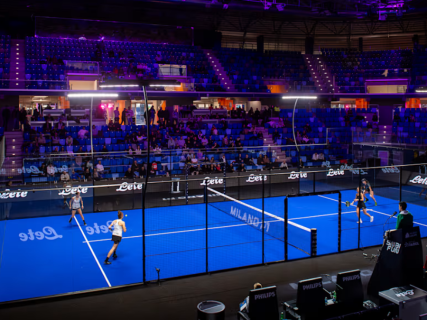

The professional padel has found a new way to grow its business: sports betting. Starting in 2027, all matches of the Qatar Airways Premier Padel Tour, both men's and women's, will be able to feed official betting markets through data recorded by referees and low-latency live broadcasts. Premier Padel has chosen iGame Media as the exclusive partner for the technology and distribution of these products, while Sportradar will take on the integrity monitoring of the market.
The operation means much more than placing a new option in a betting house. It means turning every match, every point, and every incident of the game into raw material for a market that will be able to operate practically in real time. The agreement will cover more than 2,400 matches of the 2027 season and will allow offering markets both before the match and during its development. That is, padel will not only be watchable: it will also be possible to bet on it while it is being played.
The FIP and Premier Padel present the decision as a commercial opportunity that must be developed under a regulated framework and with integrity controls. Sportradar will use its Universal Fraud Detection System (UFDS), a tool that analyzes international betting activity through artificial intelligence and experts to identify patterns that may point to possible match-fixing. The company claims that its system monitors more than a million matches in over 70 sports and works with hundreds of operators and betting platforms.
The question, however, starts right there: what happens when a sport that wants to grow decides to turn its matches into a betting product?
A new source of income for a circuit that wants to grow
From a business perspective, the move has an evident logic. Premier Padel needs to continue increasing its revenues, attract international audiences, and consolidate itself as a global competition. The organizations themselves argue that the new commercial agreements will allow reinvesting part of the revenues in professional sports, the players, the events, and the fan experience.
There can also be a positive effect on the audience. Betting can introduce new viewers to a sport that is still young compared to other major professional disciplines. The circuit itself is growing in attendance: the Paris Major gathered 81,000 spectators in September, compared to 64,000 the previous year, according to Premier Padel.
But there is a question that the commercial discourse leaves quite open: what part of that money will actually end up transforming into better conditions for the sport and its protagonists.
The FIP and Premier Padel talk about reinvesting the income generated by commercial partnerships, but the announcement does not detail how much money the agreement will generate, what percentage will be allocated to the circuit, what part will reach the players, or what specific investments will be financed with those new resources. It is also not specified that the income must be linked to specific improvements in infrastructure, prizes, working conditions, or player protection.
Neither the FIP nor Premier Padel specify how much money will be received and what percentage will be allocated to improving the circuit, either by investing in infrastructure or in labor improvements
Paddle tennis thus gains a new source of funding, but it is still unclear how this new revenue will translate into tangible improvements within the courts.
The problem is not just match-fixing
The main argument of the FIP to support the arrival of betting is precisely the risk that it can generate. And the organization seems to assume that the problem exists: it talks about match-fixing prevention, training for players, coaches, and referees, reporting mechanisms, and permanent market monitoring. It is also developing a specific channel to communicate possible integrity issues.
It is a necessary step. But it also reveals a paradox that is hard to avoid: the same ecosystem that generates a new commercial opportunity forces the reinforcement of mechanisms aimed at controlling its side effects.
The match-fixing is the most evident risk. The possibility of betting during the match multiplies the available markets and, with them, the number of events likely to generate bets. In the new model, operators will be able to use official data from referees and low-latency broadcasts to offer live markets. This increases the commercial appeal of the product, but it also makes any information that allows anticipating an event in the match more valuable.
And the problem does not have to be limited to deciding who wins or loses. The more detailed the market, the more events of the game can become the subject of a bet. The integrity challenge then lies in monitoring not only the final result but also anomalous patterns around the development of the match.
Sportradar will be precisely the one to monitor that market. Its system analyzes movements and betting patterns to detect suspicious behaviors and relay alerts to sports organizations.
But detecting an anomaly does not equate to preventing it. The system can generate an alert and initiate an investigation; it cannot replace prevention, player education, clear rules, or a structure capable of protecting those who may be under pressure.
Players more exposed
Here appears one of the points that occupies the least space in the announcement and raises the most questions: the position of the players.
Professional padel is not a homogeneous universe. There is an elite capable of generating large incomes and a much broader part of the circuit that finds itself in different economic positions. For the latter, the pressure that can accompany a betting market on their matches deserves special attention.
Sportradar itself includes among its prevention programs training on the personal, economic, and disciplinary consequences of match-fixing and fraud related to betting.
This is not a minor detail. When an economic market appears around an athlete that moves money on every point, every set, or every match, the value of the information that athlete possesses also increases and the temptation to try to influence them.
There enter threats, pressures, contacts through social networks or attempts to obtain privileged information. The problem may come from someone who wants to manipulate a meeting, but also from a community of bettors who personally hold the player responsible for having frustrated a bet.
The FIP assures that it wants to protect players, officials, competitions, and the entire padel community. But precisely for that reason, protection should be as visible a part of the agreement as the technology that will allow opening the market.
What audience does padel want to conquer?
The other debate is less technological and more uncomfortable. Premier Padel wants to become a global sport, increase its audience, and reach new fans. Betting can contribute to that. It is a route used for years by other sports to generate following, conversation, and audiovisual consumption. But gaining viewers through betting is not exactly the same as gaining fans of the sport.
A person can follow a match because they are interested in a couple, a rivalry, a competition, or the evolution of a player. They can also do it because they have bet on the outcome of a set. These are audiences that may coincide, but do not necessarily pursue the same thing.
Gaining viewers through betting is not exactly the same as gaining fans of the sport
And here arises the risk that audience growth is measured solely in volume and not in quality: more connected users, more bets, more markets, and more minutes of broadcasting do not automatically mean a stronger sports community.
The industry itself presents betting as an opportunity to make the product more attractive and offer a more immersive experience to fans. iGame Media, in fact, talks about pre-match and live markets, scoreboards, and specific content to bring bettors closer to players and competitions.
The open question is whether padel wants to attract that audience because it helps build a broader fan base or because it is a commercially profitable audience.
Padel will have to demonstrate that it controls the business it has just opened. The movement comes at a time of expansion for the sport. Premier Padel already has 26 events on its calendar and seeks to expand its international presence, while the FIP wants to consolidate an increasingly global professional structure.
The entry of betting fits perfectly into that strategy. It brings in money, generates new audiovisual products, can increase international exposure, and turns each match into a more sophisticated commercial asset. But it also changes the nature of the spectacle. Starting in 2027, an error, an injury, a serve, a golden point, or a comeback will not only be sporting events, but they may also have an economic market operating in real time behind them.
That is why the true success of this agreement should not be measured only by how much money it generates or by how many betting houses offer Premier Padel. It will also have to be measured by how much of that money returns to the sport, how players are protected, and what capacity the circuit has to detect and pursue irregularities before they become a threat to the competition.
Paddle has decided to open a new door. Now it will have to demonstrate that it knows who enters through it and, above all, that it does not let business dictate what makes the sport exist: that the result is decided on the court.