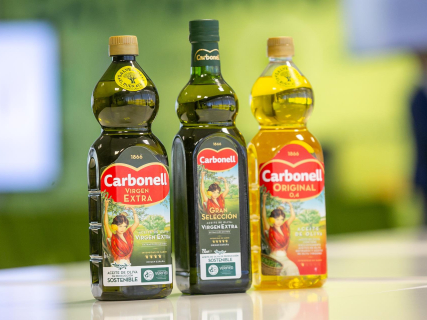

The Italian multinational Coricelli has decided to increase its purchase offer for Deoleo to 500 million euros, positioning itself above the offers presented by the Spanish companies Dcoop and Acesur, and has requested to have exclusivity in the negotiations until the operation is closed.
Specifically, the oil company of the Pietro Coricelli family reacted after KPMG, one of the advisors in the process along with William Blair, informed it a week ago of its exit from the contest to acquire the manufacturer of Carbonell and Bertolli. According to the Italian newspaper "Italia Oggi," reported by Europa Press, on August 15, during the 'ferragosto' in Italy, Coricelli made a counteroffer of 500 million euros, thus surpassing the 470 million euros from Dcoop and the 460 million from Acesur.
In addition to improving the financial amount and getting ahead of the proposals from the Spanish firms, Coricelli would have demanded to have "exclusivity in the negotiation" until the completion of the transaction, a point that could receive the green light throughout today, according to sources close to the process who spoke to Europa Press.
These same sources point out that the operation is being channeled directly through Farmers Elite Global, a Spanish holding company that acts as the parent company of the Italian family's business group.
This company, which all the group's subsidiaries depend on both in Spain and Italy (including Pietro Coricelli SPA) and in the United States, has its registered office in Seville since 2015.
Likewise, the consulted sources recalled that the presence of the Coricelli family in the Spanish business predates that date, as it also controls companies such as Aceites Abasa, located in Baena (Córdoba), acquired in the early 2000s.
The sale process of the owner of brands such as Koipe and Carbonell has accelerated in recent weeks and is expected to conclude in September. The funds CVC and Alchemy, holders of 50.9% and 40.3%, respectively, of Deoleo, communicated to the National Securities Market Commission (CNMV) that they are evaluating different strategic alternatives regarding their investment, among which includes the "possible total or partial sale" of "part of their assets and businesses."
Deoleo clarified that, as of August 19, "no definitive decision had been made" and emphasized that he was unaware if the process, "currently underway," would lead to a "concrete operation or, if applicable, the terms under which this could take place."
The announcement of buyer interest has strongly boosted the shares of the Spanish olive oil multinational: last Wednesday, its shares rose by up to 25.14%. However, this Friday, after 2:30 PM, they recorded declines of up to 2.92%, placing the share price at 0.466 euros.
A key sector for the Spanish economy
In this context, CCOO has demanded that the future buyer of Deoleo guarantees stable and quality employment, as well as the maintenance of the industrial fabric in the community. The union advocates for national capital projects and rejects the entry of funds or competitors that could compromise the reputation of olive oil and job security.
The general secretary of CCOO Industry of Andalusia, José Hurtado Quirós, has urged the Administration to activate the regulations on foreign investments in order to protect the productive capacity of the olive oil sector against speculative funds, recalling the precedent of Talgo, when the Government halted the takeover bid from the Hungarian group Ganz-MaVag (Magyar Vagon) on the Spanish company.
For its part, sources from Dcoop consulted by Europa Press have requested that the final buyer be "aligned with quality and the fight against fraud," while admitting that "it would be bad for Spain to lose leadership in such a strategic sector."
The mayor of Córdoba, José María Bellido, has valued, regarding the potential purchase of Deoleo by Dcoop, that "if it can stay in the land, all the better," and added that he "thinks it is good, obviously, because it is a cooperative from the land" and it is a "giant in the sector."
In this line, Bellido has emphasized that "behind a large cooperative and that company, there are many small producers who are the ones who later provide their product to those companies or cooperatives." "Many families live off the work provided by those small producers, so we have a lot at stake and obviously we will be there to help," he concluded.