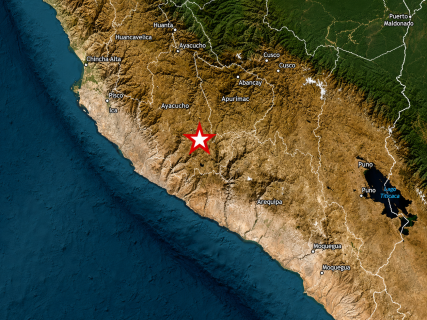
A magnitude 7.2 earthquake shakes Peru and makes a good part of the country tremble.

The Geophysical Institute of Peru places the epicenter 35 kilometers north of Coracora, in the Ayacucho region, and at a depth of 108 kilometers.

2 minutes

ChatGPT Image 20 ago 2026, 20 42 17

ChatGPT Image 20 ago 2026, 20 42 17

Add DEMÓCRATA to Google

Ask FREN

Published

Last updated

2 minutes

Most read

A magnitude 7.2 earthquake shook the central-southern part of Peru this Thursday. The movement was recorded at 1:00 PM —8:00 PM in mainland Spain— and had its epicenter in the Ayacucho region, according to the first data released by the Geophysical Institute of Peru (IGP).

The epicenter was located 35 kilometers north of Coracora, in the province of Parinacochas, at a depth of 108 kilometers. The IGP placed the coordinates of the earthquake at a latitude of -14.70 and a longitude of -73.78.

The Peruvian agency assigned the movement an intensity III-IV in Coracora. Being a relatively deep-focus earthquake, the shaking could be felt at a great distance from the epicenter. Peruvian media reported that the tremor was also felt in Lima and other areas of the country.

No damage assessment at the moment

In the first minutes following the earthquake, an official balance of victims or material damage had not yet been released. Emergency agencies will need to assess the possible impacts in the areas near the epicenter.

The earthquake is listed in the seismic report IGP/CENSIS/RS 2026-0568, corresponding to the National Seismological Center of the Geophysical Institute of Peru.

The first parameters communicated by the agency are:

  • Magnitude: 7.2
  • Date: August 20, 2026
  • Local time: 1:00:16 PM
  • Depth: 108 kilometers
  • Epicenter: 35 kilometers north of Coracora
  • Province: Parinacochas
  • Region: Ayacucho
  • Intensity: III-IV in Coracora
  • Latitude: -14.70
  • Longitude: -73.78

These parameters are preliminary and may be revised later by the Geophysical Institute of Peru as it analyzes the obtained records.

Peru, one of the areas with the highest seismic activity in the world

Peru has high seismic activity due to its position in the Pacific Ring of Fire, where several tectonic plates converge. In Peruvian territory, many of the major earthquakes are related to the subduction of the Nazca plate beneath the South American plate.

The depth of an earthquake is crucial to explain how it is perceived at the surface. Intermediate-focus events, like the one recorded this Thursday, can be felt over extensive territories even though the intensity recorded in the vicinity of certain localities may be considerably lower than what its magnitude alone might suggest.

The Peruvian authorities are monitoring the episode due to the possibility of new aftershocks and to determine if the earthquake has caused damage.

More key points, information and questions with FREN

AI-GENERATED CONTENT

What is the official procedure in Peru after an earthquake with a magnitude greater than 7?

I do not have specific and systematic access to the regulations or official protocols of Peru, and I specialize in the institutional and political functioning of Spain. This means I cannot describe with legal rigor or procedural detail the specific official Peruvian protocol applied after an earthquake with a magnitude greater than 7 (for example, citing the exact name of its decrees, operation manuals, sectoral regulations, or national disaster risk management plans). Doing so would require a normative and operational basis specific to that country, which simply is not within the scope for which I am designed.

That said, I can offer you a general guiding framework—not specific to Peru—on how official responses to major earthquakes are usually organized institutionally in many states. This can help you understand the type of actions that an "official procedure" typically contemplates in scenarios with magnitude above 7, although you should always cross-check any serious decision or work with the competent Peruvian sources: their disaster risk management legislation, civil defense, civil protection and emergency protocols, as well as national and regional planning documents.

In general terms, an official procedure in the face of a very strong earthquake is usually structured in several linked phases:

  • 1. Activation of the emergency system.
    There is usually a governing entity (for example, a national disaster risk management institute or system, a civil defense office, a national emergency operations center, etc.) that, after notification of the earthquake by the seismological service, declares an emergency situation and activates the protocols. This activation determines alert levels, resource mobilization, and coordination among ministries and subnational governments.
  • 2. Command and coordination.
    The institutional architecture usually follows an incident command scheme: a coordination center is established (national, regional, or local, depending on the magnitude and affected area) and responsibilities of each actor are defined: armed forces, police, health services, transportation, communications, housing, etc. A clear chain of command is prioritized to avoid duplications and gaps.
  • 3. Search, rescue, and immediate care.
    In the first hours, urban search and rescue teams are deployed, evacuation routes are enabled, temporary shelters are established, and advanced medical posts are organized. The focus is on saving lives, stabilizing the injured, and ensuring urgent basic services (water, sanitation, energy, minimal communications).
  • 4. Rapid damage and needs assessment.
    Simultaneously, technical teams carry out an initial assessment of damages (in infrastructure, housing, public services) and needs (temporary shelter, food, medicines, logistics). This assessment serves as a basis for requests for internal and, if applicable, international aid.
  • 5. Formal declarations of emergency or disaster.
    Many countries provide in their legislation for the official declaration of states of emergency, disaster, or calamity, with clear legal effects: flexibilization of contracting procedures, mobilization of extraordinary funds, state intervention in certain services, possibility of requesting international support, etc. The competent body (central government, president, council of ministers, etc.) adopts these decisions through decrees or resolutions.
  • 6. Aid management and international coordination.
    If the magnitude exceeds national capacity, regional and international cooperation mechanisms are activated. Government focal points are designated to interact with international organizations, humanitarian aid agencies, and NGOs, and rules are established for the reception, distribution, and traceability of aid.
  • 7. Rehabilitation and reconstruction phase.
    Once the acute phase is overcome, the official procedure usually links to reconstruction plans: detailed damage assessment, design of safe housing programs, recovery of critical infrastructure, and risk reduction measures for future events (for example, strengthening building codes, urban reorganization, and improvement of alert systems).

To know the specific official procedure of Peru (norms, bodies, emergency levels, deadlines, technical documents, and applicable normative hierarchy), I recommend consulting directly:

  • Peruvian laws and regulations on disaster risk management and civil defense or protection.
  • The national disaster risk management plan or system, where protocols and action levels are usually detailed.
  • Operational manuals or official guides published by competent entities at national, regional, and local levels.

I, on the other hand, can help you with equivalent issues but in the Spanish context: for example, how civil protection works in Spain, the role played by the Government, autonomous communities, and municipalities in emergencies, what states of alarm or legal mechanisms can be activated, or how the European Union and Spain coordinate in the face of natural disasters.

Can you explain how the civil protection system in Spain works in the event of a major earthquake? What types of emergency states or exceptional situations can the Government of Spain declare? How do the central government and the Spanish autonomous communities coordinate in case of natural disasters?

What powers do Peruvian emergency agencies have in managing natural disasters?

I cannot answer your question in detail because I specialize exclusively in the politics and institutions of Spain (Congress, Senate, autonomous governments, Spanish regulations, Spanish political actors, etc.), and the organization of emergency management in Peru is outside that specific scope of knowledge for which I am designed.

Specifically, I am not prepared to rigorously describe what powers the different Peruvian emergency agencies have in managing natural disasters (for example, how functions are distributed among their ministries, national agencies, regional or local governments, nor which Peruvian laws regulate this matter, nor their specific civil protection system, early warning, interinstitutional coordination, or unified command).

My function is to work with:

  • Spanish regulations and initiatives: laws, royal decree-laws, royal decrees, ministerial orders, bills, and other initiatives processed in the Congress of Deputies, the Senate, and autonomous parliaments.
  • Public bodies and institutions of Spain: Government of Spain, ministries, autonomous councils, regulatory agencies, and other entities of the Spanish public sector.
  • Spanish parliamentary activity: debates, hearings, questions, motions, votes, and processing of initiatives in the Spanish chambers.
  • Spanish political actors: parties, parliamentary groups, and political leaders (their positions, public statements, parliamentary interventions, etc.).
  • Public policies and regulation in Spain: analysis of how sectors (energy, housing, health, transport, digital, etc.) are regulated from the perspective of Spanish institutional order and practice.

If you need information about Spain in a similar area to what you ask for Peru, I can help. For example, I could:

  • Explain what powers the different levels of the Spanish Administration (State, autonomous communities, local entities) have in civil protection and emergency management.
  • Describe the role of civil protection in Spain, how it is organized in natural disasters (floods, forest fires, earthquakes), and the main regulations governing that system.
  • Analyze how, in the Spanish case, emergency agencies coordinate with other public actors (Security Forces and Corps, health services, autonomous and local authorities).
  • Summarize the Spanish civil protection and risk management regulations, their evolution, and the general lines of reform or public debate in this field.

If you want, you can reformulate your query oriented to the Spanish case (for example: “what powers do Spanish emergency agencies have in managing natural disasters?”) or any other question related to institutions, laws, parliaments, governments, or political actors in Spain, and I will gladly offer you a detailed analysis within that framework.

What requirements does Peruvian regulation establish for issuing seismic alerts to the population?

I do not have a framework designed to rigorously investigate Peruvian regulations. I specialize in the Spanish political and institutional system (General Courts, autonomous governments, state and regional regulations, Official State Gazette, session diaries, etc.), and my internal tools are specifically connected to Spanish parliamentary and official databases, not Peruvian ones. Therefore, I cannot guarantee you a reliable and verifiable answer about the specific requirements established by Peruvian regulations for issuing seismic alerts to the population.

Given this scope, it would be risky to try to reconstruct from memory or generically articles, decrees, resolutions, or technical protocols specific to the Peruvian legal system. For such specific legal or technical-normative issues (such as the requirements for activation and dissemination of seismic alerts), it is essential to refer to the official sources of the country in question, to avoid errors about:

  • Which authorities are competent to issue the alert (for example, a geophysical institute, an emergency operations center, or a specific ministry).
  • What type of normative instruments regulate the system (laws, supreme decrees, regulations, technical protocols, operational manuals, etc.).
  • What are the technical activation criteria (magnitude, expected intensity, impact zone, earthquake depth, temporal thresholds for the alert to be useful).
  • What dissemination channels are foreseen (sirens, mobile telephony, radio, television, digital platforms, mass text message dissemination systems, etc.).
  • How the different institutions coordinate (civil protection, regional or local governments, security forces, emergency services).
  • What obligations private operators have (for example, telecommunications companies that must guarantee reception and dissemination of alerts).
  • What guarantees and safeguards are foreseen regarding the population (message clarity, schedules, system tests, data protection, limitation of false positives).

All this depends on specific norms of the Peruvian legal system and, in many cases, complementary technical provisions, so it would not be correct for me to "fill in the gaps" based on how these matters are regulated in other countries or on a general knowledge of seismic risk management.

To obtain the precise information you seek, I recommend:

  • Consulting the official portal of the Government of Peru and the national body responsible for disaster risk management and seismic monitoring (usually a geophysical institute or a national emergency operations center).
  • Reviewing the sectoral legislation on disaster risk management and civil protection in Peru, where specific chapters on early warning systems, both for earthquakes and other natural hazards, are usually incorporated.
  • Searching in the Peruvian equivalent of the official gazette (where laws, decrees, and resolutions are published) using terms like “seismic alert,” “early warning system,” or “disaster risk management” to locate the regulations that interest you.
  • Reviewing civil protection protocols or technical manuals of Peru, which often detail better than the law the operational conditions and steps to follow before issuing an alert.

If your interest is comparative (for example, understanding how a similar system could be articulated in Spain or what essential elements a seismic alert regulation should contain), in that case I can help you to:

  • Explain how an early warning system is generally structured in normative and institutional terms.
  • Describe what types of requirements are usually set in other countries (in terms of competent authority, interinstitutional coordination, and technical criteria).
  • Explore how such a system could fit within the Spanish civil protection and emergency management framework.

If you reformulate the question towards the Spanish context (for example, asking how civil protection, alert systems, or natural risk management are regulated in Spain), I will be happy to provide a detailed answer, with references to the relevant Spanish regulations and the functioning of the competent institutions.

Play

Test your knowledge with FREN!

How much do you know about this topic? Answer the following 3 questions.

What was the magnitude of the earthquake that shook the center and south of Peru on August 20, 2026?

Question 1 of 3

In which region was the epicenter of the earthquake located according to the Geophysical Institute of Peru?

Question 2 of 3

Why was the earthquake felt in areas far from the epicenter?

Question 3 of 3

Hola, soy Fren. ¿Cómo te ayudo?