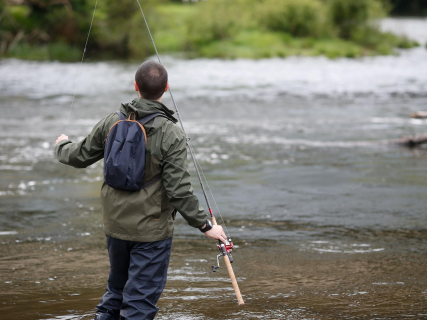

Ecologists in Action has expressed its surprise and rejection after learning that the Government of Cantabria has decided to maintain a catch quota of 20 salmon for the 2027 fishing campaign.
"The salmon in Cantabria is swimming towards extinction," the organization has denounced, which assumed that in 2027 a total ban would be implemented, following the line of the rest of the autonomous communities.
In a public statement, the NGO has pointed out that from the regional Executive "they can no longer pretend to be deaf and blind to the overwhelming reality of the unanimous scientific conclusions and the continuous reduction of populations in recent years."
As the group has reproached, "The Government of Cantabria has been left alone maintaining the fishery and continues to move in fiction as it manages resources that no longer exist, such as the quota of 70 specimens from the year 2025, when 8 were caught, or the quota of 38 specimens from the year 2026, when 3 were caught."
The NGO emphasizes that the regional Executive has also "been left alone" by "ignoring the solid conclusions of national and international scientific bodies that study the situation of the Atlantic salmon, which recommend a total ban, just like the Scientific Committee designated by the Ministry of Ecological Transition; this administration remains as the last hope for the species if it is finally included in the Spanish Catalog of Threatened Species and in the LESPRE."
Regarding the causes of the decline of the salmon, the organization indicates that it is essential to act "urgently" on the blockage of rivers by dams and weirs, many of which are already unused, which is why it calls on the Hydrographic Confederation to accelerate their demolition or the proper permeability of the still operational infrastructures.
In addition, the environmental entity considers priorities the "necessary" respect for ecological flows during drought periods, the elimination of polluting discharges, the forest restoration of the banks, the reinforcement of fry release programs, and the implementation of a total ban.
The NGO recalls that "With the decline of the species, already noted since the mid-20th century and not taking the necessary measures at the time, it makes evident that there are decades of responsible and coordinated work ahead for all administrations to try to recover the populations, and that is what they should be doing," and emphasizes that "ignoring reality will only prolong the agony of the Atlantic salmon, not to mention that the European eel is in the same situation and for the same reasons."
"If urgent measures that are well known are not taken, we will witness the loss of two of the most emblematic species of the natural heritage of Cantabria," the environmental organization has warned.