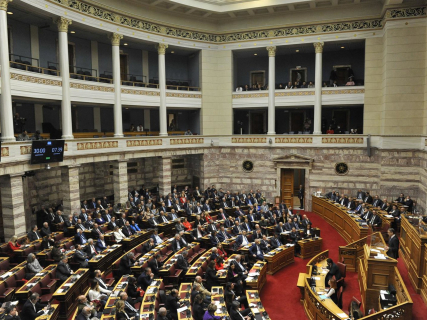

The Greek Parliament has given its final approval this Thursday to a bill that will prevent minors under 15 years old from accessing social media services starting January 1, 2027, after passing the second reading in the competent committees with majority support from the groups.
New Democracy, the party in government, has been the only party that has supported the text both in the preparatory phase and in the final vote. The Communist Party of Greece (KKE, for its initials in Greek) and Plefsi Eleftherias opposed it from the beginning of the process, and in the final session, they were joined in rejection by Hellenic Solution, SYRIZA (Coalition of the Radical Left), and Niki (Patriotic Democratic Movement), which had reserved their position until this moment. PASOK (Panhellenic Socialist Movement) also waited for the final debate to clarify its position and ultimately chose abstention.
The main clash between the Executive and the opposition parties has focused on the age verification mechanism and the guarantees for the protection of personal data, the responsibility for which will rest with the digital platforms themselves, according to the ANA agency. The opposing parties have denounced that these are general and partial measures, without sufficient scientific backing, and have criticized that they are approved before the European regulations on the matter are released.
The Minister of State, Akis Skertsos, has defended that the new regulation is "necessary, effective, compatible with community law, and proportionate," and has accused the opposition of maintaining a "superficial, sterile, and irresponsible" attitude during the processing. He has also rejected PASOK's criticisms, which argue that the Executive would be using the protection of minors for electoral and communication purposes.
"We have been legislating since 2019 with a single criterion: the protection of public health and safety and, even more, the protection of vulnerable people," Skertsos responded, in statements collected by the same media. In this context, the minister has recalled other measures of the Government aimed at safeguarding the child population, such as restrictions on tobacco and alcohol consumption, and has reproached the opposition for not supporting at that time the provisions aimed at reinforcing their compliance.
On the other hand, the Greek Minister of Digital Governance, Dimitris Papastergiou, has emphasized the urgency of intervening in what he considers a growing social problem and has focused on the application 'Kids Wallet', created to interoperate with the platforms and verify if a user has reached 15 years of age.
According to Papastergiou, the tool respects privacy because "it does not monitor any page or any message" and does not transmit personal data, including the date of birth, limiting itself to confirming whether the user is older or younger than the set age. The minister has stressed that it is essential to move towards an agreement at the European level.
The head of Digital Governance has also cited the conclusions of the European Commission regarding the possibility of setting a minimum age for access to social networks and developing a common digital solution to verify it. According to his words, the technical design is already ready for deployment and Greece is participating in this project along with Cyprus, France, Ireland, Italy, Spain, and Denmark.