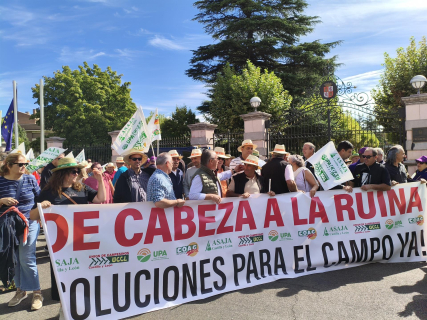

More than half a thousand farmers have gathered this Thursday in front of the headquarters of the Presidency of the Junta de Castilla y León to demand from the regional government a package of specific aid for the agricultural sector, which they consider to be in "bankruptcy" and "ruin" after a poor cereal campaign that leaves the sowing of the 2026-2027 campaign up in the air.
Supported by representatives of cooperatives and companies linked to the field, the attendees filled the Plaza de Castilla y León behind a large banner with the slogan "Headfirst into ruin! Solutions for the field now!" and with posters against the Mercosur agreement or denouncing that while in 2020 farmers and ranchers were "heroes," since 2024 they are treated as "criminals" for going out to demand "dignified" conditions.
With hats and flags from the various calling agricultural organizations (Asaja, Unión de Campesinos, UPA, and COAG), the protesters set off firecrackers and lit fireworks, all in front of a large police presence that monitored the protest.
In this context, the president of Asaja Castilla y León, Donaciano Dujo, emphasized that this is the fourth mobilization of the year in a "very serious" scenario for cereal in the Community, with a very weak harvest, costs that have "shot up" above 800 euros per hectare in dryland, stagnant prices at origin around 200 euros per ton, and an average yield of 3,100 kilos per hectare.
The final balance of the campaign stands, according to Dujo, at 4.9 million tons, 40 percent less than the previous year, with losses estimated at 300 million euros. In light of this situation, he warned that the field "can’t take it anymore" and lacks the "economic capacity" to face the sowing of 26-27."
"We are in a situation of bankruptcy, of discouragement, in a situation where we do not understand that what has always been a thriving sector, with professionalism, with production, today, due to the extremely high costs, due to wars, due to bad European and government policies, we are in ruin," he pointed out.
The leader of Asaja has emphasized that it is unfeasible to risk 160,000 euros in the next planting without clear support from the administrations. He has recalled that the central Government has approved aid that they consider "insufficient," but that will allow mobilizing 150 million for the cereal of Castilla and León, and has demanded that the Junta contribute a similar amount and "under similar conditions."
Direct claim to Mañueco and demand for equivalent aid
Donaciano Dujo has expressly addressed the regional president, Alfonso Fernández Mañueco, who committed "without fissures" to the countryside, to support a sector that generates wealth in the rural environment and which, he said, "must be saved from this bump."
In similar terms, the coordinator of UCCL, Jesús Manuel González Palacín, has warned that facing the next campaign with the current situation is "practically impossible," which is why he has demanded from the Junta a level of involvement comparable to that of the Ministry through direct aid.
"Any other formula is not valid for us," González Palacín has pointed out, who believes that only with that type of support can a "more or less calm" campaign be faced, since, if not, the main economic sector of Castilla and León would be left "at the feet of the horses," on which "many people" depend, including transforming companies and the agro-industry.
Although he qualifies the situation as punctual, the head of UCCL has stressed the urgency of substantial measures, such as agricultural insurance that covers 4,000 kilos per hectare, a "safety net" that he considers essential to guarantee the viability of the farms.
In addition, González Palacín has requested a Common Agricultural Policy (CAP) focused on farmers as the main title, a regulation to curb the speculation of oil companies and prevent abuses in fuels, and the revision of international trade agreements that, in his opinion, cause Spanish cereal to be the last to be sold.
COAG demands a specific budget and a halt to imports
The coordinator of COAG Castilla y León and member of the UPA-COAG Alliance, Lorenzo Rivera, has reminded that the organizations already warned two years ago, in a meeting with the president of the Junta, about the delicate situation of cereal. At that time, he explained, they were told it was "free market" and that there were no "possibilities," but later the war conflicts and the international context have skyrocketed costs and imports, worsening the ruin of the producers.
"People reach a limit where there are no money reserves to face new sowings, there is also no credit capacity and above all patience runs out," Rivera has warned, who has insisted that cereal is a strategic sector and an economic engine. If it is allowed to fall, he has alerted, it can be reduced to something "residual," as happened with sugar beet, a scenario they do not want to repeat. "There are two million hectares that we have of cereal production capacity, and also a cereal that is needed in this country," he added.
The person in charge of COAG has reiterated his demand to Mañueco to enable a "special budget" for a sector in "critical" situation and has asked that the aids, just like the state ones, be aimed at compensating the extra cost of fertilizers and diesel, reminding that the Community "charges 28 percent of the percentage of gasoline and diesel taxes for that, like all autonomous communities," and that "it has an obligation to behave and to put money on the table to save this sector."
Rivera has also focused on the imports of cereal from Ukraine, which he has assured are mostly in the hands of large investment funds, and has urged to activate the safeguard clauses of the European Union to limit their impact on local producers.
UPA warns of the abandonment of the countryside and demands compliance with the chain law
The general secretary of UPA in Castilla y León, Aurelio González, has reminded that they already requested support from the Junta to overcome the current crisis and to be able to face the next sowing, which he has described as "fundamental," because now "the accounts do not add up" and, when this is repeated for several years, it ends up being "abandoned."
"We cannot afford to leave a large part of the territory of Castilla y León lost that in the end may become fodder for the flames," warned González, who has called for aid directed primarily to farmers and to family farms, those that keep the towns "open".
Along with direct aid, he has demanded that the food chain law be enforced, since, despite there being a specific direction and a defender, no action or sanction is known, despite complaints having been filed.
González has assured that farmers know "how to do the math" and calculate their losses and has criticized that the "graduates who are in the Junta" do not do so, who, he said, wait for the producers themselves to report and "confront" the companies that buy from them. Therefore, he has requested that "not a single euro of aid" be granted to industries that violate the food chain law.
"We have to clearly save food sovereignty and that is our job, to produce food and it is the work we have inherited from our parents, from our grandparents and we have to maintain it because we have to sustain the rural environment and the future for our children, for that we have to be on the street," he concluded.