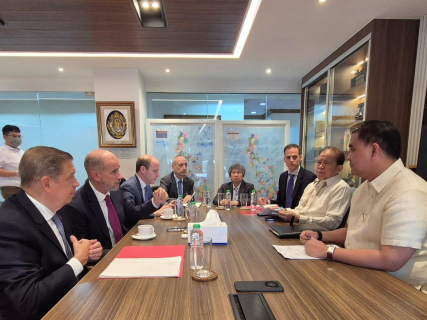

The Minister of Agriculture, Fisheries and Food, Luis Planas, held a working meeting in Manila with his Filipino counterpart, the Secretary of Agriculture, Francisco P. Tiu Laurel, Jr., with the intention of strengthening cooperation between Spain and the Philippines in the agricultural and fishing sectors.
During the meeting, Planas expressed his gratitude for the support of the Filipino government to reactivate purchases of Spanish pork —Spain is the second supplier of pork meat to the country, only behind Brazil— since May 22, once regionalization against African swine fever (ASF) was effectively applied.
This understanding has allowed Spain to resume shipments of pork products from areas declared free of the disease, thus reopening a key market for the sector.
The return to normalcy in this destination is particularly significant for the Spanish pork industry, as it is the third market in volume, accounting for 14% of its total exports. Spain has been authorized to export pork to the Philippines since 2013 and in 2025 had 175 authorized facilities to operate.
In 2025, Spanish sales of pork to the Philippines totaled 86.78 million euros, making it the third most exported agri-food product to this country, only behind spirits, liquors, and alcoholic beverages and offal.
Throughout the meeting, the two ministers reviewed options to expand bilateral collaboration in agriculture, livestock, fishing, and food, focusing on joint opportunities for modernization, digitalization, and increasing productivity in the agri-food system. They also addressed the need to adapt production to the impacts of climate change and natural disasters.
The agri-food trade between both countries shows a positive balance for Spain of 318.48 million euros. In 2025, Spanish exports in the sector to the Philippines reached 577.07 million euros, compared to imports of 258.59 million euros.
Gastronomy as a driver of foreign promotion
In addition, Luis Planas' agenda in Manila has included the presentation of the Group of Spanish Chefs in the Philippines, a project promoted by the Embassy of Spain and the Official Spanish Chamber of Commerce, Industry and Navigation in the Philippines. This initiative has brought together chefs and representatives of Spanish catering in the country, along with distributors and importers of food products from Spain, in addition to the Official Spanish Chamber of Commerce, Industry and Navigation in the Philippines itself.
The minister has highlighted the contribution of chefs and catering professionals as ambassadors of Spanish products and gastronomic culture abroad, and has emphasized gastronomy "as a sector that connects the countryside and the sea with the food industry, distribution, catering, and tourism."
In this context, he has underscored the relevance of the International Plan for Spanish Gastronomy, whose objective is to strengthen the international projection of Spanish cuisine and consolidate its role as a cultural, economic, and social engine. This plan is part of the National Food Strategy and has been designed through a participatory process in which various agents of the agri-food and gastronomic ecosystem have participated.