Concentrations in Ceuta today, September 2: map, schedules, and where Feijóo and Abascal will be.

More than 260 municipalities join the support day for the autonomous city, with two differentiated calls in Madrid and different events in several capitals.

4 minutes

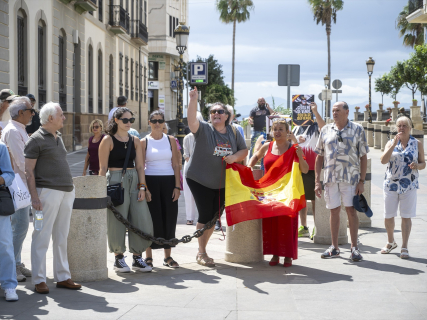
EuropaPress 7734648 varias personas portan bandera espana mientras manifiestan ayuntamiento 27

EuropaPress 7734648 varias personas portan bandera espana mientras manifiestan ayuntamiento 27

Add DEMÓCRATA to Google

Ask FREN

Published

Last updated

4 minutes

Most read

The concentrations in support of Ceuta are held this Wednesday, September 2, Ceuta Day, in hundreds of Spanish municipalities. The day, initially driven by a citizen initiative and later supported by the Spanish Federation of Municipalities and Provinces (FEMP) and various city councils, has a general reference time of 20:00 hours on the Peninsula and 19:00 hours in the Canary Islands and Ceuta.

More than 260 municipalities had officially supported the mobilizations until the end of August. The call is not, however, identical in all cities: there are institutional acts, citizen concentrations, and calls promoted by parties or associations. Madrid will have special prominence due to the presence of Alberto Núñez Feijóo and Santiago Abascal, who will coincide in the Plaza de Cibeles.

Map of the concentrations for Ceuta on September 2

These are some of the main calls with confirmed time and place. When there are different acts in the same city, they appear separately to avoid confusion.

City Time Place Organizer / type Situation
Madrid 20:00 Congress of Deputies Citizen call "For Ceuta" Confirmed
Madrid 20:00 Plaza de Cibeles City Council of Madrid / FEMP Confirmed
Barcelona 20:00 Plaça de Sant Jaume PP Barcelona and political call Confirmed for this organizer
Barcelona 20:00 Plaça de Catalunya Sections of the citizen call Differentiated call
Ceuta 19:00 Royal Walls → Plaza de los Reyes FPAV and Forum Ceuta 21st Century Confirmed
Sevilla 20:00 Plaza Nueva City Council / FEMP Confirmed
Málaga 20:00 City Hall Door, Avenida de Cervantes 4 City Council Confirmed
Córdoba 20:00 City Council, calle Capitulares City Council / FEMP Confirmed
Huelva 20:00 City Hall Door City Council / FEMP Confirmed
Jaén 20:00 Plaza de las Batallas Citizen call Confirmed as an independent act
València 20:00 City Hall Square City Council / FEMP Confirmed
Zaragoza 20:00 Plaza del Pilar City Council Confirmed
Guadalajara 20:00 Plaza Mayor City Council Confirmed
A Coruña 20:00 Plaza de María Pita Municipal call Confirmed
Las Palmas de Gran Canaria 19:00 Plaza de Santa Ana Local call Confirmed
Telde 19:00 Plaza de San Juan Local call Confirmed
Puerto del Rosario 19:00 Next to the City Hall Local call Confirmed
Santa Cruz de Tenerife 19:00 In front of the City Hall Institutional call Confirmed

Madrid concentrates the political focus: Feijóo and Abascal will be in Cibeles

Madrid is the city that presents the greatest particularity. At 8:00 PM, two calls coincide: the citizen initiative "Por Ceuta", in front of the Congress of Deputies, and the event in the Plaza de Cibeles linked to the call of the FEMP and the City Council of Madrid.

The call of Cibeles was surrounded by controversy during the hours prior. The Government Delegation in Madrid finally stated that it had not prohibited the concentrations and indicated that the events could take place normally, although it raised that the municipalities do not have the competence to call demonstrations as an institution. 

Apart from that administrative controversy, Alberto Núñez Feijóo and Santiago Abascal are expected to attend Cibeles along with representatives of their respective parties. The coincidence of the leaders of the PP and Vox turns this point into one of the main political focuses of the day.

In addition to the capital, several municipalities in the Community of Madrid have joined the mobilizations, including Alcalá de Henares, Alcobendas, Boadilla del Monte, Las Rozas, Majadahonda, Pozuelo de Alarcón, San Sebastián de los Reyes, Tres Cantos, Leganés, Móstoles, Pinto, and Aranjuez.

Barcelona maintains two differentiated calls

Barcelona also has more than one meeting point. The PP of Barcelona is holding an event at 8:00 PM in the Plaça de Sant Jaume, in front of the City Hall, while sectors of the citizen call place their concentration in the Plaça de Catalunya.

The two events coincide in timing, but do not have the same organizer. Therefore, those who wish to attend must check beforehand which concentration they want to follow and who organizes it.

Ceuta celebrates its own demonstration

The autonomous city is the central stage of the day. The Provincial Federation of Neighborhood Associations and Forum Ceuta Siglo XXI unified their calls and proposed a single mobilization starting at 7:00 PM from the Royal Walls.

The information published about the route presents a difference in the final point. The call recorded in the piece maintains the arrival at the Plaza de los Reyes, while information disseminated by the neighborhood organization and local media places the end at the Plaza de África. Therefore, the route starting from the Royal Walls is confirmed, but the exact finishing point must be checked with the organization before the march.

In any case, the mobilization will be a march and not a static concentration. In Ceuta, in addition, the urban bus service has been announced as free from 5:30 PM to facilitate the movements of the participants.

Andalusia gathers numerous concentrations

In Andalusia, Seville celebrates its concentration at 8:00 PM in Plaza Nueva, while Málaga maintains the event in front of the City Hall, at Avenida de Cervantes 4. Córdoba has set the meeting point in front of the City Hall, on Calle Capitulares, and Huelva will do the same in front of its city hall.

Jaén presents a difference regarding those institutional calls: it maintains an independent citizen event in Plaza de las Batallas at 8:00 PM.

Canary Islands moves the concentrations to 7:00 PM

In the Canary Islands, the main mobilizations begin at 7:00 PM, one hour earlier than the mainland calls. Las Palmas de Gran Canaria has the meeting point in Plaza de Santa Ana; Telde, in Plaza de San Juan; Puerto del Rosario, next to the City Hall, and Santa Cruz de Tenerife, in front of the City Hall.

More key points, information and questions with FREN

AI-GENERATED CONTENT

What is the process for a citizen call to obtain institutional support from the FEMP?

The FEMP (Spanish Federation of Municipalities and Provinces) does not have a "regulated procedure" in the strict sense to support citizen calls, but it does follow fairly stable practices: initiatives come driven by platforms or NGOs, are channeled through member municipalities, and are translated, if applicable, into agreements of FEMP internal bodies (Governing Board, Territorial Council, or commissions). What follows describes the typical path and the limits to keep in mind.

1. Prepare the citizen initiative
  • Clearly define the objective: the FEMP represents local entities, so the call must have a clear connection with municipal or provincial competences (local public services, social inclusion, urban sustainability, participation, equality, etc.).
  • Proposal document: a brief text (3-5 pages) is usually recommended, including:
    • Diagnosis of the problem.
    • Objectives of the call (campaign, event, declaration, network of municipalities, etc.).
    • Type of support requested from the FEMP (symbolic adhesion, dissemination among municipalities, preparation of recommendations, promotion of a network of cities, etc.).
    • Who promotes the initiative (entities, neighborhood platforms, NGOs...).
  • Endorsements and support: having endorsements from neighborhood associations, sectoral organizations, or existing networks strengthens the request.
2. Channel the request through member municipalities
  • Contact municipal governments: the most effective channel is usually not to address the FEMP directly in the abstract, but first to obtain the support of one or more significant municipalities (large cities or provincial capitals, but also municipalities especially involved in the issue).
  • Plenary or Local Governing Board agreement: many councils, when they take on a citizen initiative, bring it to their plenary or governing board and approve a motion or institutional declaration in which:
    • The citizen call is supported.
    • The FEMP is urged to back it and disseminate it among its members.
  • Forwarding to the FEMP: the municipality itself, through its mayor's office or institutional relations councilor, sends the motion and the initiative dossier to the FEMP (presidency, general secretariat, or the competent sectoral commission).
3. Internal processing at the FEMP
  • Technical services: the proposal is usually analyzed by the FEMP's technical and legal team, which assesses:
    • Fit with the federation's purposes.
    • Consistency with previous positions.
    • Absence of conflict with current regulations or with state/autonomous competences.
  • Working commissions: if the matter fits within a sectoral commission (for example, Social Services and Migration, Environment, Equality), it is common for the issue to be taken there first, for a report or agreement proposal.
  • Governing Board: it is the key executive body of the FEMP. It can:
    • Approve a statement of support for the citizen call.
    • Recommend municipalities to join or participate.
    • Incorporate the initiative into a FEMP campaign.
  • Territorial Council: when the issue has a broad territorial dimension or requires a more weighty political position, the matter can be elevated to the Territorial Council for more representative support of municipal and provincial diversity.
4. Forms of institutional support from the FEMP
  • Declarations or resolutions: text approved by the Governing Board, Territorial Council, or commissions, expressing the FEMP's support for the call and encouraging municipalities to join.
  • Dissemination: sending circulars to member municipalities, publication on the website, inclusion in newsletters or training sessions.
  • Adhesion as a collaborating entity: in some cases, the FEMP appears as a member of the organizing committee, collaborating entity, or institutional sponsor.
  • Promotion of networks or programs: if the initiative fits with FEMP's strategic lines, it can materialize in thematic city networks (for example, against gender violence, for childhood, climate, etc.).
5. Legal and political limits
  • Respect for the competence framework: the FEMP cannot assume commitments that correspond to the State or autonomous communities, nor promote actions that exceed local competences.
  • Basic institutional neutrality: support for partisan, electoral, or clearly opposed calls to the federation's internal plurality is avoided.
  • Municipal autonomy: although the FEMP may recommend supporting a call, each municipality maintains full freedom to join or not, or to modulate its degree of involvement.

In summary, for a citizen call to obtain FEMP support, it is usually decisive to prepare a good dossier, get several municipalities to formally assume it, and have the federation's internal bodies transform that momentum into a declaration or agreement that serves as a reference for the entire municipal movement.

How can I structure a specific dossier to present my citizen initiative to the FEMP through my municipality? What type of motion should the municipal plenary approve to formally request FEMP's support for a citizen campaign? In which FEMP commissions and networks would a call on neighborhood participation and public space improvement best fit?

What powers does the president of the FEMP have in coordinating municipal mobilizations?

The president of the FEMP plays a relevant role in the visibility and political coordination of municipalities, but their formal powers regarding mobilizations are more about promotion and representation than direct command over municipalities. They cannot "order" a municipal protest, but they can issue calls, propose joint actions, and use the Federation's structure to articulate coordinated responses.

General framework: what the FEMP is and represents

The Spanish Federation of Municipalities and Provinces is the association of local entities with the greatest presence in Spain. According to the fifth additional provision of Law 7/1985, it holds the institutional representation of Local Administration before the General State Administration and can sign agreements on behalf of municipalism (BOE, Red.es–FEMP agreement).

Within this framework, the FEMP presidency embodies the political voice of all associated municipalities, provincial councils, island councils, and insular councils. Its functions are always exercised in relation to collegiate bodies (Plenary, Territorial Council, Governing Board) that set the general line and adopt formal agreements.

Presidency functions relevant to mobilizations

Based on consulted sources (FEMP, BOE, and municipal group statements), several practical competencies of the president in coordinating mobilizations can be identified:

  • Institutional representation: the Presidency acts on behalf of the FEMP before other administrations and forums (for example, European Committee of the Regions or parliamentary commissions), allowing it to issue political messages and call to action in the name of municipalism.
  • Promotion and political call from the FEMP: the FEMP itself has issued notes in which it "calls for gatherings in front of town halls" as a show of support for Ceuta, setting date, time, and format of the events (FEMP note on Ceuta). This decision is communicated by the president, who uses the Federation's brand and channels.
  • Leadership and spokesperson role: in mobilizations supporting Ceuta, the president has presented the initiative as an expression of solidarity from the "8,132 Spanish municipalities," positioning themselves as the political reference of the municipal movement, although actual participation depends on each council.
  • Internal agenda capacity: the Presidency can propose that FEMP bodies (such as the Governing Board) be held in specific places related to the mobilization—for example, announcing that a Governing Board will be held in Ceuta as a sign of support—thus reinforcing the institutional character of the action.

Limits: collegiate bodies and municipal autonomy

The sources also clarify the limits of this coordination capacity:

  • Subjection to FEMP governing bodies: the Socialist Group in the FEMP has publicly denounced that the president "does not have the competence to file legal action" without prior agreement of the Governing Board and that certain initiatives have been taken "outside the Statutes" and collegiate bodies (Socialist Group statement).
  • Need for internal consensus: other municipal leaders have criticized "unilateral" calls for mayors' gatherings or political acts, demanding that they be agreed upon in the Governing Board or competent bodies and presented as agreements of the entire Federation, not as initiatives of a single political force.
  • Autonomy of each municipality: although the FEMP may issue a general call, each local corporation decides whether to join, how, and in what format. In the case of gatherings for Ceuta, some municipalities have announced their participation and others have explicitly communicated that they will not join or will do so with their own nuances; the FEMP has no hierarchical power to impose mobilization on municipalities.

Summary: real scope of protest coordination

In practice, the president's powers in coordinating municipal mobilizations can be summarized as follows:

  • Full in the political-communicative sphere: proposing, announcing, and providing institutional coverage to calls to gather, demonstrate, or adopt common positions.
  • Shared with FEMP bodies when the action affects the institution itself (for example, filing appeals, adopting formal positions, or convening events on behalf of the entire Federation).
  • Limited regarding execution: mobilizations depend on sovereign decisions of each municipality and the balance of power in FEMP internal bodies.

Thus, the FEMP president is a political coordinator and catalyst of joint mobilizations, but not a hierarchical superior with legal capacity to order municipal protests. Their strength derives from internal consensus within the Federation and the legitimacy recognized by the municipalities themselves.

Can you summarize how the FEMP is internally structured and which bodies intervene when a joint mobilization is decided? What specific criticisms have different parties made about how the FEMP has called the gatherings for Ceuta? How do the FEMP's powers relate to the municipal autonomy recognized in the Constitution and the Local Regime Bases Law?

What have been the results of the latest municipal elections in Ceuta and what is the current composition of its city council?

Based on the official and journalistic information consulted, it can be stated with certainty that, after the local elections on May 28, 2023, the People's Party (PP) was the most voted force in Ceuta and that the Assembly of the Autonomous City—which functions as the municipal plenary—was very fragmented, with five forces represented. The President of the City and highest authority of the City Council remains Juan Jesús Vivas Lara, who presides over both the Government Council and the Assembly in the current legislature.

Results and basic seat distribution in 2023

The municipal elections in Ceuta on May 28, 2023, are part of the set of local elections called by Royal Decree 207/2023, of April 3, whose results were published by the Central Electoral Board in the "Official State Gazette" (BOE) on November 1, 2023. Subsequently, the Resolution of October 20, 2025 of the Presidency of the Central Electoral Board corrected some errors in that general summary (text in the BOE). However, the available excerpt of that resolution focuses on correcting data from other municipalities (for example, Grajera, in Segovia) and does not reproduce the specific table for Ceuta, so the detailed votes and councilors per candidacy cannot be extracted from that source line by line.

Recent journalistic documentation does clarify a key fact: in the current legislature, the Vox leader in Ceuta, Juan Sergio Redondo, speaks of an "alternative absolute majority" formed by nine PP deputies and four Vox, that is, 13 seats out of 25, when demanding a PP–Vox coalition government in the autonomous city (article in Demócrata). This passage explicitly confirms that:

  • The PP has 9 seats in the Ceuta Assembly.
  • Vox has 4 seats.

Since the Assembly plenary is made up of 25 members, from these data it is deduced that the remaining 12 seats are distributed among the PSOE, the Movement for Dignity and Citizenship (MDyC), and the platform Ceuta Ya!, which are repeatedly cited as present groups with representation. However, in the consulted texts, the exact breakdown of the number of seats corresponding to each of them, nor the detailed vote percentage, appears, so that fine distribution cannot be rigorously reconstructed solely from these sources.

Current political composition of the City Council/Assembly

The Autonomous City of Ceuta has as basic institutional bodies the Government Council and the Ceuta Assembly. According to an institutional note from the Senate dated September 2, 2025, in the XI Legislature "both institutions are presided over by Juan Jesús Vivas Lara" (Senate note). This information corroborates that:

  • The mayor-president (president of the City and the Assembly) is Juan Jesús Vivas Lara (PP).
  • The PP leads the city government, relying on agreements with other forces to pass votes in the plenary.

Recent political press also mentions that there are "agreements" of the PP with the PSOE and the MDyC for governability and the distribution of certain institutional positions—for example, vice presidencies of the Assembly or posts in the Port Authority's Board of Directors—agreements that Vox openly criticizes when demanding entry into the local Executive. This fits with a minority government situation of the PP, variably supported by other groups, in a plenary where no formation alone reaches the 13 seats that mark the absolute majority.

Summary

  • The latest municipal elections in Ceuta were held on May 28, 2023, within the local election cycle regulated by Royal Decree 207/2023.
  • The data published in the BOE and journalistic references confirm that:
    • The PP is the force with the greatest representation, with 9 seats.
    • Vox has 4 seats.
    • The remaining seats (up to 25) are distributed among PSOE, MDyC, and Ceuta Ya!, although the exact figures for each group do not appear in the official excerpts consulted here.
  • The current mayor-president of Ceuta is Juan Jesús Vivas Lara (PP), who presides over both the Assembly and the Government Council of the autonomous city.

To know with full precision the number of votes and councilors assigned to PSOE, MDyC, and Ceuta Ya! in 2023, the strictly official reference is the summary of local election results of the Central Electoral Board published in the BOE on November 1, 2023, to which the cited correction resolutions refer; that complete table is not reproduced in the excerpts consulted here.

Play

Test your knowledge with FREN!

How much do you know about this topic? Answer the following 3 questions.

What particularity does the demonstration planned in Ceuta have compared to other cities?

Question 1 of 3

How many municipalities had officially supported the mobilizations for Ceuta by August 29?

Question 2 of 3

What difference do the calls in Madrid and Barcelona have compared to other cities?

Question 3 of 3

Hola, soy Fren. ¿Cómo te ayudo?