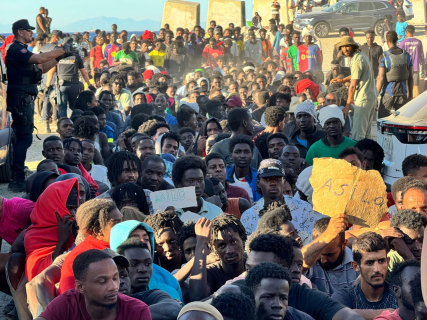

The massive entry of about 72,000 people in Ceuta on July 30 and 31 again places the focus on the actions of Morocco and on the information that the Spanish security services had before the arrival of thousands of people to the autonomous city. A report from the National Center for Immigration and Borders (CENIF), sent to the judge of the National Court María Tardón, states that the events responded to a planned process in which members of the Moroccan security forces would have participated.
The publication of the content of that document has also provoked a new reaction from the Minister of the Interior, Fernando Grande-Marlaska. The minister has asked the director general of the Police, Francisco Pardo, to clarify since when the institution had that report and whether its conclusions are indeed those that have leaked. Marlaska considers it especially relevant to determine the path of that information due to its possible relation to national security.
The Police points to an organized process
The report from CENIF, an intelligence unit integrated into the General Commissariat of Immigration and Borders, rules out that the entry was exclusively the result of a spontaneous movement caused by mafias or by a call on social media. The hypothesis included in the document is that the migratory purpose would have served as a cover for an operation directed from the Moroccan side of the border.
The documentation was sent to the National Court after Judge María Tardón requested information from the National Police and the Civil Guard to determine if the events could present indications of a crime against the independence of the State.
One of the elements that CENIF uses to support the existence of prior planning is the subsequent behavior of those who accessed Ceuta. According to the report, around 90% returned to Morocco a few hours after entering Spanish territory, a behavior that the investigation considers hardly compatible with a migratory operation whose main objective was to remain in Spain.
Prior alerts before the massive entry
The CENIF had issued on July 29 a alert about the risk of an entry in Ceuta and Melilla expected for the following day. The communication sent to the border posts classified the possibility of coordinated illegal accesses both by swimming and by jumping the fence as "extreme risk."
The documentation now known places those warnings at the center of the investigation. The Police had identified before the events a risk of massive and coordinated entry, while the report subsequently sent to the judge analyzes how the operation finally developed.
The issue takes on a new dimension after Marlaska's reaction. The minister has demanded that the director general of the Police determine since when the report attributing an active role to Moroccan agents in organizing the accesses had been in the institution's possession.
Moroccan gendarmes would have guided the groups
One of the main conclusions of the document is that there would have been active guidance by Moroccan agents. According to the information disseminated about the report, gendarmes deployed in the Castillejos area would have given instructions to the groups concentrated there and directed the flow towards certain points from which the accesses to Ceuta would occur.
The document also records the presence of plainclothes individuals who would have supervised the movements on the ground and transmitted instructions to the uniformed agents. Among the highlighted areas is the jetty of El Tarajal.
The investigation also incorporates graphic records that, according to the published information, would show those individuals giving instructions to Moroccan agents. These elements are part of the evidence that the National Court will have to assess.
Three waves with different profiles
The CENIF also analyzes the profile of the people who arrived in Ceuta and distinguishes three phases during the two days of the massive entry. The first began before 11:00 a.m. on July 30 and was mainly characterized by young men, between 15 and 25 years old, many of them equipped with wetsuits, fins, and various flotation devices. The majority were Moroccan citizens.
Between 11:00 AM and 10:00 PM, a second wave occurred, with a greater presence of families, women, and children. In this group, people from sub-Saharan Africa also began to join, and the same equipment used for sea crossings did not predominate.
From 10:00 PM on the 30th and during the 31st of July, a profile similar to that of the first phase predominated again, with young men prepared to make the journey by swimming.
The police interpretation is that this succession would have initially allowed saturating the response capacity in the area of El Tarajal and subsequently hindered the containment of other groups.
The focus now shifts to the information received by the Interior
The report also suggests that the events may have had a counterintelligence dimension, having generated a questioning of the capacity of Spanish intelligence services to anticipate the operation.
This hypothesis is particularly relevant because there were prior alerts. The investigation must determine what information reached the Spanish authorities, when they received it, and what measures were taken based on those warnings.
The issue adds to the explanations offered by Marlaska in Congress, where the minister assured that the CNI had conveyed information about the existing risk before the mass entry. Now, after the content of the CENIF report became known, Marlaska also wants to know when the Police became aware of the data pointing to a possible intervention by Moroccan agents.
The comparison with the call of August 15
The document also establishes a comparison with a second call scheduled for August 15. According to the CENIF, on that occasion, the Moroccan authorities exercised much greater control over the mobilization, which allowed avoiding the reproduction of the scenario from late July.
The difference between both episodes is used by the Police as another element to support that the entry on the 30th and 31st of July was not a spontaneous phenomenon, but a process whose organization and execution must be investigated.
The National Court and the Prosecutor's Office must now assess the content of the report and determine if the described facts have criminal relevance. In parallel, Marlaska's request raises another question: what the Police knew, since when they knew it, and when that information reached the Ministry of the Interior.