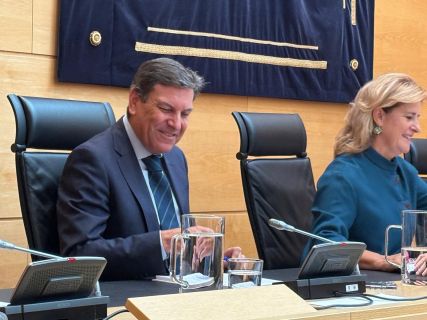

The counselor of Economy and Finance and spokesperson of the Junta de Castilla y León, Carlos Fernández Carriedo, has positively assessed that the early call for elections halts the processing of the reform of the autonomous financing model, and has expressed his confidence that the Executive that comes out of the polls on November 29 will be able to design an "equal" system.
During his intervention this Friday in the Commission of Economy and Finance of the Cortes, where he presented the draft Law of General Budgets of the Community for 2027, he pointed out that "fortunately the early call for elections, after the failure of the policies of the Government of Spain, will prevent the processing of the bill for the reform of autonomous financing that was pushed at the last minute by Pedro Sánchez and Oriol Junqueras".
He criticized that the model proposed by the Government of Pedro Sánchez was, in his opinion, a system "that did not respond to technical criteria and that did not guarantee the necessary funding for the provision of public services in our Community", in addition to being "a model based on financing to separatists in exchange for parliamentary support".
In this line, Fernández Carriedo has reiterated: "Let us hope that the new Government that emerges from the polls on November 29 is capable of articulating a system that attends to the principles of solidarity and sufficiency of resources, in a framework of equality and multilateralism among all the Autonomous Communities".
The spokesperson of the Junta has emphasized that the proposal from Castilla y León "does not consist of demanding privileges, but rather ensuring equality of access to public services, defending a fair, sufficient, solidary, and multilateral autonomous financing system".
Detailing these principles, he explained that the new model must be "fair, that addresses the real cost of services, as well as demographic and geographic factors, so that services are provided under equal conditions throughout the national territory"; "sufficient, that compensates for the current underfunding of all the Autonomous Communities, providing greater resources to the system"; and "solidary, that strengthens the territorial and social cohesion of the State, avoiding imbalances that increase inequalities, such as those generated by the agreement between the Government of Spain and ERC".
In the same way, he has claimed that the funding scheme should be "multilateral, that promotes the negotiation of the new model with a joint and transparent debate, and avoiding any type of bilateral negotiation that seeks to impose on all Communities what only benefits some political parties that are not committed to the general interest of Spain."
Macroeconomic Context of Castilla y León
Regarding the macroeconomic context, Fernández Carriedo has defended that the economy of Castilla y León, despite the "uncertainty and risks" observed on an international scale, maintains "strength, expansion of activity, and job creation."
He has recalled that the Budget Project is analyzed in a "very complex" environment, conditioned by the rising cost of energy, inflation, the tightening of monetary policy, and geopolitical tensions. Nevertheless, he has highlighted the 3 percent growth of the regional GDP in 2025 according to the INE, which placed the Community as the third with the highest growth, as well as an annual rate of 2.9 percent in the second quarter of the year, above the Spanish average and double the community average.
In this framework, the counselor has valued the behavior of industrial production, the increase in gross capital formation, and the process of internationalization of the regional economy, with exports exceeding 20 billion euros in 2024 and 2025.
He has also highlighted the evolution of the labor market, with an unemployment rate of 8.4 percent, 1.5 points below the national average, and the forecasts of the AIReF and Hispalink, which place Castilla y León among the most dynamic regions in the country.
On the other hand, Fernández Carriedo has pointed out that the revenue scenario for 2027 contemplates a forecast deficit of 0.1 percent of GDP and a contained level of debt, in line with the non-financial spending limit approved by the Cortes. This, he said, will allow "to maintain the solvency of public accounts, and continue among the Communities with a level of indebtedness over GDP below the regional average," so that it would remain below 17.3 percent.
He added that the regional accounts incorporate the end of the European Union funds linked to the Recovery and Resilience Mechanism, "which means about 400 million euros less" that affect the total volume of available resources.
To conclude, the counselor has censured the "situation of uncertainty generated by the Government in Spain in recent years," which forces the autonomous communities to prepare their forecasts "without knowing in detail and precisely certain national information," after a legislature "without approved state budget projects or spending ceilings."