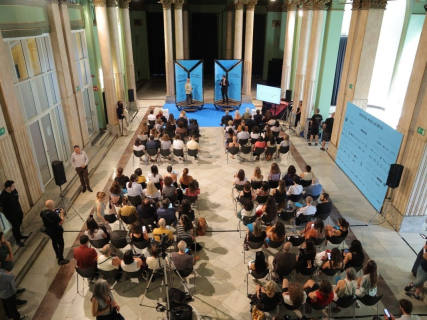
Allianz abandons the Festival of Ideas after the threat of boycott: the keys to the controversy over Israel

More than thirty participants questioned their presence at the festival in Madrid due to the insurer's ties to Israel. Allianz has withdrawn its sponsorship two days before the start, but the organization maintains the celebration from September 17 to 20.

3 minutes

WhatsApp Image 2026 09 15 at 16.44.50

WhatsApp Image 2026 09 15 at 16.44.50

Add DEMÓCRATA to Google

Ask FREN

Published

Last updated

3 minutes

Most read

The Madrid Ideas Festival will face its third edition without one of its main financial supports. Allianz has withdrawn its sponsorship after more than thirty participants threatened not to attend the event due to the insurer's ties with Israel.

The decision comes just two days before the start of the festival, scheduled between September 17 and 20. Among those who had suspended their participation are filmmaker Rodrigo Sorogoyen, presenter Inés Hernand, writer Alana S. Portero, singer Rodrigo Cuevas, and philosopher Paul B. Preciado.

Why the controversy began

The conflict erupted when a group of participants announced that they would suspend their presence as long as the Ideas Festival maintained its financial support from Allianz.

The signatories questioned the company's economic relations with Israel, particularly its investments in Israeli government bonds, and demanded that the festival publicly break with the insurer.

The protest placed the organization in front of an immediate problem: keeping its main sponsor could provoke the withdrawal of a significant portion of the participants with just 48 hours left before the opening.

Who threatened not to participate

The protest grew throughout this Monday. Initial reports mentioned about twenty signatories, but later more than thirty participants were linked to the threat of withdrawal.

Among the highlighted names are Rodrigo Sorogoyen, Inés Hernand, Alana S. Portero, Rodrigo Cuevas, and Paul B. Preciado.

Their participation had been conditioned on the festival severing ties with Allianz's sponsorship.

Allianz was the main sponsor

The exit has a particularly relevant economic dimension because Allianz was not a minor collaborator.

The insurer itself had announced on September 3 that it would be, for the third consecutive year, the main sponsor of the Ideas Festival. Additionally, it was expected that the Plaza de España stage would bear its name and host conversations with figures such as Zadie Smith, Paul B. Preciado, Édouard Louis, Lydia Cacho, Rodrigo Sorogoyen, or Rodrigo Cuevas.

Allianz had also prepared two dedicated spaces for health and wellness and for family activities.

Allianz finally withdraws its sponsorship

After the threat of withdrawal from the participants, Allianz decided to abandon the sponsorship of the Ideas Festival.

The exit forces the organization to face the economic impact just hours before the start of the event. The artistic director of the festival, Marcela Vélez, has acknowledged that the economic situation is complicated after losing this support.

The withdrawal resolves, in principle, the main condition raised by the participants who had suspended their presence: that the contest would stop having the support of the insurer.

The Festival of Ideas is not canceled

The immediate consequence will not be the cancellation of the festival.

The organization has confirmed that the 2026 edition will go ahead between September 17 and 20, despite the economic hole caused by the sponsor's exit.

The contest brings together this year more than a hundred participants and develops a good part of its programming through free activities open to the public.

What Urtasun has said

The controversy has also reached the Government. The Minister of Culture, Ernest Urtasun, has spoken out about the presence of companies related to Israel in cultural events.

"I don't like the participation of companies linked to Israel," the minister said when asked about the controversy of the Festival of Ideas.

His statements came when the participants were still conditioning their presence on the break between the festival and Allianz.

When is the Festival of Ideas in Madrid

The third edition will be held from Thursday, September 17 to Sunday, September 20 in different spaces in Madrid. Its thematic axis will be this year "Bodies".

The programming addresses issues related to identity, technology, mental health, human relationships, and artistic creation. Among the announced participants are Zadie Smith, Paul B. Preciado, Édouard Louis, Pablo d'Ors, Nazareth Castellanos, Niño de Elche, Rocío Molina, and Chantal Maillard, among others.

Most of the activities are free, although some require prior registration.

What happens now with the participants who threatened to withdraw

This is now the main pending point. The participants had conditioned their presence on the festival breaking its relationship with Allianz and that disconnection has already occurred.

The organization is trying to recover the normality of the programming two days before the start. Therefore, it will be necessary to individually check which participants definitively confirm their attendance after the sponsor's exit.

More key points, information and questions with FREN

AI-GENERATED CONTENT

What are the pending procedures and next steps for the financing and organization of the Festival of Ideas after Allianz's withdrawal?

In the sources consulted (general press, specialized press, and documentary databases), there is no public information linking Allianz with the Festival of Ideas nor detailing a specific withdrawal of sponsorship or the agreements signed. This means that, with the available information, it is not possible to describe official and specific “pending procedures” for that particular festival, but only to explain what steps are usually necessary in such a case and how financing and organization are reorganized when a relevant sponsor withdraws.

Starting from there, the main work blocks and procedures that are usually pending after the exit of a sponsor such as a large insurance company would be the following:

1. Legal and financial closure with the outgoing sponsor
  • Review of the sponsorship contract: check clauses on early termination, penalties, notice periods, and remaining obligations (use of brand, visibility commitments already publicized, events already scheduled, etc.).
  • Financial settlement: determine if refunds, payment for services already rendered, or compensations are due. In a festival with public projection, this is also coordinated with tax and accounting advisory.
  • Reputational management: agree, if possible, on a shared narrative of the exit to minimize image risks for the festival, the sponsor, and, if applicable, the public institutions associated.
2. Reconfiguration of financing
  • Quantification of the “financial gap”: update the budget with what Allianz ceases to contribute (cash sponsorship, in-kind, insurance services, etc.) and determine if the festival remains viable with the planned format.
  • Search for new private sponsors: design and send a new sponsorship package to potential companies (banking, energy, telecommunications, other insurers, consumer brands) with adjusted scenarios: main sponsorship, co-sponsorship, or network of collaborators.
  • Strengthening public financing: if the festival has support from city councils, autonomous communities, or ministries, two lines may open:
    • Negotiate the extension of existing grants or agreements.
    • Apply for new calls for cultural, tourism, or innovation aid, respecting deadlines and requirements (activity reports, economic justification, territorial impact, etc.).
  • Adjustment of the revenue model: review whether total free admission is maintained or some type of ticketing, voluntary contribution reservations, “patron” packages, or other formulas for attracting resources from the public and community are introduced.
3. Logistical and programming reorganization
  • Resizing the festival: if the funding gap is significant, it may be necessary to cut programming days, stages, fees, or services (technical production, streaming, parallel activities), preserving the core content.
  • Review of contracts with suppliers: negotiation of new conditions or, if applicable, termination or substitution of certain services (production, sound, video, communication, security, insurance, etc.).
  • Updating commitments with artists and guests: confirm whether dates, formats, and fees are maintained, or if changes are considered (for example, shifting from large stage formats to dialogues, round tables, or mixed in-person–online formats).
4. Relationship with administrations and regulatory compliance
  • Permits and licenses: if the scale change affects capacities, spaces, or schedules, it may be necessary to review municipal licenses, security plans, self-protection plans, and liability insurance.
  • Justification of public aid: when there are grants or agreements in force, the modification of the budget and program requires adapting the activity report and sometimes requesting a formal modification of the file.
  • Transparency and accountability: especially if the festival involves public media or cultural bodies, it is common to prepare reports explaining the impact of the sponsor's withdrawal and how the project has been rebalanced.
5. Public communication and community engagement
  • Official message about the festival's continuity: clarify whether the planned edition is maintained, in what format, and with what support, to avoid cancellation rumors that damage participation and the event's prestige.
  • Brand and materials management: replace Allianz logos on the website, posters, social media, and audiovisual pieces, according to the deadlines and terms agreed in the original contract.
  • Involvement of members, subscribers, and local community: in festivals closely linked to a media outlet or territory, the base of members and collaborators is usually activated to support the edition in a more fragile context.

If you have specific internal information about the agreement with Allianz (type of contract, amount, duration, presence of public institutions), I can help you ground these general steps into a much more precise timeline and roadmap for the Festival of Ideas case.

What competencies and functions does Minister of Culture Ernest Urtasun have according to Spanish legislation?

The Minister of Culture, currently Ernest Urtasun, exercises his competencies within the framework of the Government organization regulations and, more specifically, those regulating the structure of the Ministry of Culture. Since 2024, this structure is based, among others, on Royal Decree 323/2024, of March 26, which develops the basic organic structure of the Ministry of Culture and defines it as the department responsible for proposing and executing the Government's policy on culture.

1. Basic regulatory framework of his competencies

The functions and competencies of the Minister of Culture mainly derive from:

  • Royal Decree 323/2024, of March 26, which develops the basic organic structure of the Ministry of Culture and modifies Royal Decree 1009/2023, of December 5, on the basic structure of ministerial departments. This royal decree:
    • Determines that the Ministry of Culture is the department of the General State Administration responsible for cultural policy.
    • Distributes competencies among the Secretary of State for Culture, the general directorates, and dependent bodies.
  • Royal Decree 1009/2023, of December 5, which sets the basic organic structure of ministerial departments, and whose modification by RD 323/2024 places the Ministry of Culture within the general Government scheme.
  • Law 40/2015, on the Legal Regime of the Public Sector, whose article 61.k) is expressly cited as a competency title for the minister to sign agreements on behalf of the General State Administration within his scope of action.

Additionally, resolutions from the Ministry itself and its bodies (for example, those related to the Management of Cultural Infrastructure and Equipment or agreements on cultural rights and heritage) repeatedly rely on specific articles of Royal Decree 323/2024, highlighting that much of the Department's ordinary action is channeled under the minister's authority.

2. Political and administrative leadership of the department

As head of the Ministry of Culture, Ernest Urtasun exercises the top management of the department. Functionally, this translates into:

  • Defining priorities and strategic lines of the Government's cultural policy and being politically accountable for them before the Council of Ministers and the General Courts.
  • Promoting normative projects within his scope: draft bills, royal decree projects, statutes of bodies, and other provisions affecting the State's cultural organization (for example, regulation of autonomous cultural bodies or programs like the Young Cultural Voucher).
  • Approving or proposing the signing of agreements with autonomous communities, local entities, cultural institutions, foundations, and international organizations in areas such as cultural heritage, promotion of reading, cultural rights, or intellectual property. The publication resolutions of agreements in the Official State Gazette expressly state that the minister acts “by virtue” of his appointment and the powers granted by article 61.k) of Law 40/2015 and Royal Decree 323/2024.
  • Directing and coordinating the actions of the Secretary of State for Culture, the general directorates (Cultural Rights, Cultural Heritage and Fine Arts, Book, Comics and Reading, Performing Arts and Music, etc.), and attached bodies (such as the Management of Cultural Infrastructure and Equipment).
3. Material competencies in the cultural field

Based on what Royal Decree 323/2024 details, the regulations assign the Ministry—and therefore its head—a broad set of material functions, among which stand out:

  • General cultural policy: proposal and execution of the Government's cultural policy, including the design of programs and plans to promote culture throughout the territory.
  • Cultural rights and access to culture: article 4.1.a of RD 323/2024 entrusts the Directorate General of Cultural Rights with designing and developing policies to promote cultural rights; the minister sets these guidelines and is responsible for their coherence with the Government's general policy.
  • Cultural heritage and state museums: article 5.1.s of the same decree assigns the Directorate General of Cultural Heritage and Fine Arts the management and promotion of state-owned museums attached to the Ministry of Culture, as well as protection and dissemination actions of heritage. The minister approves major strategic decisions in this field (declarations of Asset of Cultural Interest, heritage subsidy lines, agreements for activities in state museums, etc.).
  • Cultural industries and incentives: the specific regulations cited in press releases and resolutions (such as those related to the Coordination Center for Cultural Industries) assign the Ministry the design of policies to promote cultural industries in coordination with the Secretary of State. The minister defines these programs, promotes aid calls, and submits strategic cultural sector subsidy royal decrees for approval by the Council of Ministers.
  • Book, reading, and national awards: resolutions on the Collective Catalog of Bibliographic Heritage and decisions on National Culture Awards show that the minister directs policies supporting the book sector, promoting reading, and recognizing literary creation, including guiding award bases and adapting them to languages with statutory recognition.
  • International cultural relations: the Ministry promotes agreements and external projection projects (international book fairs, participation as guest country in major events, etc.), whose political orientation corresponds to the minister.
4. Representation and signing powers

In numerous agreements published in the Official State Gazette, it is indicated that Ernest Urtasun acts “on behalf of the General State Administration, in the exercise of his competencies, in accordance with Royal Decree 323/2024 and article 61.k) of Law 40/2015.” This reflects two key functions:

  • Institutional representation of the State in the cultural field, both domestically (agreements with other administrations and private entities) and abroad.
  • Signing agreements and legal acts on behalf of the General State Administration when allowed by Law 40/2015 and the ministry's structural regulations.

In summary, Spanish legislation places the Minister of Culture as the ultimate responsible for state cultural policy and department leadership, with competencies covering strategic definition, normative proposal, heritage and museum oversight, promotion of cultural rights and industries, and representation of Spain in the cultural field.

Can you break down, body by body, what specific functions Royal Decree 323/2024 assigns to each unit of the Ministry of Culture? What role does the Minister of Culture have in the approval of state subsidies and aid to the cultural sector according to recent regulations? How are the competencies of the Ministry of Culture coordinated with those of the autonomous communities regarding cultural heritage and museums?

What legal requirements exist for a company to be the main sponsor of a cultural event in Spain?

In Spain, there is no single “cultural sponsorship law,” but rather a set of rules and principles that condition who can be the main sponsor of a cultural event and under what terms. In practice, almost any company can sponsor, but it must respect general requirements (capacity to contract and legality of the activity) and specific limits on advertising, regulated sectors, and, if applicable, relations with the Administration.

1. Basic applicable regulatory framework
  • Advertising in general: the Law 34/1988, General Advertising Law, establishes what is understood by advertising and defines illegal advertising (for example, that which attacks dignity, violates fundamental rights, or uses women in a degrading way, promotes violence or discrimination, etc.). Any main sponsorship with brand visibility is considered advertising communication and is subject to these limits.
  • Patronage and tax benefits: the tax regime for sponsorships with projection to events of exceptional public interest connects with Law 49/2002 (cited in later regulations and interpretative resolutions). It does not so much condition the “possibility” of sponsoring as the access to tax incentives and how advertising and publicity expenses must be structured.
  • Subsidies and public funds: when the cultural event has public financing or is structured through aid, Law 38/2003, General Subsidies Law and its regulations are relevant. They influence how beneficiaries and collaborators are selected and the transparency and control of spending.
  • Regulated sectors:
    • Tobacco: advertising of tobacco products is heavily restricted by Law 28/2005, amended by Law 42/2010, which regulates, among other aspects, consumption and advertising. These limits make it practically very difficult for a tobacco company to appear as a visible sponsor of a cultural event aimed at the general public.
    • Gambling: Law 13/2011, on gambling regulation and Royal Decree 958/2020 on commercial communications of gambling activities establish a specific regime for advertising, sponsorship, and promotion of gambling, emphasizing the protection of minors and vulnerable groups and responsible gambling.
  • Audiovisual and regional/local regulations: besides these state laws, regional advertising, public shows regulations, and, when sponsorship is materialized in audiovisual media, audiovisual communication regulations must be respected, as well as municipal ordinances on public space use.
2. Typical requirements for the sponsoring company

As a general rule, a main sponsoring company must:

  • Have legal capacity and ability to act to contract, and its activity must be lawful.
  • Not violate general prohibitions: it cannot use sponsorship as a channel for illegal advertising messages according to the General Advertising Law (for example, discriminatory content, degrading use of women's bodies, or promoting violent conduct or contrary to fundamental rights).
  • If the sponsorship is articulated through a public administration (ministry, autonomous community, city council, public cultural entity), it is usual to require:
    • Being up to date with tax and Social Security obligations.
    • Not being subject to prohibitions to contract with the public sector (due to sanctions, corruption crimes, subsidy fraud, etc.).
  • If the company belongs to a regulated sector (tobacco, gambling, partly certain online gambling, etc.), the specific advertising and sponsorship conditions established by sectoral regulations must be met: authorizations, recipient limitations, time slots, media, warnings, etc.
3. Content and limits of sponsorship and brand visibility

Being the main sponsor does not allow circumventing advertising rules. Specifically:

  • Sponsorship cannot become misleading or unfair advertising, nor include messages that violate dignity or promote stereotypes or discrimination, especially regarding women and minors (Law 34/1988 expressly incorporates these limits in the definition of illegal advertising).
  • If the event is suitable for or aimed at minors, special caution applies to:
    • Gambling advertising: under Law 13/2011 and its regulatory development, exposure of minors to gambling commercial communications, including sponsorships, is severely limited.
    • Tobacco advertising: Law 28/2005 and its amendments practically block any advertising presence in closed public use spaces, cultural or leisure venues.
  • Identification of the advertising nature must be clear: the public must understand that the brand's presence responds to a sponsorship agreement and not to a “neutral” recommendation by the organization.
4. Formal requirements of the sponsorship contract

Although largely governed by common civil and commercial law, in practice a main sponsorship contract usually includes:

  • Object and scope of the sponsorship (event or series of events, territorial scope, duration).
  • Considerations: economic or in-kind contribution from the company, and visibility rights (logos, mentions in materials, stage presence, tickets, hospitality, etc.).
  • Use of brand and image: rules on how the sponsor's and cultural entity's name and logos will be used, and, if applicable, image rights of artists or participants.
  • Compliance clauses: obligation of both parties to respect advertising, gambling, tobacco, and any other applicable regulations, with specific termination causes if serious violations occur.
  • Data protection when sponsorship involves transfer or exploitation of attendee databases or direct marketing actions.
  • Anti-money laundering and transparency in economic flows when there is a relation with risk sectors or public funds.

In summary, a company can be the main sponsor of a cultural event in Spain if it meets the general contracting requirements and respects the applicable sectoral and advertising restrictions. The real risk is not so much in “who” sponsors, but in “how” that sponsorship is presented and communicated to the public, especially when minors or regulated sectors are involved.

Play

Test your knowledge with FREN!

How much do you know about this topic? Answer the following 3 questions.

Why did Allianz decide to withdraw sponsorship from the Madrid Festival of Ideas?

Question 1 of 3

When will the third edition of the Madrid Festival of Ideas take place?

Question 2 of 3

What was the main condition imposed by the participants to maintain their presence at the Festival of Ideas?

Question 3 of 3

Hola, soy Fren. ¿Cómo te ayudo?