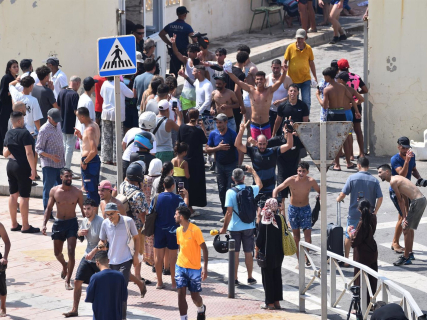
Ceuta reinforces security after the disturbances: 12 detained and 40 more riot police

A soldier was lightly injured during the attack on an Army vehicle. The Government calls for calm, increases police presence, and condemns the threats against Red Cross volunteers.

4 minutes

fotonoticia 20260828132403 1920

fotonoticia 20260828132403 1920

Add DEMÓCRATA to Google

Ask FREN

Published

Last updated

4 minutes

Most read

The migration crisis in Ceuta has led to new public order problems after several altercations between migrants, neighbors, and security forces. The National Police has already arrested 12 Moroccan citizens for their alleged participation in the attack against a military vehicle, while the Ministry of the Interior has announced the sending of 40 more riot police to the autonomous city.

The incidents occur almost a month after the mass entries recorded on July 30 and 31. Although most of the people who crossed the border later returned to Morocco, thousands of migrants continue in Ceuta and the resources set up to accommodate them remain under heavy pressure.

Twelve arrested for the attack on a military vehicle

The National Police arrested this Friday 12 Moroccan citizens for their alleged involvement in the attack suffered by a military vehicle during the early morning. According to a police spokesperson in Ceuta, a group of migrants threw stones and other objects at the vehicle, in which four soldiers were traveling.

The soldiers managed to leave the site and requested police intervention after one of the soldiers was lightly injured by the impact of a stone. Authorities are now investigating the circumstances of the attack and the possible individual responsibility of those arrested. 

Protests interrupt Red Cross assistance

Tension has also moved to the areas where numerous migrants remain concentrated. Dozens of protesters participated in a sit-in to prevent Red Cross vehicles from reaching the beach of El Trampolín, where the organization distributes food and water.

The protest has forced a temporary interruption of the distribution, while other incidents were recorded during the afternoon of Friday on the beaches of El Trampolín and Benítez, such as the destruction of the improvised shelters by the migrants. Given the situation, the Police were forced to intervene to prevent direct confrontations.

After the altercations, the Minister of Inclusion, Social Security, and Migration, Elma Saiz, has demanded that the threats against volunteers cease and has defended the work of humanitarian organizations. Saiz has described the Ceuta society as an example of "coexistence, solidarity, and serenity," while asking not to collectively blame either the neighbors or the migrants for the violent acts.

Interior sends another 40 riot police

The Minister of the Interior, Fernando Grande-Marlaska, announced this Friday the sending of 40 agents from the Police Intervention Units to reinforce security and contain new disturbances. Before this last reinforcement, the Interior had estimated the deployment at 880 national police, 270 more than before the mass entries, and 714 civil guards. Part of the agents are dedicated to border surveillance, while others intervene in identification tasks, citizen security, and processing of files.

Days earlier, the Government declared the situation of interest for National Security in Ceuta, designating the Minister of Territorial Policy, Ángel Víctor Torres, as the functional authority to coordinate the response. The measure adopted has served to integrate state and autonomous resources under a common structure.

How many migrants remain in Ceuta

As of August 28, the exact number of people who continue in the city remains a subject of discrepancies, as the Interior estimates that around 5,000 migrants remain, while the estimates handled by the Ceuta authorities have ranged between 8,000 and 12,000. The discrepancies respond to the movements of entry and exit, returns, transfers, and the difficulties in completing identification. 

In any case, Marlaska has raised to 1,898 the number of identified minors, who require a specific procedure different from others, as they cannot be returned automatically and must remain under protection while their age, identity, family situation, and possible transfer are determined.

The Executive has enabled temporary resources to decongest the beaches and other improvised settlements to thus concentrate humanitarian attention, improve sanitary conditions, and facilitate identification, asylum, or return procedures.

The Government defends collaboration with Morocco

The Minister of Foreign Affairs, José Manuel Albares, has described the collaboration with Morocco as "essential." According to the balance conveyed by the Government, this coordination allowed a wide majority of those who entered on July 30 and 31 to return in the following hours and contributed to thwarting a new mass attempt in mid-August.

The Moroccan security forces have reinforced controls in Fnideq, that is, Castillejos, and on the access roads to the border. During the attempted entry on August 15, Morocco intercepted hundreds of people before they reached the border perimeter.

Albares has assured that the dialogue with Rabat has remained active from the very first moment. He has also reiterated the Spanish Government's rejection of the Moroccan claims regarding Ceuta and Melilla, a different issue from the operational cooperation to control migratory movements.

The Ceuta Assembly condemns violence

The Ceuta Assembly has unanimously approved an institutional declaration condemning violence and supporting the security forces, public services, and humanitarian organizations.

The document warns that the city is in a critical situation and demands sufficient resources to restore normalcy. The groups represented in the Assembly have also requested that individual incidents not be used to fuel confrontations between communities.

More key points, information and questions with FREN

AI-GENERATED CONTENT

What is the parliamentary status of the declaration of interest for National Security in Ceuta and what legal steps are required for its extension or lifting?

The situation of interest for National Security in Ceuta has been declared very recently by governmental means through Royal Decree 681/2026, of August 25, published in the BOE, and has been complemented with another Royal Decree on Resource Declaration and a Situation Report approved by the Council of Ministers on August 25, 2026. As of today, what exists is a declaration in force adopted by the Government; in official databases it still does not appear associated with a specific parliamentary procedure beyond the general control that the Chambers may exercise.

1. Current parliamentary situation of the declaration on Ceuta

From the official information consulted, the following results:

  • Within the Executive branch, there is the Royal Decree 681/2026, of August 25, "declaring the situation of interest for national security in the city of Ceuta," published in the BOE and also referenced on the La Moncloa website.
  • The same Council of Ministers also approved a Royal Decree approving the Declaration of Resources to be used in the situation of interest for national security in the city of Ceuta, pursuant to article 29 of Law 36/2015, and a Situation Report on the humanitarian and migratory crisis in the city of Ceuta.
  • In the Cortes, there are initiatives related to National Security, illegal immigration, and Ceuta and Melilla (non-legislative motions, oral and written questions, etc.), but there is not yet a specific parliamentary file processing or modifying the declaration of the situation of interest in Ceuta.

In strict terms, therefore, the declaration for Ceuta is in an essentially executive phase: it is an act of the President of the Government formalized by royal decree, subject to parliamentary control (debates, questions, appearances, resolutions), but not to ratification nor to a parliamentary “state” comparable to a bill or legislative proposal.

2. Applicable legal framework

The regime for these situations is found in Law 36/2015, of September 28, on National Security, interpreted, as it affects the declaration of the situation of interest, by the Constitutional Court Ruling 184/2016.

  • The “situation of interest for National Security” is a crisis situation that requires reinforced coordination of the competent authorities under the Government’s direction, but it is addressed with ordinary powers of the Administrations and does not allow suspension of fundamental rights.
  • The law assigns to the President of the Government the competence to declare the situation by means of a royal decree.
  • The declaration must indicate, at least: definition of the crisis, territorial scope, duration and possible extension, functional authority (if any), and resources to be used.
  • The Government must immediately inform the Congress of Deputies of the declaration, the measures adopted, and the evolution of the situation.

3. Legal steps for the extension

Law 36/2015 expressly foresees that the declaration must state its duration and, if applicable, its possible extension. From this framework it follows:

  • The extension does not occur automatically: it requires a new formal act by the President of the Government, also by royal decree agreed in the Council of Ministers.
  • This new royal decree must modify or complement the previous one, specifying the new period of validity and, if appropriate, the adaptation of resources and organization.
  • Again, the Government must inform the Congress of the decision to extend and the situation of the crisis. Parliament may react through debates, appearances, non-legislative motions, resolutions, or even legislative initiatives that condition or regulate in more detail this type of situation.

4. Legal steps for lifting or cessation

The lifting follows a symmetrical logic:

  • When the circumstances that justified the situation of interest for National Security in Ceuta disappear, the President of the Government must issue a new royal decree that declares the cessation of the situation or nullifies the initial declaration.
  • This termination royal decree is also adopted in the Council of Ministers and published in the BOE, setting the date of loss of validity of the special situation.
  • Again, the Government must report to the Congress on the decision and the evaluation of crisis management.
  • Parliament does not formally “lift” the situation (it is not a state of alarm or exception), but it can politically force the closure through resolutions, legislative initiatives, or even political responsibility mechanisms if it considers the extension unjustified.

In summary: the declaration of interest for National Security in Ceuta is today a royal decree in force issued by the Government, subject to the control of the Cortes but without its own parliamentary processing; its extension or lifting always requires a new royal decree by the President of the Government, with immediate information to Congress and full adherence to the ordinary parliamentary control framework.

What are the powers and functions of the Minister of Territorial Policy as functional authority in situations of interest for National Security?

Law 36/2015, of September 28, on National Security, does not specifically and automatically assign the Minister of Territorial Policy the status of functional authority in situations of interest for National Security. What it does is define, in general terms, the figure of the functional authority in these situations, who will be designated case by case by the President of the Government in the royal decree declaring the situation of interest for National Security. Therefore, the Minister of Territorial Policy can be the functional authority when so designated, and in that case assumes the powers that the law provides for that figure.

According to Law 36/2015 (text in the BOE), the situation of interest for National Security is characterized by:

  • The seriousness of its effects.
  • The scale, urgency, and cross-cutting nature of the measures necessary to address it.
  • The need for reinforced coordination of the competent authorities, using their ordinary powers.

The declaration of this situation is made by the President of the Government by royal decree, which must include, among other elements, "the appointment, if applicable, of a functional authority, and the determination of their powers to direct and coordinate the necessary actions." That is, the royal decree itself specifies the scope of the functions of the head of the Ministry designated as functional authority.

Generally, the functions and powers of the functional authority in these situations, which would apply to the Minister of Territorial Policy if designated, can be summarized as follows:

  • Operational direction and coordination: assumes the direction and coordination of the necessary actions to manage the crisis, based on the ordinary powers of each Administration. The law emphasizes that the situation is addressed with ordinary means and without suspension of fundamental rights.
  • Promotion of coordinated management: acts as a driving and cohesion point among the different ministerial departments, autonomous communities, and other involved Administrations or bodies, ensuring an integrated response within the framework of the National Security System.
  • Application of plans and use of resources: uses the preparation plans and resource provision foreseen in the law and the catalogs of human and material resources approved by the Government, to ensure they are mobilized and distributed gradually and proportionally to the needs of the situation.
  • Presidency or leadership of crisis structures: the regulation foresees that the Specialized Crisis Management Committee of the National Security Council is chaired by a member of the Council itself or, if applicable, by the designated functional authority. If the Minister of Territorial Policy were appointed functional authority, they could chair that body in the specific management of the situation.
  • Channeling of information: guarantees the flow of information among the Administrations, the coordination bodies of the National Security System, and the Government itself, facilitating that the President of the Government and the Council of Ministers can make informed decisions.
  • Proposal of measures: in coordination with the National Security Council and its specialized committee, can propose strategic and operational guidelines and measures to address the crisis, within the framework set by the declaration royal decree and the applicable legislation.

Law 36/2015 also establishes that, in the situation of interest for National Security, the President of the Government will convene the National Security Council to exercise the functions of direction and coordination of the management of the situation. In cases where a functional authority is designated, the National Security Council advises on their appointment and continues to play a role of strategic advice and supervision, while the functional authority assumes the coordinated day-to-day management.

In summary, the Minister of Territorial Policy, when acting as functional authority in a situation of interest for National Security, is the central piece of direction, coordination, and operational management of the public response, under the political direction of the President of the Government and within the framework of the National Security System defined by Law 36/2015. Their specific powers are set in the declaration royal decree, always respecting that actions are taken with the ordinary powers of the Administrations and without suspension of fundamental rights.

Could you explain in more detail what exactly a “situation of interest for National Security” is according to Law 36/2015? How does the functional authority in a situation of interest for National Security differ from the authorities in states of alarm, exception, and siege? What role do the autonomous communities and local entities have when a situation of interest for National Security is declared?

What legal requirements exist for the return of unaccompanied migrant minors in Spain and what procedures does the current legislation establish?

In Spain, the return or repatriation of unaccompanied migrant minors is strongly conditioned by the principle of the best interests of the child and by immigration and child protection regulations. In practice, the law configures repatriation as an exceptional and highly protective measure, which can only be agreed upon if it is demonstrated to be the most favorable option for the minor.

1. Basic regulatory framework

  • Organic Law 4/2000, on Immigration (LOEX), especially its article 35 on unaccompanied foreign minors and the new articles 35 bis and following on extraordinary migratory contingencies.
  • Immigration Regulation, approved by Royal Decree 557/2011, whose chapter III of title XI (arts. 189‑198) develops the requirements and procedure for repatriation.
  • Framework Protocol on certain actions regarding Unaccompanied Foreign Minors, approved by Agreement published by Resolution of October 13, 2014 (BOE-A-2014-10515), which specifies administrative practice (age determination, registration in RMENA, repatriation processing, etc.).
  • Organic Law 1/1996, on Legal Protection of Minors, and its reform by Law 26/2015 (BOE-A-2015-8470), which set principles (best interests of the child, right to be heard, protection against violence) and rules on return and family reunification.
  • Specific bilateral conventions and agreements (for example, with Senegal and Romania) on repatriation of unaccompanied minors.

2. Legal requirements for repatriation

From the LOEX, its Regulation, and the Framework Protocol, among others, these essential requirements emerge:

  • Best interests of the child as the decisive criterion: repatriation can only be agreed if it is proven that return to the country of origin or another host country is the best solution for their development and protection (art. 3 of the Convention on the Rights of the Child and LO 1/1996).
  • Location and assessment of the family or a safe care resource in the country of origin: it must be verified that the minor will be reintegrated with their family or in an adequate protection center and that there will be no risk to their safety.
  • Non-refoulement guarantee: repatriation is prohibited if it exposes the minor to persecution, violence, trafficking, exploitation, or any serious violation of rights.
  • Participation and hearing of the minor: they must be heard according to their age and maturity, and their opinions must be taken into account. The intervention is based on the right to be heard established in LO 1/1996.
  • Mandatory intervention of the Public Prosecutor: supervises the entire process to safeguard the rights of the minor, including age determination and the repatriation file.
  • Guardianship or custody by the public child protection entity of the autonomous community: from the moment minority and absence of adult references are confirmed, the public entity assumes protection, according to the Civil Code and LO 1/1996.
  • Processing before the Government Delegation/Subdelegation: these are the immigration authorities competent to decide on repatriation and, if applicable, on residence authorization.
  • Documentation and residence authorization: if repatriation under safe conditions is not possible, LOEX and Law 26/2015 provide for documentation of the minor and granting of residence authorization; this authorization does not prevent a later repatriation if it is shown to be in their benefit.

3. Legal procedure for return/repatriation

The procedure, as described by the Immigration Regulation and the Framework Protocol, can be summarized in these phases:

  • 1) Location and initial police action
    The Security Forces locate the minor, record their data, and register them in the Registry of Unaccompanied Foreign Minors (RMENA). If there are doubts about age, the Public Prosecutor is notified.
  • 2) Age determination
    The Public Prosecutor leads an age determination file when minority is uncertain. They may authorize medical tests, always with informed consent and respect for the minor’s dignity. Their decree is provisional and reviewable.
  • 3) Assumption of guardianship and protection
    Once minority is declared, the public child protection entity of the autonomous community assumes immediate reception and, if applicable, guardianship. An individual protection plan is prepared, which may include a family reintegration program (Law 26/2015).
  • 4) Investigations for repatriation
    The protection entity, in coordination with the Government Delegation/Subdelegation and consular authorities of the country of origin, analyzes:
    • Possible location of the family and their caregiving capacity.
    • Existence of adequate reception centers in the country of origin.
    • Absence of risks to the minor’s integrity and rights.
  • 5) Proposal by the protection entity and administrative file
    When repatriation is considered possible and appropriate, the protection entity submits a proposal to the Government Delegation/Subdelegation, accompanied by social, educational, and psychological reports, as well as information gathered from the country of origin.
  • 6) Administrative resolution
    The Government Delegation/Subdelegation issues a reasoned resolution, after hearing the minor and with a report from the Public Prosecutor. If sufficient guarantees are not met, it must opt for documentation and residence in Spain.
  • 7) Appeals and judicial control
    The resolution is appealable administratively and in contentious-administrative proceedings. Additionally, decisions affecting guardianship, custody, and protection measures may be subject to control by the juvenile and family courts, according to LO 1/1996 and the Civil Code.

In sum, Spanish legislation does not conceive the “return” of unaccompanied minors as a mere immigration procedure, but as a child protection procedure subject to strict substantive guarantees (best interests, non-refoulement, safe environment in origin) and formal guarantees (hearing of the minor, public guardianship, prosecutorial intervention, reasoned resolution, and judicial control).

Play

Test your knowledge with FREN!

How much do you know about this topic? Answer the following 3 questions.

Why were 12 Moroccan citizens detained in Ceuta?

Question 1 of 3

What measure has the Government taken to coordinate the response to the crisis in Ceuta?

Question 2 of 3

What protest action temporarily interrupted Red Cross assistance on El Trampolín beach?

Question 3 of 3

Hola, soy Fren. ¿Cómo te ayudo?