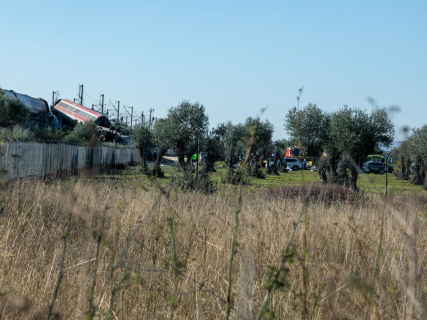
Feijóo warns of an internal Adif report that forecasts up to 2030 a 94% increase in the risk of accidents

Feijóo denounces an internal Adif report that foresees more accidents until 2030 and promises an urgent audit and an emergency plan in the railway network.

fotonoticia 20261103172415 1920

fotonoticia 20261103172415 1920

Add DEMÓCRATA to Google

Ask FREN

Published

Last updated

4 minutes

Most read

Elecciones 29N · Encuestas

La media de las encuestas

Media a 2 de noviembre de 2026 · 16 institutos

  • PP30,5 %
  • PSOE27,4 %
  • Vox19,1 %
  • Frente Amplio6,4 %
  • ERC2,4 %
  • Podemos2,4 %
010203040ene 2024jul 2024ene 2025jul 2025ene 2026jul 2026

Media del último estudio de cada instituto en 30 días y su evolución semanal desde el 23J. Partidos con al menos un 2 %.

Todas las encuestas

Elecciones generales del 29 de noviembre · Demócrata

The president of the PP, Alberto Núñez Feijóo, warned this Tuesday that an internal Adif document, known to the Government, anticipates a 94% increase in the risk of accidents in which the administrator of the railway infrastructure would have responsibility.

At an information breakfast organized by Europa Press, Feijóo indicated that the Executive is aware, thanks to that report, that in the coming years various indicators of the railway system will deteriorate.

According to the figures he presented, the report, with a horizon of 2030, envisages a drop of nearly 30% in the reliability of the facilities, a worsening of 34% in the punctuality of the trains, a decline of 4% in the degree of compliance with preventive maintenance plans, and a rebound of 94% in the risk of accidents attributable to Adif.

He added that this document has also been sent to the railway operators, who have already filed objections.

"We have to proceed to a total reset of the railway infrastructures and, therefore, of the safety systems and their protocols. We have to know why maintenance has not kept pace with the increase in the use of the tracks. We have to know why hundreds of deaths and 170 breakdowns occurred on the Madrid-Seville line, some very serious, and everything was ignored," Feijóo stressed.

"Are they really going to repeat to us that we are close to zero risk? What are Spaniards supposed to do if two days ago they promised a Madrid-Barcelona AVE at 350 kilometers and now they say it may have to be closed?... All my solidarity with the citizens who get on a train in fear and all the support for the workers in charge of the railway system. They do not deserve the cowardly singling out to which they are being subjected and I guarantee them that they will be respected again," added the PP leader.

Feijóo maintained that, in order to address the problems in the Public Administration, "one has to listen to public employees" and that to fulfill that purpose "it is enough to put the best in the command posts".

"A strong State needs public servants selected for their management, for their technical knowledge. It is easy to understand. If the measure of your demand is to put a doorman from a strip club in Renfe, then do not be surprised that things do not work. This has to be changed. The managers of public companies and departments have to be chosen for ability, not for political affinity," he emphasized.

IMMEDIATE AUDIT OF THE RAIL NETWORK

During the event, Feijóo detailed that, if he reaches Moncloa, one of his first decisions will be to commission a quick audit of the railway safety systems, whose results he wants to know "in weeks," in addition to proceeding with an immediate reorganization of Adif.

That review would cover the reports from the train drivers, the speed reduction points scattered throughout the network, and the safety systems, with special focus on the railway corridor where the deaths have occurred.

He also proposed analyzing the deployment of the ERTMS system and questioned that corridors without this protection mechanism still exist.

Based on the conclusions of said audit, Feijóo advanced a "shock plan" to act from the budgetary and economic point of view, through the "declaration of an emergency" and the approval in the Council of Ministers of the necessary expenditure.

"If I have to stop a line, I will stop it. If I have to lower the speed on certain sections, I will do it," he stated, while also proposing to review the situation of the corridors of Catalonia, Andalusia and Levante.

PRIORITY TO MAINTENANCE OVER NEW WORKS

The PP leader insisted that the preservation and maintenance of railway and road infrastructure will take priority over the start of new projects. "If I cannot start a new project, I will not start it," he warned, criticizing the current state of Spanish motorways and assuring that he had never observed a similar situation.

He recalled that, when he assumed the Presidency of the Xunta de Galicia in 2009, one of his first measures was to promote road conservation and maintenance contracts with a term of five years, given the budgetary restrictions he anticipated.

The PP president added that the audit will include a "separate piece" focused on the railway network, with special attention to accidents and safety failures.

In his intervention, he denounced that 115 people have died in just nine months on the same railway line; that derailments on Spanish tracks have increased by 212% since 2018; that accident precursors have soared by more than 90% on AVE and 30% on the conventional network, and that AVE accounts for more than 70% of high-speed deaths "in the world". "And we need to know why," he argued.

THE PROFILE OF THE MINISTER OF TRANSPORTS HE HAS IN MIND

The president of the PP and candidate for President of the Government has pointed out that he already has defined the profile of the person who could take over the Transport portfolio if he reaches the Moncloa.

"I have in mind the profile of a good Minister of Fomento, without a doubt," he indicated, pointing out that he has been working for years with a team specialized in infrastructure.

Asked whether he has already decided who would occupy that position, he has avoided revealing names and has recalled that his ability to make that appointment will depend on the election results.

In this line, the leader of the opposition has defended that it is essential to have a minister who knows the department from day one. "We need a Minister of Fomento who arrives learned," he pointed out, before reiterating that it must be someone "who knows what he is talking about".

More key points, information and questions with FREN

AI-GENERATED CONTENT

At what parliamentary stage is the processing of any legislative reform related to railway safety in Spain currently?

As of November 3, 2026, the consulted sources do not show a specific state legislative reform on railway safety that is currently in the amendment, report, or approval phase in the General Courts. There are regulatory reforms in preparation and related laws that have already completed their parliamentary process. The distinction is important: a public hearing by the Ministry is not a parliamentary phase.

State reforms: governmental processing

  • New Railway Sector Regulation. The draft royal decree is in public consultation from September 25 until November 12, 2026. It is the most clearly identified open procedure: it allows submitting observations before its possible approval by the Government. It updates the regulation to adapt it, among other modifications, to Law 26/2022 and the operational safety and interoperability framework. It is not pending a vote in Congress or Senate (Transport public consultation).
  • Modification of Royal Decree 929/2020. Its public consultation ended on May 18, 2026; the consulted sources do not show its subsequent definitive approval. The draft modifies the calculation of driving time, including certain intervals under 45 minutes, and expands the obligations to facilitate inspections by the State Railway Safety Agency. Its status is therefore regulatory drafting, not parliamentary legislative processing (Demócrata analysis).

Laws whose parliamentary process has already ended

The state reform most directly linked to accident investigation is Law 2/2024, which created the Independent Administrative Authority for the Technical Investigation of Railway, Maritime, and Civil Aviation Accidents and Incidents. Congress completed its approval on July 23, 2024, after considering Senate amendments. It is not pending debate: subsequent actions regarding its organization or headquarters are development and execution, not continuation of that processing (definitive approval by Congress).

At the regional level, there are also completed reforms:

  • Valencian Community: Law 3/2026, of June 29, published on July 2, modifies through its article 110 Law 7/2018 on railway safety and, through article 112, the statute of the Valencian Railway Safety Agency. Its legislative phase has already ended (text published in the DOGV).
  • Catalonia: Law 7/2026, of June 4, published on June 5, reforms Railway Law 4/2006 regarding sanctions for behaviors that damage infrastructures. It is a reform related to its protection, not a comprehensive review of operational safety; it is also approved (publication in the DOGC).

Other actions that should not be confused with a pending law

Royal Decree 466/2026, which modifies aspects of the State Railway Safety Agency, and orders TRM/367/2026 and TRM/535/2026, on circulation of historic trains and authorization of auxiliary rolling stock, respectively, have already been published. These are approved governmental regulations, not parliamentary projects (royal decree; historic trains; auxiliary material).

Likewise, the draft law on aid to the victims of Adamuz and Gélida, file 121/000085, was listed in commission and amendments in July; that historical data does not prove an open processing currently, and its purpose is assistance, not reforming railway safety (project publication).

In conclusion: the identified open procedure is the consultation of the new regulation; the main located legislative reforms are already approved.

What are the powers and attributions of the Minister of Transport according to Spanish legislation?

The Minister of Transport and Sustainable Mobility directs the state policy on infrastructures, transport services, and sustainable mobility, and is responsible for managing their department. It is important to distinguish their personal attributions as minister from the competencies of the Ministry, many of which are directly exercised by the State Secretariat, general directorates, and attached bodies.

1. Political direction and responsibility

Article 4 of Law 50/1997, of the Government establishes the general functions applicable to the holder of Transport:

  • Develop the Government's action in their department, according to the agreements of the Council of Ministers and the president's guidelines.
  • Exercise regulatory authority in matters pertaining to the Ministry.
  • Exercise the competencies attributed by laws and organizational provisions.
  • Endorse, when appropriate, the acts of the King related to their competencies.

Their departmental responsibility is exercised under the direction and coordination of the President of the Government; it does not constitute unlimited decision-making capacity over any transport-related matter.

2. Matters they direct

Article 7 of Royal Decree 829/2023 assigns the department the proposal and execution of policies on infrastructures, state-competence land transport, air, and maritime transport. Article 1 of Royal Decree 253/2024 specifies the following areas:

  • Infrastructures and services: transport infrastructures under state competence and administrative control, planning, and regulation of corresponding services.
  • Sustainable mobility: promotion of its social, economic, and environmental dimension, including active mobility.
  • Investments: planning and programming of investments in those infrastructures, matters, and services.
  • Postal services: normative regulation of the sector.
  • Geographic information: promotion and direction of state services of astronomy, geodesy, geophysics, and cartography.

These actions must be oriented towards safe and sustainable mobility, based on social justice criteria.

3. Normative powers and proposals to the Government

The minister promotes the drafting of norms within their scope and submits the corresponding proposals to the Council of Ministers, following the Government Law procedure. They do not approve laws or royal decree-laws alone: the Council approves bill projects and their submission to the Cortes, as well as decree-laws and regulations whose approval corresponds to it.

Normative preparation requires studies, consultations, reports, and impact analyses legally foreseen. The Technical General Secretariat provides legal support and coordinates the department's normative activities.

4. Organization, management, and supervision

The State Secretariat for Transport and Sustainable Mobility and the Undersecretariat depend directly on the minister. The former develops sector policies and coordinates infrastructures, services, and investments; the latter assumes common services and budget programming functions.

Strategic direction and result control of Puertos del Estado, Adif, Adif-High Speed, Renfe-Operator, and Enaire are attributed to the State Secretariat. Therefore, they should not be confused with personal intervention by the minister in all their operational decisions.

Article 20 of the Government Law allows the minister to delegate competencies to certain bodies, respecting legally non-delegable matters.

5. Territorial and international cooperation

The department cooperates with territorial administrations in sustainable urban mobility and infrastructure integration. The Subdirectorate General of International Relations, directly dependent on the minister, coordinates relations and international representation, especially before the European Union, in collaboration with Foreign Affairs.

The essential limit is the distribution of competencies: their attributions are exercised without invading those of other administrations, ministries, or bodies with their own functions.

What legal requirements are demanded to access management positions in public companies like Adif?

There is no single requirement for all management positions in a public company: demands vary according to the nature of the entity and the position. In an organization like Adif, it is necessary to distinguish between senior officials, personnel hired under senior management regime, and positions of responsibility subject to ordinary labor contracts. Not every appointment requires a competitive exam, but discretion does not allow ignoring legal suitability requirements or incurring arbitrariness.

1. Which regulations must be applied

The general framework includes Law 40/2015, on the Legal Regime of the Public Sector; the Basic Statute of the Public Employee, approved by Royal Legislative Decree 5/2015; and the organizational rules and statutes of each entity. Also relevant are Law 3/2015, regulating the exercise of senior officials, Royal Decree 1382/1985 on senior labor management, and incompatibility legislation.

A public business entity and a state commercial company do not have exactly the same regime. In state companies, private law predominates, although public obligations on personnel, budget, and control remain. Therefore, all civil service employment requirements should not be automatically transferred to any business management.

2. If the position has senior official status

When the position is included within the scope of Law 3/2015, suitability is required, assessed through appropriate training and experience, and honorability in legal terms. Declaration obligations and rules on dedication, incompatibilities, and conflicts of interest must also be fulfilled.

The appointment may be discretionary according to organizational regulations, without a competitive exam. That does not mean anyone can be chosen: position requirements and legal prohibitions must be respected. Senior official status depends on its regulation, not simply on the title including "director."

3. If there is a senior management contract

Royal Decree 1382/1985 regulates a special labor relationship based on mutual trust. It covers functions involving powers related to the company's general objectives, exercised with autonomy and full responsibility, under instructions from superior bodies.

It is not enough to call the worker "manager": their real functions matter. This relationship allows a margin of choice linked to trust but does not eliminate public limitations applicable to the entity. The contract does not automatically make its holder a senior official. Training, experience, and other conditions must be contrasted with the specific regulation of the position.

4. If access is through ordinary labor selection

When it concerns labor personnel subject to public selection, the principles of equality, merit, and ability apply, along with publicity, transparency, and objectivity. Specific requirements are set in the bases and must relate to the functions.

  • Degree and experience: those required for the position; there is no single university degree for all public management.
  • Functional capacity: aptitude to perform the tasks.
  • Age: compliance with legally applicable limits.
  • Nationality or access authorization: according to the position's regime; a general reservation for Spaniards for all labor employment should not be presumed.
  • Legal status: absence of disqualification and, when applicable, of disciplinary separation preventing access.
  • Compatibility: respect for restrictions on other activities and conflicts of interest.

5. What to check in a specific Adif position

The decisive check consists of identifying who appoints, what functions are exercised, what link is established, and what requirements the statutes or call set. There is no universal obligation to be a civil servant to manage a public company. But political or personal trust alone is not enough when regulations require qualification, experience, or a competitive procedure.

Play

Test your knowledge with FREN!

How much do you know about this topic? Answer the following 3 questions.

What percentage increase in the risk of accidents in railway infrastructures does the Adif internal report attribute until 2030?

Question 1 of 3

What measure has Feijóo proposed if he becomes President of the Government regarding railway safety?

Question 2 of 3

What priority has Feijóo indicated for railway and road infrastructures?

Question 3 of 3