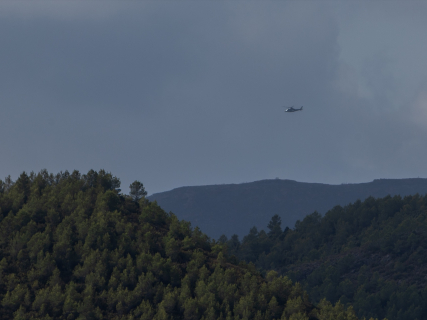
Fires in Spain today, Thursday, August 27: Collserola is already controlled and Pina de Montalgrao leaves a new stabilized focus.

The fire in Barcelona has been controlled after affecting 54 hectares, while the new fire declared in Castellón during the day on Wednesday was stabilized shortly after.

3 minutes

incendios 27 agosto

incendios 27 agosto

Add DEMÓCRATA to Google

Ask FREN

Published

Last updated

3 minutes

Most read

The situation of the wildfires presents this Thursday, August 27, a favorable evolution in the main hotspots recorded during the last hours. The fire declared in Collserola, in Barcelona, has been controlled after several days of work and after affecting 54 hectares, while the teams maintain vigilance over the perimeter to avoid possible reproductions. 

The main news from the previous day occurred in Pina de Montalgrao, in Castellón, where a new wildfire mobilized ground and aerial resources during the afternoon. The rapid intervention allowed to stabilize the fire in about an hour and a half, while the fire in Segorbe remains controlled and other large hotspots from August are still in the surveillance phase.

Collserola is controlled after affecting 54 hectares

The fire declared in the Natural Park of the Sierra de Collserola, in Barcelona, has been controlled after affecting 54 hectares. The fire forced during the emergency to preventively confine the neighborhoods of Torre Baró and Ciutat Meridiana and to evacuate about 30 homes.

The improvement of conditions during the night and the work of the teams allowed to consolidate the perimeter and advance to the control phase. The Firefighters continue on the ground to eliminate possible secondary hotspots and complete the extinction work, while the investigation into the causes of the fire is maintained.

Pina de Montalgrao leaves a new stabilized wildfire

The most relevant new hotspot in the last hours was declared on Wednesday in Pina de Montalgrao, in the province of Castellón. The fire mobilized four units of forest firefighters, a ground team from the Provincial Consortium, a forest coordinator, and four aerial resources after confirming that the fire affected forest mass.

The evolution was favorable and the fire was stabilized approximately an hour and a half after being declared. The aerial resources were able to withdraw and the ground teams continued working on the affected area to complete the extinction work. 

Segorbe remains controlled after affecting 633 hectares

The fire in Segorbe, caused by a lightning strike and spread to the surroundings of Gátova, remains controlled after six days of work. The last confirmed affected area amounts to 633 hectares within the surroundings of the Natural Park of the Sierra Calderona. 

The control declaration has allowed leaving behind the most serious phase of the emergency, although the fire has not yet been extinguished. The operation maintains surveillance and consolidation work on the perimeter while some restrictions continue in the affected environment.

Pinofranqueado maintains surveillance after being controlled

The fire in Pinofranqueado, in the Cáceres region of Las Hurdes, remains controlled after the emergency that forced the evacuation of several hamlets and kept the town of Nuñomoral confined. The favorable evolution allowed the danger level to be reduced to zero and to move to a phase focused on perimeter surveillance.

The work continues in the affected areas as recovery progresses after a fire that left thousands of hectares burned and maintained one of the largest extinguishing devices of August for several days.

The major fires of August advance towards the final phase

The favorable evolution of recent days has allowed other major hotspots, such as Las Peñas de Riglos, in Huesca, or the fire of Niebla, between Huelva and Sevilla, to leave behind the emergency phase. The devices maintain monitoring work in the affected areas before they can be declared definitively extinguished.

Attention is now focused on monitoring possible re-ignitions and on new hotspots that may arise in a period in which temperature, wind, and dryness of the land continue to be determining factors for the evolution of the fires.

More key points, information and questions with FREN

AI-GENERATED CONTENT

What are the established procedures and protocols for the official declaration of the extinction of a forest fire in Spain?

In Spain, there is no single state regulation that details step by step how and who must declare a forest fire extinguished, because operational competence lies with the autonomous communities. However, the regional protocols are very similar to each other and follow a common scheme of phases, commands, and verifications before officially declaring a fire extinguished.

1. Operational phases of a forest fire

In practice, almost all administrations use four main states:

  • Active fire: the fire spreads freely, with advancing flame fronts that require continuous direct or indirect attack. It is the phase of maximum mobilization of ground and aerial resources.
  • Stabilized fire: it is considered that there is no uncontrolled perimeter advance, because the defense lines (water lines, firebreaks, controlled burns) are working. Still, the interior of the perimeter continues to have active spots and a lot of residual heat.
  • Controlled fire: the extinction command estimates that the fire does not have the capacity to spread outside the perimeter again, except under extraordinary meteorological circumstances. Inside the perimeter, there may still be hot spots, burning logs, or embers.
  • Extinguished fire: it is considered that there are no active spots or embers capable of reactivating within the perimeter, neither on the surface nor in depth. The extinction device is lifted and, at most, it moves to an ordinary preventive surveillance phase.
2. Who has the competence to declare each phase

The basic competence in forest fire extinction lies with the autonomous communities, through their forestry services, regional firefighters, or provincial consortia. Within the device, it is usually organized as follows:

  • Extinction Direction or Technical Director of Extinction (often a forestry engineer or designated fire officer): is the one who, at the Advanced Command Post (PMA), proposes and decides the transition between operational phases (active, stabilized, controlled, extinguished) based on technical data.
  • Intervention Command or Operations Chief: coordinates the different teams on the ground and reports the situation in each sector of the perimeter to the Extinction Director. Their reports are decisive for changing phases.
  • Autonomous Operational Coordination Center (CECOP / CECOES / regional CECOPI, depending on the region): receives the proposal from the Extinction Director and validates it for institutional communication purposes. In significant fires, the declaration of “controlled” or “extinguished” is also communicated by the competent Department (environment, interior, etc.).
  • General State Administration: when state resources have intervened (UME, amphibious planes, state brigades), it does not declare extinction by itself; it coordinates with the autonomous community and withdraws or maintains its resources according to the decisions of the regional extinction command.
3. Technical verifications prior to declaring a fire extinguished

Before moving from “controlled” to “extinguished,” a series of technical checks are carried out, which usually include:

  • Complete perimeter review: brigades and crews walk the entire fire line on foot, checking edges, slopes, hollow logs, and hard-to-access areas. They look for any residual hot spots.
  • Use of thermal cameras: either portable or installed on drones or helicopters, to detect heat pockets not visible to the naked eye, especially in large surface fires or dense forest masses.
  • Finishing and liquidation: manual extinction with water or tools of any detected incipient spot, with special attention to roots, stumps, peat, or accumulations of fine fuel.
  • Surveillance during a minimum period: depending on meteorology (wind, temperature, humidity) and fuel type, a surveillance service is maintained with mobile patrols, watchtowers, or cameras. In some protocols, the definitive extinction is not proposed until a certain number of hours without reactivations have passed.
4. Documentation and coordination with Civil Protection and the State

The declaration of each phase change is reflected in the operational documentation:

  • Periodic situation reports prepared at the PMA (with provisional affected area, mobilized resources, fire evolution, and operational phase).
  • Final fire report or record, which includes the official time of stabilization, control, and extinction, as well as data on damages, probable causes, and resources used.

In terms of coordination:

  • The regional CECOP informs Civil Protection (regional and, if applicable, state) of each phase change, for managing evacuations, confinements, road closures, or lifting measures.
  • When the fire has required activation of a Special Civil Protection Plan for Forest Fires (INFO, INFOPA, etc.), the declaration of “extinguished” serves as a basis to deactivate the plan or lower its emergency level.
  • If General State Administration resources have intervened, the situation is formally communicated so that the UME and other resources can withdraw or remain only on surveillance tasks, as agreed by the unified command.

In summary, the official declaration of extinction is a technical decision by the Extinction Director, validated and communicated by the competent regional authority, supported by thorough perimeter verifications and coordinated with Civil Protection and, where applicable, with the State when state resources have intervened.

Can you explain with real examples how the declaration of extinguished fire has been managed in some of the major recent forest fires in Spain? What differences exist between the protocols of the different autonomous communities for declaring a forest fire as controlled and extinguished? How are civil protection plans (INFO, INFOPA, etc.) coordinated with the phases of a forest fire and its extinction declaration?

What competencies do the autonomous and state fire brigades have in the management of forest fires according to current legislation?

How many large-scale forest fires have been recorded in Spain during the summer in the last five years?

The official information available in the consulted documents does not provide, in a closed and broken down by summer manner, a complete series of “large forest fires” (GIF, more than 500 hectares) for each of the last five years. However, it does allow approximating the order of magnitude and having very clear annual figures for 2023‑2025, which are the best documented years: around 19 GIF in 2023, 17 in 2024, and between 61 and 65 GIF in 2025, most concentrated in the summer months.

Definition and sources

According to the Ministry of the Interior and MITECO, a large forest fire (GIF) is one that exceeds 500 hectares burned. This category is systematically used in the General Forest Fire Statistics and in campaign summaries.

The data we can extract precisely mainly come from:

  • Notes and summaries from the Ministry of the Interior and MITECO (for example, the 2023 campaign summary by CECOD, included in the Interior Ministry note of 5/8/2024: Ministry of the Interior note).
  • 2024 monitoring reports from the Ministry of the Interior: 2024 monitoring report.
  • Ministerial orders of minimum services that include 2025 campaign statistical data, such as the Order TED/1068/2025, or Interior notes on the campaign extension: 2025 campaign extension.

Data by years (with summer emphasis)

2023

The State Coordination and Direction Committee (CECOD) made a balance of the 2023 campaign in the Interior Ministry note of 5/8/2024. It indicates that:

  • In 2023, more than 7,700 fires occurred, affecting 89,068 ha.
  • 19 large forest fires (over 500 ha) were recorded throughout 2023.

It is not broken down how many of those 19 GIF were strictly between June and September, but by the usual pattern, it can be assumed that the vast majority occurred in summer.

2024

The 2024 monitoring report from the Ministry of the Interior, released on 09/13/2024, offers a clear figure:

  • In 2024, just over 5,800 fires occurred, affecting 48,550 ha.
  • Only 17 were large forest fires, which burned about 17,287 ha (around 40 % of the total burned area) according to that report.

Again, the document does not offer a “summer only” cut, but practically all GIF are concentrated in the high-risk campaign (June‑October), with the peak in July‑September.

2025

2025 appears in all sources as an extraordinarily bad year in terms of large fires:

  • Orders TED/1067/2025 and TED/1068/2025 (BOE of 09/30/2025) record that, between January 1 and September 14, there had been 61 large forest fires (GIF), tripling the decade average, with 348,349.93 ha of forest affected (Order TED/1067/2025, Order TED/1068/2025).
  • NGOs like Greenpeace and WWF raise the figure to 63–65 GIF in all 2025, always with the same definition (>500 ha), according to their statements analyzed in the investigation.

Those 61‑65 GIF are very mostly concentrated in summer and early autumn of 2025, when the strong increase in burned area occurred.

2021 and 2022

For 2021 and 2022, the specifically reviewed documents do not provide a closed number of GIF for the whole year or summer, although they do contextualize:

  • 2022 is described in several sources as one of the worst years of recent decades, with about 268,000 ha affected in Spain, but without an official GIF figure in the consulted texts.
  • The detailed annual reports from MITECO and the General Forest Fire Statistics include that series, but they have not been recovered in complete numerical format in this search.

Conclusion: what can we say about the summers of the last five years

With the located information, it can be said that:

  • In the last five summers, the number of large forest fires in Spain has ranged between around 17‑19 GIF in relatively benign years (2023‑2024) and more than 60 GIF in the extremely adverse summer of 2025.
  • For 2023, 2024, and 2025, we do have clear official annual data (19, 17, and at least 61 GIF respectively), with the caveat that the statistics refer to the whole year and not exclusively to the summer months, although the summer concentration is evident.
  • For 2021 and 2022, the reviewed sources confirm the severity (especially 2022), but without detailed GIF figures; one would have to go directly to the full MITECO series to have the exact breakdown by year and season.

In summary, official data show a worrying trend: large fires are less frequent than small incidents, but they concentrate a disproportionate part of the burned area and, in years like 2025, they spike to figures far above the historical average during summer.

Play

Test your knowledge with FREN!

How much do you know about this topic? Answer the following 3 questions.

What measure was taken during the emergency in the Collserola fire?

Question 1 of 3

What area was affected by the Segorbe fire?

Question 2 of 3

What was the main news related to fires on the previous day?

Question 3 of 3

Hola, soy Fren. ¿Cómo te ayudo?