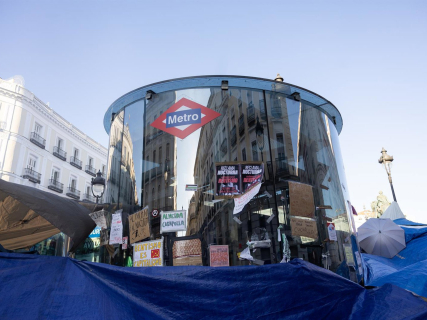

The Sol Metro station will remain closed "until further notice" to carry out "urgent cleaning works" after high levels of ammonia were detected due to the accumulation of urine, feces, and other organic waste linked to the camping in favor of housing at Puerta del Sol. Despite this, the Cercanías station and access through 'the whale' continue to operate as "no health problems" have been noted.
The president of the Community of Madrid, Isabel Díaz Ayuso, explained this Friday in an interview that the regional government ordered the closure of the Metro station following the request of occupational risk prevention services and the unions, who alerted to the "unsanitary conditions" existing inside.
According to sources from the regional government, the closure occurred at 12:15 PM due to the impossibility of "guaranteeing the safety of the workers." The reopening is contingent upon the complete removal of the substances accumulated in the pits and ventilation systems.
Díaz Ayuso has denounced that "nobody knows what is being suffered in the center of Madrid" and that citizens cannot "go shopping and to restaurants." She has also stated that "all the surrounding streets and all the shops are empty because people are afraid to go shopping in that environment," as she noted on 'esRadio' in statements collected by Europa Press.
In the same interview, she held the president of the government responsible for the situation. "What is happening in Madrid is Pedro Sánchez, who has decided that he is going to keep the city wrecked, stuck, uncomfortable because he cannot stand that we are doing well and because he wants to show the Spain that awaits us," she reproached.
Claim to the government delegate and effects on the service
Later, the counselor of Housing, Transport, and Infrastructure, Jorge Rodrigo, sent a letter to the government delegate, Francisco Martín, in which he conveys these facts and urges him to take measures to evict the camping, in order to allow access to the square for the teams and means necessary for urgent sanitation tasks.
In his writing, the counselor details that Metro has attended to the request of the Prevention and Occupational Health Area of the public company, which demanded to stop the activity at the station and suspend the usual work, "until the necessary tasks are carried out and it is confirmed that the sanitary conditions are restored."
The cleaning operation requires that specialized teams can enter the ventilation shafts through the exterior grates located on the surface of the square, something that at the moment is not possible as they are occupied by the camping.
Until it is possible to intervene at these points, the Sol station "will not provide service," emphasized Rodrigo. Thus, none of the three Metro lines that converge at this interchange will stop at Sol until further notice, which will force travelers to reorganize their routes using nearby alternative stations.
The regional government has apologized for the inconveniences that this measure may cause in the movements of the people of Madrid, but emphasizes that it maintains its priority in the protection "of the health and well-being of Metro workers."
The counselor had already sent another letter on Thursday to the government delegate in which he warned of the "serious health conditions" at the Sol Metro station "due to the accumulation of urine, excrement, and other organic waste in the shafts and ventilation accesses" and in which he insisted on the need to dismantle the camping.
In that letter, the regional official also detailed the health risks arising from this situation. "In a closed space where urine accumulates, the combination of natural evaporation, bacterial decomposition, and lack of ventilation generates a complex mixture of gases, vapors, and organic and inorganic aerosols. The main process is due to ureal fermentation: environmental bacteria (producers of the enzyme urease) rapidly decompose the urea from urine," he explained to the delegate.
Cercanías keeps its station open and without incidents
For its part, sources from Cercanías have indicated that in its Sol facilities no "health problems" have been noted and, therefore, the main access, known as 'the whale', which is under its custody, remains operational. "Cercanías trains will stop at the Sol station as on a normal day," they have emphasized.
The company has insisted that "it has not detected these health problems nor has there been any incident related to the camping taking place in Sol, so it finds no reason for the closure."
Renfe Cercanías Madrid has added that it has not received any instruction from the authorities to close the station and that it has opted to keep the main access, that of "the whale," which it manages directly, open, after verifying that "there are no such health problems and that no security incidents have been recorded during these days due to the camping in Sol."
Consequently, the Cercanías trains on lines C-3 and C-4 a and b will continue to make commercial stops in Sol this Friday the 16th, with total normality.
The Sol station is a node shared by Metro and Cercanías, with several accesses, of which only the main one depends on Cercanías. From the state operator, they recall that on other occasions this access has been closed by police decision or by the Delegation of the Government due to possible crowds, such as during large demonstrations in the square, concerts, or the lighting of the Christmas lights.