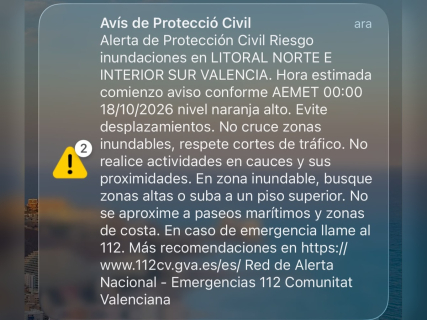
Civil Protection activates the ES-Alert in Valencia due to flood risk and asks to avoid travel

The alert, sent to mobile phones, warns of an episode of rain with a high orange level starting at 00:00 hours on Sunday, October 18, on the northern coast and southern interior of Valencia.

alerta esalert valencia 1200x900

alerta esalert valencia 1200x900

Add DEMÓCRATA to Google

Ask FREN

Published

Last updated

1 minute

Most read

Elecciones 29N · Encuestas

La media de las encuestas

Media a 17 de noviembre de 2026 · 17 institutos

  • PP31,4 %
  • PSOE27,2 %
  • Vox18,9 %
  • Frente Amplio6,2 %
  • ERC2,4 %
01020304050ene 2024jul 2024ene 2025jul 2025ene 2026jul 2026

Media del último estudio de cada instituto en 30 días y su evolución semanal desde el 23J. Partidos con al menos un 2 %.

Todas las encuestas

Elecciones generales del 29 de noviembre · Demócrata

Civil Protection has sent this Saturday an ES-Alert to the mobile phones of Valencia due to the risk of flooding expected for the coming hours. The message warns of a rainfall episode of high orange level that, according to the information provided by the State Meteorological Agency (Aemet), will begin at 00:00 hours on Sunday, October 18.

The alert affects the northern coast and the southern interior of the province of Valencia and has been disseminated through the National Civil Protection Alert Network. Authorities recommend avoiding travel, not crossing flood-prone areas, and respecting traffic closures that may be established.

Civil Protection asks to stay away from ravines and flood-prone areas

The notice sent to citizens includes several safety recommendations due to the risk of flooding. Civil Protection asks not to carry out activities in riverbeds or in their proximity and warns of the need to seek elevated areas or go to upper floors if found in a flood-prone area.

It also recommends not approaching promenades or coastal areas while the adverse weather episode persists.

The message reminds that, in any emergency situation, citizens must call 112 and follow the instructions of the emergency services of the Generalitat Valenciana.

More key points, information and questions with FREN

AI-GENERATED CONTENT

What procedures and requirements must be met to activate the ES-Alert system in a Spanish province?

To activate ES-Alert in a province, it is necessary to distinguish between the decision to issue an alert, which corresponds to the authority competent in the emergency, and its technical sending, which is carried out by authorized personnel. The province can serve to delimit the affected territory, but it should not be confused with a level of authorization: what matters is who directs the emergency and which population needs to receive the warning.

Sufficient documentation has not been obtained to confirm here the official procedure applicable to each autonomous community. Therefore, the following explanation is a guide to the necessary checks, not a list of mandatory legal procedures nor an operational protocol that replaces the current one.

1. Identify the authority and applicable procedure

The first check is to determine who has the competence to decide the warning in the specific scenario. For this, the applicable civil protection plan, its population information procedure, and the ES-Alert usage instructions must be consulted.

It is not advisable to assume that the same provincial, autonomous, or state authority must always authorize it. Nor should it be presumed that a request from a town hall alone equates to an order to send: it is necessary to identify the decision-making body and the authorized center that would execute that decision.

2. Justify the need for the warning

Before issuing it, the operational evaluation must specify:

  • The danger: what is happening or may happen and what information supports it.
  • The urgency: why it is necessary to warn at that moment.
  • The exposed persons: which areas may suffer consequences.
  • The protective behavior: what recipients should do to reduce the risk.

These are safety and message usefulness checks. Without consulting the corresponding protocol, it cannot be stated that there is a single threshold for all of Spain nor that any meteorological warning automatically activates the system.

3. Delimit the sending area

The decision must be translated into a precise geographical delimitation. Before selecting the entire province, it must be checked whether the danger really affects all its territory or only certain municipalities or sectors.

It is also advisable to review neighboring areas and coordinate decisions when the risk extends to other territories. The goal is to avoid both leaving people exposed without warning and generating unnecessary or confusing instructions with an overly broad message.

4. Prepare, authorize, and verify the message

As an operational drafting criterion, the warning should identify the danger and the affected area, indicate a clear action, and point out where to obtain official information. It is important to avoid contradictory instructions, technical jargon, and ambiguous temporal references.

Before sending, the text, territorial scope, and correspondence between both must be verified. Authorization and technical checks must comply with the issuing center's procedure. A double validation system, a specific signature, or a particular form cannot be considered mandatory without checking their current instructions.

5. Execute the sending and maintain follow-up

The action does not end by pressing the send order. Emergency management must consider how to verify its execution, coordinate information through other channels, and decide if new instructions, an update, or a communication of the end of the danger are needed.

In summary: for a real case, the decisive documentation is the applicable civil protection plan and the authorized ES-Alert procedure. With them, four questions must be resolved: who decides, who sends, to which area, and with what instructions.

What are the competencies and powers of Civil Protection in emergency management according to Spanish legislation?

In Spain, Civil Protection is a system of action by public administrations, not a single body with all competencies over emergencies. Its main framework is the Law 17/2015, of July 9, of the National Civil Protection System: it includes prevention, planning, response, and recovery, through coordination of the State, autonomous communities, and local entities.

1. Prevention, preparation, and planning

The competent administrations must identify and assess risks, reduce their possible consequences, and prepare the necessary resources. Among their powers are:

  • Analyze threats and vulnerabilities, develop risk maps, and assess the impact on emergencies of certain activities.
  • Promote preventive information, awareness, and citizen self-protection, ensuring accessibility for people with disabilities and vulnerable groups.
  • Develop plans that determine organization, mobilization of means, and administrative coordination: General State Plan, autonomous or local territorial plans, special plans, and self-protection plans.

The Government approves the Basic Civil Protection Standard, the General State Plan, and special plans of state competence. Additionally, the law provides for a mandatory emergency training plan for all non-university educational centers, developed through state and autonomous collaboration.

2. Detection, monitoring, information, and alert

The National Alert Network communicates warnings to competent authorities to keep essential services and the public informed. Public bodies that detect imminent danger threats must immediately communicate them to the National Emergency Monitoring and Coordination Center.

This center, part of the Directorate General of Civil Protection and Emergencies, manages national information and alert networks. Autonomous bodies channel emergency information and transmit corresponding alerts. Plans must include preventive communication programs and warnings that allow protective measures to be adopted.

3. Direction and operational response

Direction corresponds to the authority provided in the applicable plan; it is not automatically attributed to the State for intervening state resources. According to their functions, emergency technical services, firefighters, health services, police, rescue, forestry services, and Armed Forces, including the Military Emergency Unit, participate.

Autonomous centers can act as operational coordination centers. Volunteer organizations and collaborating entities, when requested, act subordinated to public services: they do not replace the responsible authority nor exercise independent command.

4. Territorial distribution and state competencies

Autonomous communities and local entities exercise their competencies through their services and plans. The State can provide human and material resources to emergencies not declared of national interest; police and military forces maintain their natural commands and act under the direction provided in the plan.

The Minister of the Interior promotes and coordinates state policy, directs state competence plans, and declares emergencies of national interest and their termination. In the latter, they assume the corresponding direction and coordination, and the national center acts as an operational coordination center.

Government delegates coordinate state services territorially. The National Civil Protection Council articulates cooperation between the State, autonomous communities, and local administration.

5. Recovery and external cooperation

After the immediate response, Civil Protection includes actions to restore normality, assess damages, and coordinate aid. The Government can declare an area severely affected by an emergency; recovery aid contributes to restoration and is not compensatory.

Finally, the Interior Ministry is the Spanish contact point for the European Union Civil Protection Mechanism and can mobilize resources for disasters in third countries according to treaties, agreements, or Government accords.

What regulations govern the issuance of emergency alerts and coordination among different emergency services in Spain?

In Spain, the issuance of alerts and emergency coordination are regulated through a framework of civil protection, telecommunications, and territorial planning, not by a single norm. The central references are Law 17/2015, of the National Civil Protection System; Law 11/2022, General Telecommunications; and Royal Decree 903/1997, related to 112. To determine who warns, who directs, and how each service intervenes, the plans applicable to the territory and risk must also be consulted.

1. Law of the National Civil Protection System

The Law 17/2015, of July 9, constitutes the general framework. Its most relevant provisions for this matter are:

  • Article 6: recognizes the right to receive information about collective risks, protection measures, and behaviors the population must follow. Information must be provided during the emergency and also preventively.
  • Article 12: creates the National Civil Protection Alert Network, managed by the Ministry of the Interior through the National Emergency Monitoring and Coordination Center. Bodies that detect threats must communicate them immediately; autonomous bodies channel information and transmit the alert to the corresponding party.
  • Articles 14 and 17: establish plans as instruments to mobilize resources and coordinate administrations. They integrate, among others, civil protection, firefighters, security forces, health emergencies, rescue, and Military Emergency Unit.
  • Article 18: assigns the national center functions of information, alert, and connection between administrations.
2. Alerts to mobile phones and other channels

Article 75 of Law 11/2022, of June 28, obliges mobile operators to transmit public alerts in the event of major disasters or imminent or ongoing emergencies, under terms to be determined by regulation.

Additionally, it allows establishing other electronic, audiovisual channels or applications by royal decree, provided they have equivalent effectiveness in coverage and reach, including temporarily present persons. Reception must be simple and transmission free for both recipients and the issuing entity. It is advisable to distinguish this technical transmission obligation from the decision to issue the warning, which must be framed within civil protection competencies and plans.

3. Attention and coordination through 112

Royal Decree 903/1997, of June 16, regulates access to the European emergency number. Its articles 2 and 3 allow requesting urgent health assistance, fire extinguishing, rescue, citizen security, and civil protection free of charge, regardless of the responsible administration.

Its article 2.2 requires service providers to adopt measures and enter into agreements or conventions necessary to ensure a rapid, orderly, and effective action, especially when services do not depend on them. Therefore, 112 facilitates joint response but does not replace the competencies of each service.

4. Regulatory development and operational plans

Royal Decree 524/2023, of June 20, approves the Basic Civil Protection Standard. This regulatory level is complemented by the General State Emergency Plan, approved in December 2020, and the territorial, special, and self-protection plans legally provided.

There are also specific guidelines for adverse meteorological phenomena, floods, forest fires, and transport of hazardous goods, published on April 27, 2026. For a specific emergency, the autonomous regulations and the activated plan complete this state framework and determine its operational application.

Play

Test your knowledge with FREN!

How much do you know about this topic? Answer the following 3 questions.

Why has Civil Protection sent an ES-Alert warning to the mobile phones in Valencia?

Question 1 of 3

What specific recommendation does Civil Protection make during the heavy rain episode?

Question 2 of 3

What number should citizens dial in case of emergency according to the warning?

Question 3 of 3