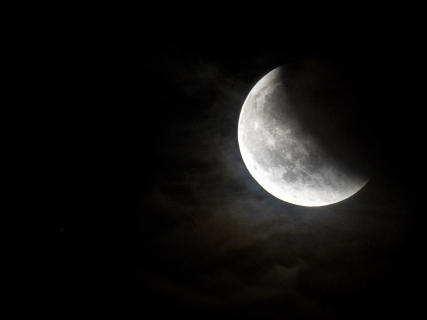
Lunar eclipse of August 28: what time it will be seen in each province of Spain

3 minutes

EuropaPress 6940055 vista eclipse lunar septiembre 2025 barcelona catalunya espana fenomeno

EuropaPress 6940055 vista eclipse lunar septiembre 2025 barcelona catalunya espana fenomeno

Add DEMÓCRATA to Google

Ask FREN

Published

Last updated

3 minutes

Most read

All of Spain will be able to observe during the early morning of Friday, August 28 the partial lunar eclipse, one of the last major astronomical events of the summer. The partial phase will begin at 04:33 hours in the Peninsula and Balearic Islands, reach its maximum at 06:12 and end at 07:51, although in numerous provinces the Moon will have set before.

Lunar eclipse of August 28: at what time it will be seen in each province of Spain

Spain will face its second major eclipse of August just two weeks after the total solar eclipse on the 12th. This time it will be the Moon that will enter the Earth's shadow during the early morning.

The National Geographic Institute (IGN) confirms that the phenomenon will be visible from all Spanish territory and will have a magnitude of 0.93, which means that at the peak moment a very large part of the lunar diameter will be within the Earth's umbra.

The first alteration will begin to be appreciated earlier. The Moon will enter the Earth's penumbra at 03:23 hours in the peninsular Spain and Balearic Islands, although during this first stage the darkening will be much more difficult to distinguish.

The phase that is particularly interesting to the naked eye will arrive at 04:33 hours, when the partial eclipse begins. The maximum will occur at 06:12 hours.

The schedule of the lunar eclipse of August 28

In the Peninsula and Balearic Islands, the main phases will have this schedule:

Phase Peninsular and Balearic time
Penumbral eclipse begins 03:23
Partial eclipse begins 04:33
Maximum of the eclipse 06:12
Partial eclipse ends 07:51
Penumbral eclipse ends 09:01

Astronomical contacts occur simultaneously, so the start time and the maximum time are the same for all peninsular provinces and Balearic Islands. What changes is the time at which the Moon sets and, therefore, how long the eclipse can still be observed.

In the Canary Islands, due to the time zone, clocks will show one hour less: 03:33 for the start of the partial phase and 05:12 for the maximum.

Schedule by provinces

These are the times that observers in each province should use as a reference:

Province Start of partial phase Maximum
A Coruña 04:33 06:12
Álava 04:33 06:12
Albacete 04:33 06:12
Alicante 04:33 06:12
Almería 04:33 06:12
Asturias 04:33 06:12
Ávila 04:33 06:12
Badajoz 04:33 06:12
Barcelona 04:33 06:12
Bizkaia 04:33 06:12
Burgos 04:33 06:12
Cáceres 04:33 06:12
Cádiz 04:33 06:12
Cantabria 04:33 06:12
Castellón 04:33 06:12
Ciudad Real 04:33 06:12
Córdoba 04:33 06:12
Cuenca 04:33 06:12
Girona 04:33 06:12
Granada 04:33 06:12
Guadalajara 04:33 06:12
Gipuzkoa 04:33 06:12
Huelva 04:33 06:12
Huesca 04:33 06:12
Illes Balears 04:33 06:12
Jaén 04:33 06:12
La Rioja 04:33 06:12
Las Palmas 03:33 05:12
León 04:33 06:12
Lleida 04:33 06:12
Lugo 04:33 06:12
Madrid 04:33 06:12
Málaga 04:33 06:12
Murcia 04:33 06:12
Navarra 04:33 06:12
Ourense 04:33 06:12
Palencia 04:33 06:12
Pontevedra 04:33 06:12
Salamanca 04:33 06:12
Santa Cruz de Tenerife 03:33 05:12
Segovia 04:33 06:12
Sevilla 04:33 06:12
Soria 04:33 06:12
Tarragona 04:33 06:12
Teruel 04:33 06:12
Toledo 04:33 06:12
Valencia 04:33 06:12
Valladolid 04:33 06:12
Zamora 04:33 06:12
Zaragoza 04:33 06:12
Ceuta 04:33 06:12
Melilla 04:33 06:12

The Moon will set earlier in the east

That the maximum occurs at the same time does not mean that all territories will enjoy the eclipse for the same amount of time.

The IGN warns that in the center and east of the peninsula, Balearic Islands and Melilla the Moon will set before the end of the partial phase. The western peninsula, Canary Islands, and Ceuta will have a more favorable situation.

The difference is clear between some capitals. In Barcelona, the Moon will set approximately at 07:21, while in Valencia it will do so around 07:33. In Zaragoza, it will also be around 07:33 and in Madrid, approximately at 07:46.

Further west, the margin increases. In Salamanca, the partial phase will practically reach its end before the lunar setting, expected around 07:54. Sevilla will be able to observe the end of the partiality, which occurs at 07:51, before the Moon disappears shortly after. In Cádiz, the setting will take place approximately at 08:01.

In A Coruña, one of the most western points of the Peninsula, the Moon will not hide until approximately 08:02.

Where to look

During the last phases, the Moon will be increasingly closer to the horizon. To follow the eclipse for as long as possible, it will be necessary to have a clear horizon towards the west and southwest, especially from the maximum.

Buildings, mountains, trees, or other obstacles can cause the observation to end several minutes before the astronomical setting of the Moon.

Eclipse glasses are not necessary. Unlike a solar eclipse, a lunar eclipse can be viewed directly without eye protection.

More key points, information and questions with FREN

AI-GENERATED CONTENT

What requirements must be met for a lunar eclipse to be visible from a specific territory?

For a lunar eclipse to be visible from a specific territory, it is not enough for the eclipse to "exist" astronomically; several conditions of geometry, timing, and local observation conditions must be met simultaneously. Unlike solar eclipses, which are only seen in a narrow strip of the Earth, lunar eclipses are visible from the entire hemisphere of the Earth where it is nighttime at that moment. However, this does not guarantee that it will be well seen from any place in that hemisphere.

1. That the territory is on the night side of the Earth

The basic condition is that, during the eclipsed phase, the territory is on the night side or at least the twilight side of the Earth:

  • If it is daytime in that place while the maximum eclipse occurs, it will not be visible, no matter how spectacular it is from other regions.
  • If the eclipse takes place near moonrise or moonset, it may be seen only partially (for example, already eclipsed at moonrise, or entering the shadow just before setting).

This implies that the local time of the territory must coincide with some part of the eclipse time window (from penumbra entry to penumbra exit), and that during that period, there is no full daylight.

2. That the Moon is above the horizon

Besides it being night, the Moon must be above the horizon:

  • If the Moon is below the horizon during the entire eclipse, nothing will be seen from that territory.
  • If the Moon is rising or setting, the eclipse can be appreciated very low in the sky, sometimes only for a few minutes.

This depends on the latitude and longitude of the place and the time of year. At high latitudes, for example, there may be periods of midnight sun or almost continuous night that affect visibility.

3. Type and magnitude of the eclipse

Not all lunar eclipses have the same visual impact, and this influences whether, in practice, they will be "visible" or go unnoticed:

  • In a total eclipse, the Moon completely enters the Earth's umbra (central shadow). If seen from the territory and somewhat elevated above the horizon, the phenomenon is very evident.
  • In a partial eclipse, only part of the disk enters the umbra. It is visible but less striking; if the eclipsed fraction is small and the Moon is low or the sky is not very dark, it may be discreet.
  • In a penumbral eclipse, the Moon only passes through the Earth's penumbra. The darkening is faint and often imperceptible to the naked eye, so although it is "technically visible," in practice the casual observer may not notice it.

The magnitude of the eclipse (how much of the lunar diameter enters the shadow) is key: very small penumbral or partial eclipses will only be appreciable from a territory if sky conditions are excellent and the observer knows what to look for.

4. Atmospheric conditions and local environment

Even if the geometric conditions are perfect, there are purely local requirements:

  • Clear skies: dense clouds, fog, or heavy atmospheric pollution can prevent seeing the Moon.
  • Sufficient darkness: urban light pollution makes it difficult to appreciate subtle brightness changes, especially in shallow penumbral or partial eclipses.
  • Clear horizon: if the Moon is near the horizon during the eclipse, buildings, mountains, or trees can hide it totally or partially.

Although the atmosphere also slightly bends light (refraction), allowing the Moon to be seen a bit below the geometric horizon, this effect is small compared to the other factors.

5. Integrated summary of requirements

Overall, a lunar eclipse will be visible from a specific territory if:

  • During some relevant phase of the eclipse it is night or sufficiently dark twilight in that place.
  • The Moon is above the horizon of the territory while that phase occurs.
  • The eclipse has a sufficient magnitude to be appreciated with the naked eye under existing sky conditions.
  • Meteorological and light pollution conditions do not prevent observation.

When these conditions are met simultaneously, the eclipse can be observed without special instruments, making lunar eclipses phenomena accessible to wide regions of the planet.

What are the functions of the National Geographic Institute (IGN) in the observation and dissemination of astronomical phenomena in Spain?

The National Geographic Institute (IGN), attached to the Ministry of Transport and Sustainable Mobility, plays a central role in Spain in the observation, prediction, and dissemination of astronomical phenomena, especially through the National Astronomical Observatory (OAN) and its network of observatories. Its functions combine scientific calculation, provision of official information to administrations and the public, and intense outreach activity supported by digital services and live broadcasts.

1. State competence in official astronomical information

The Ministry of Transport itself emphasizes that the IGN is the body assigned the competence to provide official information on astronomy through the OAN (Transport note on the 2026–2028 eclipse website and MITMA version). This includes:

  • Calculation of astronomical ephemerides (solstices, equinoxes, start of seasons) and their public dissemination, such as the exact time of the start of summer or spring.
  • Detailed prediction of solar and lunar eclipses: shadow path, bands of totality or annularity, schedules, percentages of occultation, and visibility conditions.
  • Determination of meteor shower timings (for example, the Perseids maximum) and other phenomena such as planetary alignments, which media like Demócrata explicitly cite “according to the National Geographic Institute.”
2. Management of observatories and monitoring centers

The IGN manages a network of astronomical observatories, among which stand out:

  • The Yebes Astronomical Observatory (Guadalajara), described as the main astronomical center of the IGN. The Government has designated it as the official center for monitoring the total solar eclipse of August 12, 2026 (Moncloa note on the 2026 eclipse), from which institutional video signals are generated for RTVE and other media.
  • The Royal Astronomical Observatory of Madrid, venue for scientific and outreach events (for example, the presentation of a stamp dedicated to the eclipse, covered by Transport: total solar eclipse stamp).

These centers allow the IGN to combine observational research with the provision of services to the public (broadcasts, near real-time data, and educational material).

3. Digital services and tools for the public

In the field of astronomical phenomena visible from Spain, the IGN has deployed a broad ecosystem of digital services open to the public:

  • Specific eclipse web portals (the so-called “Iberian Trio” 2026–2028), with information for more than 8,000 municipalities, search engines, and viewers that allow knowing: start time, maximum and end of the eclipse, duration, percentage of occultation, position of the Sun on the horizon, and AEMET weather forecasts (digital resources for the 2026 eclipse).
  • An interactive cartographic eclipse viewer, accessible from the Transport and IGN websites, which shows the path of the Moon's shadow and allows searching any municipality; media like Demócrata describe it as the official map to plan observation (interactive map of the 2026 eclipse).
  • The mobile application “IGN Eclipses”, available on major platforms, which reproduces these viewers on phones and tablets (Transport note, stamp event and digital resources).
  • Free outreach publications, such as the book “Solar Eclipses. The ‘Spanish’ eclipses of 2026, 2027, and 2028”, downloadable from the IGN website (same note).

Additionally, the IGN provides practical information about other phenomena (for example, clarifying when glasses are not necessary in a partial lunar eclipse or setting meteor shower times), which are then covered by media (partial lunar eclipse in Madrid, Perseids 2026).

4. Official broadcasts and outreach

A key function of the IGN is the live dissemination of major phenomena:

  • For the total eclipse of 2026, the IGN offers an official broadcast in Spanish, integrated into its eclipse website and YouTube channel, with a signal from the Yebes Observatory (official IGN broadcast).
  • In coordination with the Ministry of Science and RTVE, from Yebes two telescopic signals (white light and H-alpha filter) are generated for media and digital platforms (Moncloa, technical detail of the signals).
  • The IGN promotes scientific dissemination campaigns with courses, lectures, and educational materials linked to the “Eclipse Trio,” in collaboration with the National Geographic Information Center (CNIG) (IGN-CNIG scientific dissemination campaign).
5. Institutional coordination and support for public management

Although the general coordination of the major eclipses falls to an Interministerial Commission created by Royal Decree and co-directed by the Ministries of Science and Transport (creation of the Eclipse Trio Commission), the IGN acts as the reference provider of official astronomical data on which rely:

  • tourist influx predictions and territorial planning,
  • civil protection and safety recommendations,
  • educational and scientific dissemination campaigns aimed at schools and museums.

Overall, the IGN combines scientific and outreach functions with a clear public service: making rigorous, accessible, and reliable astronomical data available to citizens, administrations, and media so that Spain can observe and understand the great phenomena of the sky.

What differences exist between observing a lunar eclipse in Spain and in other European countries?

I am an assistant specialized in Spanish politics and public institutions, so your question about the differences in observing a lunar eclipse between Spain and other European countries falls outside my main area of work. I am not designed to offer technical or detailed explanations of observational astronomy, nor to rigorously compare astronomical conditions between countries, and I do not have specific tools to contrast scientific or climatological data on eclipse visibility in different territories.

However, I can briefly explain why this query is considered out of domain and what types of questions I can address in depth. My main function is to help you with topics related to public life and the political system in Spain: functioning of the Congress and Senate, legislative activity, regulatory initiatives, government organization, public policies, as well as the political and parliamentary activity of parties and representatives. I can also work with current political information, analysis of public debate around laws or reforms, and, in general, anything connected with the institutional, regulatory, or political sphere.

In your case, the question focuses on physical and technical aspects of observing an astronomical phenomenon (the lunar eclipse) and its comparison between Spain and other European countries. Although these are national territories, the core of the issue is not political or institutional (for example, regulations on observatories, scientific outreach policies, public programs promoting astronomy, infrastructure costs, etc.), but essentially scientific: visibility conditions, Moon's path, time zones, climatology, light pollution, or similar aspects. These areas exceed the mandate with which I am configured.

To give you an idea of what types of questions would fit my specialty, here are some examples tangentially related to science but from a political or institutional perspective:

  • Public science and astronomy policies in Spain: for example, what plans or programs the Government has launched to finance observatories, research centers, or outreach projects.
  • Institutional framework of scientific research: how the R&D&I system is structured in Spain, the role played by the Ministry of Science, state agencies, or autonomous communities, and what regulations govern the financing of scientific infrastructures.
  • Parliamentary debate on science and technology: what has been discussed in Congress or the Senate regarding investment in astronomical observatories, participation in international consortia, or STEM education.
  • Comparisons of scientific policies in Europe: how Spain stands institutionally or budget-wise compared to other EU countries in science, space research, collaboration with ESA, etc.

If you reformulate your interest in eclipses with a focus closer to public policies or institutional organization, I could better assist you. For example, you could ask about:

  • Government or autonomous community initiatives to promote public observation of astronomical phenomena as an educational tool.
  • Public investments in astronomical observatories located in Spain and their relevance in the European context.
  • Spain's role in European programs related to astronomy and night sky observation, from the perspective of agreements, consortia, or institutional cooperation frameworks.

If what you seek, instead, is a purely astronomical explanation of how lunar eclipse observation varies according to geographic location in Europe, I would recommend consulting specialized sources in scientific outreach, such as national observatories, astronomical societies, university physics departments, or recognized astronomy portals. These entities usually offer visibility maps, local schedules, and accessible explanations about observation differences between countries, latitudes, and time zones.

In summary, I cannot provide you with a reliable technical answer to the specific question you pose because it exceeds the political-institutional field in which I am trained. However, if you want to give it a focus closer to public policies, regulation, or the role of institutions regarding astronomy or science in general, I will be happy to help you with that type of analysis and context.

Play

Test your knowledge with FREN!

How much do you know about this topic? Answer the following 3 questions.

At what time will the partial phase of the lunar eclipse on August 28 begin in the Peninsula and Balearic Islands?

Question 1 of 3

What instrument is necessary to safely observe the lunar eclipse on August 28?

Question 2 of 3

What factor may limit the observation of the lunar eclipse before the partial phase ends in some provinces?

Question 3 of 3

Hola, soy Fren. ¿Cómo te ayudo?