
Concern continues over the possible new attempt of mass arrival of immigrants to Ceuta. Morocco has reinforced the security device at the border in response to the call spread on social media for this August 15. The deployment is especially concentrated in Fnideq, where Moroccan authorities have increased the presence of police and military and have reinforced the border perimeter.
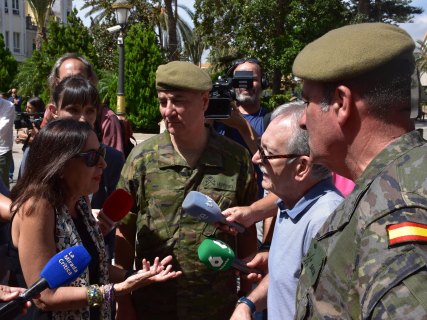
Spain also maintains an extraordinary device in Ceuta, which has been expanding over the last few days. The deployment reaches around 1,600 police and civil guards, in addition to about 2,000 military personnel. The Interior has incorporated new agents from National Police and the Civil Guard maintains measures to ensure the availability of its forces in the face of the risk of a new attempt.
Morocco secures Fnideq and acts against the organizers
Moroccan authorities have reinforced the fences with new protective elements and have deployed forces at various points around Fnideq. There have also been arrests of individuals attributed with promoting the calls to go to the border.
The movement from Rabat introduces a new element regarding the situation analyzed in recent days: the response is not limited to controlling the perimeter, but also targets those who promote the calls.
Spain maintains a device that exceeds that of the days following July 30
The Spanish reinforcement has also continued after the initial deployment. The Interior sent this week about twenty agents from the Central Brigade of Immigration and Borders to expedite the procedures related to the migrants remaining in Ceuta and announced the arrival of another 45 personnel from the Prevention and Reaction Unit. They are joined by police reinforcements, Civil Guard, and maritime and aerial units previously deployed.
The Civil Guard has also restricted new permits, vacations, and licenses for agents stationed in Ceuta and Melilla to maintain operational capacity. The measure was adopted in light of the risk scenario linked to the call on August 15. In parallel, the military presence remains reinforced in the autonomous city.
Marlaska raises the message of deterrence
The Minister of the Interior, Fernando Grande-Marlaska, has accompanied the operational reinforcement with a message directed at those who may be considering attending the call. Marlaska has warned against the promises of the mafias and has defended that people who remain in Ceuta after an irregular entry will be subjected to the corresponding procedures, without the irregular arrival being a way for their regularization or transfer to the Peninsula, except for situations that require specific protection.
The minister has also reiterated that Ceuta and Melilla are Spanish, after the statements of the Moroccan Justice Minister in which he again claimed both cities. The Minister of Defense, Margarita Robles, has maintained the same message during her recent visit to Ceuta, at a time when political tension is added to the reinforcement of border surveillance.
The mobilization network has changed since July 30
The deployment of the authorities occurs on a different scenario than that which existed before the massive entry into Ceuta at the end of July. Golden Owl, a technology company from the Scientific Park of Alicante specialized in transforming large volumes of data into business intelligence.
The analysis points out that some of the most visible groups ceased to function after the pressure exerted on them and that the activity shifted towards less evident communities. This means that mobilization may now be more difficult to locate in open networks, although the existence of a call for August 15 maintains the risk scenario that the authorities are trying to prevent.