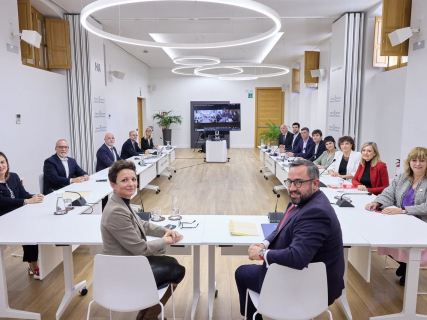

The joint commission of the Navarra-State Transfer Board confirmed this Monday the agreement by which the Foral Community will assume responsibility for Scientific and Technical Research and Development and Innovation (R&D&I), a pact that had already been endorsed last week by the Navarra representation in this body.
After the meeting, held at the Palace of Navarra, the first vice president, counselor of Presidency and Equality and spokesperson for the Foral Government, Javier Remírez, the Secretary of State for Territorial Policy, Miryam Álvarez, and the Secretary of State for Science, Innovation and Universities, Juan Cruz Cigudosa, appeared before the media to detail the scope of the transfer.
Remírez expressed a "very positive assessment as the Government of Navarra," recalling that this is "a matter we have been negotiating for more than two years." He emphasized that it is "the fifth transfer since 2019" and that it "ratifies a path by the Government of Navarra of intelligent self-government that will allow us to implement a transfer that is absolutely fundamental and key for the Foral Community of Navarra." "In that sense, we make a very positive assessment," he reiterated.
Likewise, he wanted to acknowledge the "negotiating willingness" of the central Executive. As he indicated, "we have a very positive reading of this agreement, which will be implemented starting January 1 of the next year 2027," and he expressed his "satisfaction with this agreement that consolidates a line of work, collaboration, and dialogue with the Government of Spain, which understands the Foral Community of Navarra." He also announced that "in that line we will continue working in the future, in the next legislature, to continue advancing in competencies and transfers that we are pending, both scholarships and also the part of Labor Inspection and Social Security."
For her part, Álvarez emphasized that "with this transfer we comply with the Spanish Constitution" and the Lorafna, and she considered that "it will serve to bring science closer to the citizens of Navarra and to promote to a greater degree the participation of companies in innovation, development, and research." She also took the opportunity to "thank the political groups that participate in this Transfer Board for their support of this transfer, which will serve to improve the quality of life of the citizens of Navarra."
In the same line, Juan Cruz Cigudosa has stated that "it is a pride to complete this process of transferring the competencies of R&D+i." He has emphasized "the capacity that the Foral Community of Navarra will have to design and promote innovation, the transfer of technology to society and to companies" and has also highlighted "the capacity to design, execute, and control specific R&D+i programs for the territory, with what this entails," in addition to the coordination with the State of "that complete activity."
He has also specified that "this does not diminish or hinder any of the capacities that the agents of the Navarrese ecosystem have to participate in state calls. That does not change at all. With this, we add a layer of coordination to optimize resources. Those are basically the three things that have been signed today."
According to a note from the Ministry of Territorial Policy and Democratic Memory, the transfer "establishes a framework for cooperation for the development of research, scientific and technical development, and innovation activities in Navarra."
By virtue of this agreement, the Foral Community will assume the functions of organization, planning, promotion and encouragement, management of programs and projects, and coordination of actions in the fields of research, scientific and technical development, and innovation. In turn, the General Administration of the State and Navarra will collaborate in strengthening the research infrastructure in the Foral Community, in the programming and execution of projects, and in the creation of information mechanisms, service provision, and support.
The Government of Navarra has detailed that, once the agreement is formalized by the joint commission of the Transfer Board, the next steps will be its approval by the Council of Ministers through Royal Decree and its publication in the Official State Gazette (BOE) and in the Official Gazette of Navarra (BON).
The transfer is supported by Article 44 of the Organic Law of Reintegration and Improvement of the Foral Regime of Navarra, which recognizes the Foral Community's exclusive competence in scientific and technical research, without prejudice to the powers of promotion and general coordination that correspond to the State.
Economic valuation of the transfer
To determine the economic valuation of the agreement, the items from the General State Budgets of the Ministry of Science, Innovation and Universities that fund structural, permanent activities or directly linked to the functioning of the transferred services have been identified.
These selected items total around 829 million euros, which represents about 13.3 million euros for the regional administration, applying the current allocation index in Navarra.
The Navarrese entities will be able to continue opting normally for the competitive bidding calls promoted by the State, so the estimate explicitly excludes the items intended to finance them. Likewise, duplicities in public policy areas that had already been developed from Navarra are eliminated.
Involved ministries and attendees
This transfer has required coordination among three departments of the central Government: the Ministry of Territorial Policy and Democratic Memory, the Ministry of Science, Innovation and Universities, and the Ministry of Finance.
In the session this Monday, the second vice president and counselor of Memory and Coexistence, Foreign Action and Basque of the regional Government, Ana Ollo; the delegate of the Government of Spain in Navarra, Alicia Echeverría; the general director of Autonomous and Local Cooperation, Rafael Francisco Briet; and the secretary of the Transfer Board by the State Administration, Jorge García, also participated.
Remotely, the general secretary of Autonomous and Local Financing, Mónica García; the general director of Budgetary Stability and Territorial Financial Management, Luis María Temes; the deputy general director of Autonomous Financing Management, Javier Jiménez; and the head of financial advisory of the General Secretariat of Autonomous Financing Management, Gabriela Rembado, followed the meeting.
Representing the Navarrese political formations, Cristina Ibarrola (UPN), Ainhoa Unzu (PSN), Laura Aznal (EH Bildu), Pablo Azcona (Geroa Bai), Javier García (PP), Carlos Guzmán (Contigo-Zurekin), and Emilio Jiménez (Mixed Group/Vox) participated in the meeting.