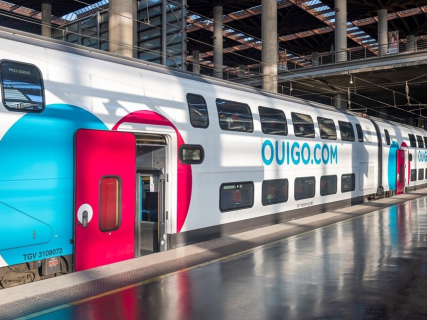
Ouigo extends until November 15 the cancellation of its trains between Madrid and Andalusia

The French operator keeps its services suspended while waiting for the reopening of the high-speed line. Affected travelers will receive a full refund for their tickets.

fotonoticia 20261031125435 1920

fotonoticia 20261031125435 1920

Add DEMÓCRATA to Google

Ask FREN

Published

Last updated

2 minutes

Most read

Elecciones 29N · Encuestas

La media de las encuestas

Media a 4 de noviembre de 2026 · 15 institutos

  • PP31,0 %
  • PSOE26,3 %
  • Vox19,5 %
  • Frente Amplio6,5 %
  • ERC2,5 %
  • Podemos2,2 %
  • SALF2,2 %
01020304050ene 2024jul 2024ene 2025jul 2025ene 2026jul 2026

Media del último estudio de cada instituto en 30 días y su evolución semanal desde el 23J. Partidos con al menos un 2 %.

Todas las encuestas

Elecciones generales del 29 de noviembre · Demócrata

Ouigo has extended at least until Sunday, 15 November the cancellation of its trains between Madrid and Andalucía, interrupted since the rail accident that occurred on 28 October last in Urda (Toledo). The French company has communicated the decision through its social media and has explained that it continues to be pending the restoration of traffic, in coordination with the administrator of railway infrastructure, Adif.

The operator has reported that the affected passengers are receiving the notifications in the email associated with their bookings and have guaranteed a full refund of the amount of their tickets.

The expansion of cancellations occurs one day after the former Minister of Transport, Óscar Puente, announced that Adif had requested judicial authorization to begin reconstruction work on the infrastructure damaged by the accident, which has caused 69 deaths.

The reopening of the line remains pending judicial authorization

On Tuesday, during the press conference following the Council of Ministers, Puente explained that the tasks of removing the trains involved in the accident had been completed and that Adif had requested permission from the instructing judge to begin the replacement of the infrastructure.

The former minister calculated that the line could be operational again in a maximum of ten natural days from judicial authorization, although he avoided committing to a specific date.

"We depend right now on the permission that the court gives us", Puente said, who clarified that the damage directly affects something over 40 meters of track, but that the work will cover about 400 meters for safety reasons.

Ouigo offers a road alternative for those affected

In addition to reimbursement of train tickets, Ouigo announced last October 31 an agreement with the transport platform Movelia to facilitate travel by bus.

The measure allows affected passengers to request a refund of the amount of certain bus tickets purchased through the platform, as long as they meet the established conditions. The agreement published initially covers trips canceled between October 28 and November 9, so there is no indication that it has been automatically extended until the 15th.

Among the included routes are the connections from Madrid with Córdoba, Sevilla and Málaga, in addition to other journeys affected by the closure of the corridor.

FACUA has recalled that, in accordance with the European regulation on the rights of rail passengers, passengers can choose between reimbursement and an alternative transport solution under the conditions set out by the regulation. The association believes that companies should not limit themselves to returning the money when the traveler needs to complete the contracted journey.

For its part, Renfe keeps blocked the sale of high-speed tickets between Madrid and Andalucía until December 13, a preventive measure that does not mean that traffic will remain suspended until that date. The public operator has indicated that it will resume services when Adif authorizes the reopening of the infrastructure.

More key points, information and questions with FREN

AI-GENERATED CONTENT

What parliamentary or administrative procedures remain for the full reopening of the high-speed rail line between Madrid and Andalusia?

There is no record of any parliamentary procedure that is a direct requirement to reopen the Madrid-Andalusia high-speed line. As of November 4, 2026, the pending steps are mainly judicial, technical, and operational: authorization to intervene in the Urda accident area, repairs and safety checks, and Adif's decision to restore traffic. Additionally, a distinction must be made between an initial reopening with restrictions and the full recovery of frequencies and capacity.

1. Judicial authorization to repair

The immediate obstacle is the authorization from the court investigating the accident to carry out works on the affected infrastructure. According to information published on November 3, the Minister of Transport placed the reopening approximately ten calendar days after the judicial permission; that period had not started then. Therefore, it is not a fixed date nor a deadline counted from the accident. This is reflected in the November 3 information.

This permission allows intervention without compromising judicial proceedings. It should not be confused with the technical authorization for trains to resume: these are distinct and successive decisions.

2. Repairs, tests, and Adif's decision

Afterwards, actions on the damaged infrastructure and necessary checks to establish safe operating conditions must be completed. The pending sequence includes:

  • Inspection and repair of elements affected by the accident.
  • Safety verifications, signaling, and telecommunications before restoring traffic.
  • Determination of operating conditions, including any temporary restrictions to be maintained.
  • Adif's reopening decision, upon which operators can organize their commercial services.

The information consulted does not identify a specific pending administrative resolution, with number and date, that would allow presenting these works as a scheduled file. It explicitly places the service recovery under the infrastructure manager's decision, as explained by Demócrata on the reopening.

3. Restoring traffic does not mean normalizing it

The communicated forecast initially contemplates fewer trains and reduced frequencies, with schedule adjustments and higher-capacity trainsets to try to preserve available seats. After infrastructure enablement, Adif, Renfe, Iryo, and Ouigo must coordinate schedules and capacity and communicate which services can effectively run.

Full recovery has been linked to the commissioning of the ERTMS, the European railway signaling and protection system, provisionally scheduled for early 2027. That horizon corresponds to the announced technical normalization, not a firm reopening date. The consulted sources also do not detail all specific authorizations remaining for its commissioning.

4. What role does Parliament have

No law, vote, or hearing appears whose approval is necessary to allow circulation. Parliamentary oversight and aid measures for those affected belong to a different level than judicial permission and technical track enablement.

In particular, the Council of Ministers agreed on November 3 on a decree-law of aid to Urda and accessibility to goods and services in emergencies. That action should not be presented as authorization to reopen the corridor.

In conclusion: three milestones must be followed: judicial permission, repair with satisfactory checks, and Adif's operational announcement. The November 14 forecast remains conditional; Renfe's sales block until December 13 also does not set the reopening. None of these dates alone guarantees full normality.

What are the competencies of the railway infrastructure manager (Adif) in managing and reconstructing lines affected by accidents?

Adif has the competence to manage traffic, assess damages, and repair or reconstruct the infrastructure it manages after an accident, aiming to restore traffic under safe conditions. This function does not allow it to replace the railway safety authority or investigators or judges. Additionally, a distinction must be made between Adif and Adif-High Speed: the competent entity depends on which infrastructure is affected and the existing agreements between both.

1. Immediate management and traffic continuity

The Railway Sector Law establishes that, in the event of an accident, technical failure, or other incident significantly disrupting traffic, the manager shall take necessary measures to respond to that disruption. Adif must have contingency plans and activate corresponding procedures, coordinating with railway companies and emergency public services.

Operationally, it can interrupt traffic, secure facilities, mobilize personnel and machinery, and reorganize traffic via available routes. Railway companies must provide resources and cooperation as required by agreed contingency plans. This coordination does not make Adif solely responsible for rescue or all civil protection actions.

2. Inspection, repair, and reconstruction

Its legal functions include control, surveillance, and inspection of infrastructure, its protection zones, and traffic. Administration also includes maintenance of lines owned or entrusted by agreement. After an accident, this translates into:

  • Inspecting and diagnosing damage to the trackbed, bridges, tunnels, and other structures.
  • Replacing rails, sleepers, ballast, and track devices.
  • Repairing electrification, signaling, communications, and traffic control systems.
  • Preparing projects, contracting works, and directing or supervising their execution.

The law assigns managers the approval of basic and construction projects of their own infrastructures and their construction, with applicable resources, agreements, and ministerial determinations. Therefore, urgency does not eliminate legal requirements for contracting, safety, or authorization. Contracting works also does not displace supervision responsibilities; functions inherent to system control, traffic, and safety management cannot be delegated to third parties.

3. Conditions to restore traffic

Adif must verify that the repaired infrastructure allows safe circulation through inspections, tests, and technical verifications. Recovery can be partial or include temporary restrictions, such as speed limits or single-track operation.

However, the State Railway Safety Agency supervises safety obligations and authorizes the entry or commissioning of fixed subsystems when appropriate. The operational reopening of a repaired section should not be confused with authorizations that may require a broader renewal or modification. Adif and operators are responsible for the safety of the system part affecting them.

4. Investigation, tests, and responsibilities

Adif must report accidents, collaborate with independent technical and judicial investigations, provide documentation, and preserve evidence. Its internal analyses do not replace those investigations. Reconstruction must respect seals and judicial orders: the need to restore service alone does not authorize removing or manipulating relevant material.

For example, Demócrata reports the judicial authorization to access with machinery and carry out reconstruction after the Adamuz accident. Finally, having competence to repair does not equate to being responsible for the accident: responsibilities must be determined separately. The law also assigns the manager to resolve claims for patrimonial liability related to its actions.

What legal requirements must a railway company like Ouigo meet to offer alternative transport in case of service cancellations?

Ouigo must offer a real alternative to complete the journey, not just refund the ticket, when the cancellation is expected to cause an arrival at the destination with at least 60 minutes delay. The choice belongs to the passenger. The main obligations are in Articles 18 and 20 of Regulation (EU) 2021/782, directly applicable in Spain.

1. Immediately offer three options

The company must inform of these possibilities and take necessary measures to execute the chosen one:

  • Refund: return the amount for unused segments and also for those already traveled if the journey has lost its purpose; when applicable, provide return to origin as soon as possible.
  • Travel as soon as possible: continue or reach the final destination by an alternative route, under comparable transport conditions.
  • Travel later: continue or use alternative transport at a later date convenient for the traveler, also under comparable conditions.

Therefore, refund cannot be imposed as the only solution when the passenger wants to complete the trip. Nor is it enough to announce that the passenger can seek other transport without specifying how their right will be enforced.

2. Guarantee a comparable and free alternative

Article 18.2 allows using own services, another railway company, or other transport modes. No supplement may be charged, even if a higher class must be offered. The company must make all reasonable efforts to avoid additional connections and minimize total delay.

Service class cannot be downgraded unless it is the only available alternative. Exact replication of the original itinerary is not required: the essential point is to reach the contracted destination under comparable conditions. Also, if the service is interrupted and cannot be continued within a reasonable time, Article 20.3 requires organizing alternative transport as soon as possible.

3. Respect the 100-minute rule

If the operator does not communicate alternative transport options within 100 minutes after the scheduled departure of the canceled service, the traveler may arrange public rail, coach, or bus transport on their own. The company must reimburse necessary, adequate, and reasonable expenses.

This deadline does not authorize waiting 100 minutes to start managing solutions: the obligation to offer options is immediate. Nor does it allow automatically contracting any taxi, VTC, or rental vehicle and demanding payment. For other means, Article 18.3 contemplates company authorization upon passenger request. Reimbursements under this article must be paid within 30 days of the request.

4. Inform, assist, and guarantee accessibility

The operator must communicate the situation and estimated schedules of substitute service as soon as available. It must also explain how to request a cancellation certificate.

  • Food and drink: free and provided while waiting, when available or reasonably supplied.
  • Accommodation and transfers: if an overnight stay is necessary, whenever physically possible. Under legally exceptional circumstances, accommodation may be limited to three nights.
  • Accessibility: alternative transport must maintain a comparable level of assistance and accessibility for persons with disabilities or reduced mobility.

In conclusion: Ouigo's commercial agreements may facilitate these solutions but cannot reduce legal rights. Refund, alternative transport, assistance, and compensation are distinct concepts; possible exceptions to compensation should not be confused with a general exemption from organizing alternatives. It is advisable to keep tickets, communications, and receipts to claim any non-compliance.

Play

Test your knowledge with FREN!

How much do you know about this topic? Answer the following 3 questions.

Why has Ouigo canceled its trains between Madrid and Andalusia?

Question 1 of 3

What alternative has Ouigo offered to passengers affected by the train cancellations?

Question 2 of 3

Until when does Renfe keep the sale of high-speed tickets between Madrid and Andalusia blocked?

Question 3 of 3