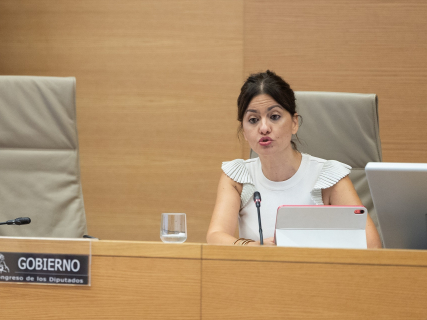

The Minister of Youth and Childhood, Sira Rego, has rejected this Monday the collective returns of minors who remain in Ceuta after the massive entry recorded on July 30 and 31. During her appearance before the Youth and Childhood Commission of Congress, she defended that before returning a child to their country, their family situation must be investigated and it must be verified that a possible reunification can be carried out with guarantees.
According to El País in its live coverage of the migration crisis in Ceuta, Rego has assured that "girls and boys are not invaders, but subjects of rights" and that those who arrived in the autonomous city are also victims. The minister has insisted that none of those minors caused the crisis and has asked not to confuse those who need protection with those responsible for what happened.
The Ministry of Youth and Childhood currently estimates 1,478 children who remain in centers dependent on the protection system of Ceuta. Rego maintains that the procedures need time to develop with guarantees and considers it necessary to alleviate the pressure on the services of the autonomous city in the meantime.
Rego rejects a collective return of minors
The minister has defended that the return of a minor cannot be executed automatically for having entered irregularly into Spain. "To return a child to their country, first, it is necessary to investigate," she explained during her intervention in Congress.
The procedure must determine the conditions of the family environment and verify if a possible reunification can be carried out safely. Rego has pointed out that, when those guarantees exist, family reunification can continue to be carried out as before.
The head of Childhood has also established a difference between that individual procedure and a generalized exit of minors. A family reunification with guarantees protects childhood, while a collective return would violate their rights, she has defended.
1,478 minors remain in the protection system of Ceuta
The latest data provided by the Ministry places the number of minors currently housed in the protection centers of the Autonomous City at 1,478. The figure reflects the pressure that the system continues to bear a month after the massive entry recorded from Morocco.
The profile of the arriving minors also presents differences compared to other migratory episodes. According to Rego, during the days of July 30 and 31, 700 girls and a particularly high number of boys and girls under 13 years old entered.
The minister argues that this change requires adapting the protection response and the available resources. Her department believes that Ceuta cannot alone take care of all the minors while the identifications and the processing of each case are underway.
Rego considers it "essential" to transfer the minors to the Peninsula
The Ministry defends that boys and girls can be temporarily accommodated in resources located in the Peninsula. Rego considers this transfer "essential" to reduce the pressure on Ceuta and guarantee adequate care conditions.
Once transferred, they could continue from any point in the country the family reunification cases or, when legally appropriate and guarantees exist, the return procedures. The minister has insisted that leaving Ceuta does not mean deciding in advance what the final outcome of those cases will be.
Youth and Childhood had already proposed to the Autonomous City a mechanism to transfer around 500 minors to resources managed by hosting entities in the Peninsula. The proposal requires coordination with Ceuta, which maintains the guardianship of the boys and girls accommodated in its protection system.
Rego: "Ceuta cannot bear this alone"
The minister has also called for the cooperation of the autonomous communities and has presented the care for minors as a responsibility that the whole country must assume. "Ceuta cannot bear this alone," she stated in Congress.
Rego believes that the Autonomous City should not be forced to choose between guaranteeing the protection of minors and avoiding the collapse of its public services. To achieve both, her department advocates for temporarily distributing the care while the cases are resolved.
The minister has also defended that "hatred does not resolve the emergency" and has rejected that migrant childhood be criminalized as a consequence of the border crisis.
Ceuta receives 25 million extraordinary to care for minors
The appearance comes after the Sectorial Conference on Childhood and Adolescence approved a one-time transfer of 25 million euros to Ceuta aimed at strengthening the care of unaccompanied migrant minors.
The credit will finance expenses for accommodation, food, clothing, medical care, legal support, socio-educational accompaniment, translation, and the expansion of places, among other needs arising from the extraordinary situation the city is experiencing.
The financial aid is combined with proposals for transfer to the Peninsula and with the individualized processing of the files. With 1,478 minors still within the Ceuta protection system, the Government maintains that the immediate priority must be to guarantee their rights while it is determined in each case whether family reunification, return, or the continuation of their protection in Spain is appropriate.