Spain registers more births than a year ago: the new map of birth rates

Spain recorded 156,887 births between January and June 2026, a 1.07% increase compared to the same period in 2025. The rise, however, does not reach the entire territory: eight communities increase births while others register declines.

4 minutes

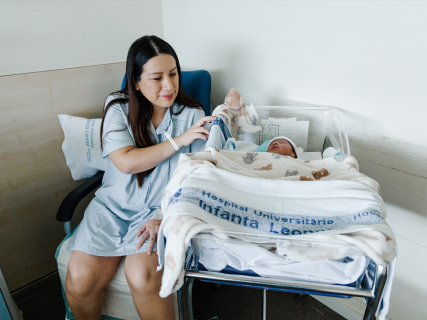
EuropaPress 7192331 zaira posa hijo santiago sido primeros bebes nacidos 2026 madrid hospital

EuropaPress 7192331 zaira posa hijo santiago sido primeros bebes nacidos 2026 madrid hospital

Add DEMÓCRATA to Google

Ask FREN

Published

Last updated

4 minutes

Most read

The birth rate in Spain is growing again, although it still remains far from the levels of a decade ago. The Monthly Birth Estimate published this Wednesday, August 19, by the National Institute of Statistics (INE), corresponding to June 2026, places the number of 156,887 babies born during the first half at 156,887, compared to 155,231 in the same period of 2025.

There are 1,656 more births in a year, an increase of 1.07%, but also 43,368 fewer than during the first six months of 2016.

Spain adds 1,656 more births than a year ago

The new data from the INE on births in Spain confirms the slight change in trend that begins to emerge after years of declines. Between January and June 2026, 156,887 children were born, 1.07% more than the 155,231 counted during the same period of the previous year.

The strictly monthly comparison also improves. In June 2026, 26,291 babies were born in Spain, while in June of last year there were 26,066. The difference is 225 more births, so the accumulated growth during the first half of the year does not depend solely on the behavior of a specific month.

The data published this August 19 are still estimates. The INE itself explains that its Monthly Birth Estimate aims to provide quick figures based on registrations made in computerized civil registries and that the estimated results are updated until the final figures are available.

The birth map: where births are increasing and where they are falling

The improvement across Spain hides significant differences between autonomous communities. During the first six months of 2026, births increased compared to the same period in 2025 in Andalusia, Asturias, Castilla y León, Catalonia, Comunidad Valenciana, Comunidad de Madrid, Region of Murcia, and La Rioja.

Conversely, the number of births decreased in Balearic Islands, Canary Islands, Cantabria, Castilla-La Mancha, Extremadura, Galicia, and Basque Country, as well as in the autonomous cities of Ceuta and Melilla. The data thus shows that the national rebound cannot be uniformly transferred across the entire territory.

Among the communities that are advancing, Murcia stands out, having recorded 6,201 births between January and June, a 4.36% increase compared to the same period in 2025. Asturias is also in positive territory: its 2,289 births represent a year-on-year increase of 2.13%.

Table: Evolution of births by communities, January-June 2026

Autonomous community Evolution compared to January-June 2025
Andalusia ↑ Increase
Asturias ↑ Increase
Balearic Islands ↓ Decrease
Canary Islands ↓ Decrease
Cantabria ↓ Decrease
Castile and León ↑ Increase
Castile-La Mancha ↓ Decrease
Catalonia ↑ Increase
Valencian Community ↑ Increase
Extremadura ↓ Decrease
Galicia ↓ Decrease
Community of Madrid ↑ Increase
Region of Murcia ↑ Increase
Basque Country ↓ Decrease
La Rioja ↑ Increase
Ceuta ↓ Decrease
Melilla ↓ Decrease

Note: Aragón and Navarra are not included in this table because the consulted information on the territorial balance does not allow classifying them with sufficient certainty between increases and decreases. It is preferable not to assign them a trend without verifying the exact data from the INE.

Galicia loses births while Murcia and Asturias advance

The behavior of Galicia contrasts with the national rebound. The four Galician provinces register fewer births than during the first half of 2025. In A Coruña, 2,799 were recorded, a 3.95% decrease; Pontevedra recorded 2,159, a 3.92% decrease; Lugo reached 787, a 0.25% decrease; and Ourense stood at 608 births, with a decrease of 5.74%.

The long-term comparison is even more significant in this last province. Ourense recorded 907 births during the first half of 2013, compared to the current 608, which represents a drop of nearly 33% over thirteen years.

On the opposite end is Murcia. Its 6,201 births until June represent an increase of 4.36% year-on-year. Only during June, 1,006 babies were born in the Region, of which 513 were boys and 493 were girls.

Mothers over 40 surpass those under 25

The new data from the INE also shows another relevant demographic change: in June, more babies were born to mothers over 40 years old than to women under 25. Specifically, 2,758 births were recorded among the former compared to 2,506 among the latter.

The bulk of births, however, continues to be concentrated in intermediate ages. During June, there were 8,643 births from mothers aged between 30 and 34 and another 7,754 corresponding to women aged between 35 and 39.

The data thus reflects the progressive shift of motherhood to older ages. It is not only a matter related to how many children are born in Spain, but also how the age at which children are had is changing.

The rebound does not erase a decade of declining birth rates

The increase of the first semester represents an improvement compared to 2025, but the perspective of a decade outlines a very different reality. The 156,887 births registered until June 2026 are 43,368 fewer than during the same period in 2016, a difference greater than 20%.

The recent series had already begun to show a change. Spain closed 2025 with 321,164 births, 0.99% more than in 2024, after that year marked the minimum of the series with 318,005. The increase in the first semester of 2026 prolongs, for now, that moderate recovery.

The INE itself contemplates in its latest projections that the number of births will begin to increase slightly in 2026 and continue to grow until 2042. This does not imply a rapid recovery of previous levels: the agency estimates that between 2026 and 2040 around 5.3 million children will be born, still 6.2% less than during the previous 15 years.

What the Monthly Birth Estimate of the INE Measures

The Monthly Birth Estimate provides demographic information much earlier than the definitive figures are published. The INE uses the registrations recorded in computerized civil registries to estimate how many births have occurred each month and compare them with the historical series.

The agency publishes updated estimates every month up to two months before the publication date. Hence, on this August 19, the results corresponding to June 2026 have been disseminated, as established by the official calendar of the institute.

The snapshot left by the first six months of the year is, therefore, that of a slight rebound in birth rates in Spain: 156,887 births, 1.07% more than a year ago. The recovery, however, remains small compared to the accumulated loss over the last decade and presents significant differences depending on the territory.

More key points, information and questions with FREN

AI-GENERATED CONTENT

What requirements must civil registries meet for their data to be included in the INE's Monthly Birth Estimate?

The Monthly Birth Estimate (EMN) of the INE is not produced directly from all births that occur, but from the registrations recorded in computerized civil registries, which the Ministry of Justice periodically sends to the statistical institute. The relevant requirements, therefore, are not "statistical" in the classical sense (minimum size, etc.), but above all technical and related to integration into civil registry systems.

According to the INE's methodological note on the EMN and the operation associated with weekly deaths and births, the procedure works as follows:

  • The population scope of the EMN is all births registered in Spain.
  • The collection method is the statistical exploitation of an administrative register: the data recorded in the civil registries.
  • The General Directorate of Legal Security and Public Faith (Ministry of Justice) sends the INE files of births recorded in INFOREG and DICIREG, the official computer applications of the Civil Registry.

From this description, it follows that, for the information from a particular civil registry to be included in the EMN, it must meet at least these basic conditions:

1. Be computerized and integrated into INFOREG or DICIREG

The EMN is fed exclusively by “computerized civil registries”. This means that the registry must:

  • Use one of the two official Civil Registry management systems (INFOREG or DICIREG), which are the platforms from which the files sent to the INE are generated.
  • Have its birth registrations recorded in those systems; births that only appear in physical books or in non-integrated applications are not part of the standard flow that reaches the INE.

In practice, this limits the source to registries that have already completed or advanced sufficiently in the modernization and computerization promoted by Justice.

2. Send their data through the competent General Directorate

The INE does not collect information “one by one” from each registry, but receives:

  • Monthly files of births recorded in INFOREG and DICIREG, sent by the General Directorate of Legal Security and Public Faith.

Therefore, for the data from a registry to be in the EMN, it is necessary that:

  • The registry submits its registrations on time to the General Directorate through the computer systems.
  • These registrations are effectively incorporated into the files that the General Directorate sends to the INE.
3. Comply with the INE's quality and format standards

The EMN methodological note refers to the detailed methodology and the standardized methodological report, where the general quality criteria of the institute's statistics are described. Although a closed list of requirements for each specific civil registry is not formulated, general conditions are established:

  • The registry must provide data in the standardized format foreseen in INFOREG/DICIREG (mandatory variables, codifications, etc.).
  • The information must meet minimum completeness and consistency standards (valid dates, residence, basic data of the mother, etc.) to be integrated into the statistical exploitation.
  • The data are used on a provisional basis, and the INE warns that they may undergo later revisions when delayed registrations or corrections are incorporated.
4. Scope and limits: what it does not imply

In the public documentation consulted from the INE, there is no nominal list of “admitted registries” nor additional legal or organizational requirements (minimum number of births, size of the judicial district, etc.). What is decisive is:

  • Being computerized and operating in INFOREG or DICIREG.
  • Correctly uploading the data to those systems, so that they enter the files that the Ministry of Justice sends to the INE.

Thus, the inclusion of data from a civil registry in the EMN does not depend on an express request to the INE, but on its effective integration into the computer infrastructure and data exchange system of the Civil Registry.

To know the technical details (fields, controls, and possible exclusions of records with incomplete information), the INE itself refers to the methodology and the standardized methodological report of the Monthly Birth Estimate, accessible from its press releases and from INEbase.

What are the competencies of the National Institute of Statistics regarding demographic matters according to Spanish legislation?

The competencies of the National Institute of Statistics (INE) in demographic matters are fundamentally defined in the Law 12/1989, on the Public Statistical Function and in Royal Decree 803/2022, which approves its current Statute. These norms are supplemented by specific provisions on censuses and registers, such as Royal Decree 753/2011 on the 2011 population and housing censuses.

1. General framework of the INE's statistical competencies

Law 12/1989 establishes the INE as an autonomous state body responsible for statistics for state purposes. Within this general framework:

  • The INE is the central body of the state public statistical function, with full powers to order and carry out statistical operations when they concern statistics of state interest (preamble and Title II of Law 12/1989, in connection with art. 149.1.31 CE).
  • Article 26, letter j), expressly assigns the INE the formation of general censuses, both demographic and economic and their derivatives, a key legal basis for its demographic competencies.
  • The Law foresees that the National Statistical Plan and its annual programs include demographic statistics (censuses, population surveys, migrations, etc.) as official operations for state purposes.

Additionally, the Law articulates cooperation with autonomous communities and local entities, especially relevant in the register and population censuses, and subjects all activity to the principles of reliability, objectivity, statistical secrecy, proportionality, and transparency (art. 2 and following).

2. INE Statute (Royal Decree 803/2022): Directorate General of Population Statistics

Royal Decree 803/2022 updates the INE Statute and specifies the organization and demographic functions in the Directorate General of Population Statistics. According to its articles:

  • The Directorate General of Population Statistics is responsible for the promotion, coordination, execution, and analysis of demographic censuses and other demographic and social statistics “that are produced taking individuals and households as the basic unit of reference.”
  • Among its specific functions (corresponding article of the Statute) are:
    • Population and housing censuses: promotion, execution, and analysis of censuses and maintenance of statistical population and territory registers (letter a)).
    • National register base: maintenance and management of the national register base, as a result of the coordination of municipal registers (letter b)).
    • Nomenclature of population entities: preparation of the official nomenclature, essential for demographic georeferencing (letter c)).
    • Demographic analysis and estimates: demographic analyses and estimates of population and households, basis for population estimates and projections (letter d)).
    • Statistics of demographic phenomena: preparation of statistics on births, deaths, marriages, migrations, and other phenomena that determine population evolution and characteristics (letter e)).
  • Other social statistics closely linked to demography (health, household living conditions, labor market, etc.) are also located under this Directorate General, enabling integrated demographic analyses.
  • It is assigned the research and promotion of the use of administrative registers and new data sources related to individuals and households, in coordination with the Directorate General of Statistical Planning and Processes (letter m)), crucial for modern demographic statistics (continuous register, civil registries, administrative migrations...).
  • It also assumes the national and international liaison and coordination in population statistics matters, especially before European institutions (letter n)).
3. Censuses, register, and official population figures

Along with the Statute and the Law, specific norms such as Royal Decree 753/2011 specify that:

  • The INE forms the population and housing censuses, relying on data from municipal registers and obtaining collaboration from municipalities and other administrations.
  • The INE exercises the direction, coordination, and execution of the work for the formation of these censuses, defines the content of the statistical project, and publishes the general results, providing information to administrations and users.

Other provisions (annual royal decrees of official population figures, joint INE–General Directorate of Autonomous and Local Cooperation resolutions on register management) consolidate two core competencies:

  • Technical coordination of the municipal register, including technical instructions to municipalities and centralized management of the national register base.
  • Proposal and technical support of the official population figures of municipalities, which the Government declares official by royal decree.
4. Summary

Overall, Spanish legislation assigns the INE full competence over state demographic statistics: design and execution of population and housing censuses, coordination and statistical exploitation of the municipal register, preparation of population and demographic phenomena statistics, estimates and projections, and coordination with the European statistical system, all under the principles of statistical secrecy, neutrality, and professional independence established in Law 12/1989.

What laws regulate the publication and updating of official demographic statistics in Spain?

In Spain, the regulation of the preparation and publication of official demographic statistics (population, birth rate, mortality, migrations) is structured around a basic statistics law, the organic-functional norms of the National Institute of Statistics (INE), and the National Statistical Plan, all framed within European regulations on official statistics.

1. Basic state norm: Law 12/1989, on the Public Statistical Function

The pillar of the system is Law 12/1989, of May 9, on the Public Statistical Function (text in BOE). This law:

  • Organizes the public statistical function and establishes the legal regime for data collection, processing, conservation, and dissemination by statistical services.
  • Establishes that statistics with mandatory response must be regulated, in their essential aspects, by law, connecting with the protection of privacy and other fundamental rights.
  • Defines the National Statistical Plan as the central instrument for organizing the statistical activity of the General State Administration, with a four-year validity.
  • Regulates statistical secrecy, the reuse of administrative registers, and coordination among state, autonomous, and local statistical services, which directly affects censuses, registers, and demographic statistics.

Although Law 12/1989 is not exclusive to demography, its material scope is potentially unlimited and fully applies to operations on population, birth rate, mortality, and migrations, as statistics for state purposes.

2. INE Statute and organization of population statistics

Royal Decree 803/2022, of October 4, approving the Statute of the Autonomous Body National Institute of Statistics (text in BOE) deeply updates the structure and functions of the INE.

  • It reorganizes the body and creates, among others, the Directorate General of Population Statistics, specifically responsible for sociodemographic indicators and surveys.
  • It strengthens the INE's role in the coordination of the National Statistical System and its alignment with the European Statistical System.
  • It expressly incorporates requirements of Regulation (EU) 2016/679 (data protection) through the figure of the Data Protection Officer, very relevant for statistics with microdata on population.

This statute does not define specific indicators of birth rate or migrations, but it regulates the legal capacity, technical competencies, and operational neutrality of the INE to produce and disseminate official demographic statistics.

3. National Statistical Plan 2025-2028

The operational instrument that specifies which demographic statistics are produced, with what content and periodicity, is the National Statistical Plan. The current one is:

  • Royal Decree 1225/2024, of December 3, approving the National Statistical Plan 2025-2028 (text in BOE).

This royal decree develops article 8 of Law 12/1989 and establishes:

  • The list of statistical operations for state purposes in the four-year period, including population and housing censuses, exploitation of the register, statistics on birth rate, mortality, and migrations, among many others.
  • For each operation, the responsible bodies, purposes, target group, territorial scope, and necessary resources.
  • The automatic integration into the Plan of statistics required by European regulations.

The Plan does not create the statistical function (already done by Law 12/1989), but specifies and organizes how the different official demographic series at the state level are produced and updated.

4. Official declaration of population figures

The official status of population figures derived from the municipal register is declared periodically by royal decree. Among others, the system includes norms such as:

  • Royal Decree 1210/2024, of November 28, which declares official the population figures as of 1-1-2024.
  • Royal Decree 1085/2023, of December 5, for the figures as of 1-1-2023.
  • And successive annual royal decrees from at least 2012 onwards.

These royal decrees, issued in execution of Law 12/1989 and the regulation of the register, grant official and binding status to the population figures used in local financing, political representation, and service planning.

5. Relevant European legal framework

The Spanish system is inserted in the framework of European statistics, expressly cited in Royal Decree 1225/2024:

  • Regulation (EC) No 223/2009, on European statistics, which establishes the principles, organization, and quality of the European Statistical System, to which the INE belongs.
  • Regulation (EU) 2019/1700, which sets a common framework for European statistics on individuals and households based on individual data, key for employment, living conditions, and partly demographic structure.
  • Regulation (EU) 2021/690, which creates the Single Market Programme and includes funding and framework for European statistics.
  • Implementing Regulation (EU) 2023/138, which defines high-value data sets and modalities of publication and reuse, impacting how certain population data are disseminated.

These norms are directly applicable in Spain and condition the design, frequency, variables, and quality of many demographic operations, which are then incorporated into the National Statistical Plan.

In summary, the regulation of official demographic statistics in Spain essentially rests on Law 12/1989, the INE Statute (Royal Decree 803/2022), the National Statistical Plan 2025-2028, and the annual royal decrees of population figures, all closely connected with the European statistical framework established by European Union regulations.

Play

Test your knowledge with FREN!

How much do you know about this topic? Answer the following 3 questions.

How many births were registered in Spain during the first half of 2026 according to the INE?

Question 1 of 3

In which autonomous community did births increase by the highest year-on-year percentage during the first half of 2026?

Question 2 of 3

Which maternal age group registered more births in June 2026 than mothers under 25 years old?

Question 3 of 3

Hola, soy Fren. ¿Cómo te ayudo?