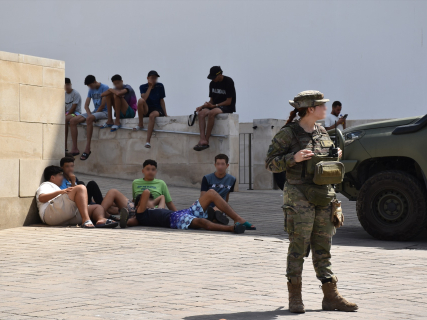
Spain reinforces the border of Ceuta due to fears of a new attempt at massive entry on August 15.

Military and Civil Guard, without permits in Ceuta and Melilla due to credible alerts from the CNI on social networks

2 minutes

guardia civil ceuta defensa

guardia civil ceuta defensa

Add DEMÓCRATA to Google

Ask FREN

Published

Last updated

2 minutes

Most read

The Ceuta border faces the coming days with a reinforced device in light of the possibility of a new attempt at mass entry from Morocco. The Ministry of Defense has ordered the cancellation of military personnel permits deployed in the autonomous city, while the Civil Guard has temporarily suspended the granting of new permits, vacations, and licenses to its agents assigned in Ceuta and Melilla.

The measures respond to new calls disseminated through social media to attempt to cross the border on August 15. According to known information, the CNI considers these calls credible and has conveyed this assessment to the agencies responsible for border security. This has led to reinforcing the availability of the forces already deployed in the two autonomous cities.

Defense and Civil Guard

The General Command of Ceuta communicated the cancellation of permits for military personnel deployed in the city, with exceptions linked to service needs. The measure affects the units participating in the device and seeks to guarantee maximum operational capacity during the coming days.

Therefore, it is not a new deployment of units from the Peninsula, but rather to keep available the military already assigned in Ceuta. The decision comes after intelligence services have deemed the calls circulating on social media for a new crossing attempt credible.

The Civil Guard has adopted a similar measure. The General Directorate has temporarily suspended the granting of new permits, vacations, and licenses for agents assigned in Ceuta and Melilla. Permits that had already been granted are not affected by the decision.

The very operational situation of the border is behind the decision. The Civil Guard has acknowledged that the vacation period had reduced the available forces and has deemed it necessary to recover operational capacity in light of the new scenario.

The restriction adds to other measures adopted during the migratory crisis of recent weeks, in which the pressure on the Ceuta border forced an increase in the presence of the State Security Forces and Corps.

August 15, a marked date on social media

The new scenario has a specific date: Saturday, August 15. On social media, messages have circulated again calling for another massive attempt to enter Ceuta, after the episode recorded at the end of July.

The existence of these calls is confirmed and has been enough for security officials to adopt preventive measures. What cannot be taken for granted is that the attempt will ultimately take place nor what its magnitude would be.

August 15 also coincides with one of the main traffic operations of the summer. The General Directorate of Traffic has scheduled a special device between 1:00 PM on Friday, August 14, and 12:00 AM on Sunday, August 16.

More key points, information and questions with FREN

AI-GENERATED CONTENT

What parliamentary procedures are necessary to amend the regulations governing leave for military personnel and the Civil Guard in border crisis situations?

Modifying the leave of military personnel and the Civil Guard in a border crisis situation generally requires an amendment to the law or regulations with the force of law that govern their service regime. This amendment can be enacted as an ordinary law or, if it affects reserved matters, as an organic law; or through a government royal decree-law that is subsequently subject to the control of the Congress. In all cases, the core of the parliamentary procedure consists of debate, possible amendment, and voting in the General Courts, with particular prominence of the Congress of Deputies. The following outlines the scheme according to the different routes.

a) Amendment through ordinary or organic law

In practice, the leave and service conditions of military personnel and the Civil Guard are usually regulated by ordinary law. Only if the reform directly affects matters reserved for organic law (for example, development of fundamental rights) should that type of norm be used. In both cases, the basic parliamentary procedure is the approval of a law in the General Courts.

The general scheme is as follows:

  • Legislative initiative: it may come from the Government (bill) or from parliamentary groups and other legitimized subjects (private member's bill). According to available information, bills are initiatives from the Government approved by the Council of Ministers and sent to the Congress for processing, while private member's bills are presented by parliamentary groups, deputies, the Senate, regional assemblies, or popular legislative initiative.
  • Purpose of the law: both bills and private member's bills aim to “create, modify or repeal laws.” In this case, they would allow modifying the leave regime in border crisis situations.
  • Parliamentary processing: the initiative is debated and voted on in the Congress and the Senate. The procedure includes general debates on the opportunity of the reform and the possibility of introducing amendments to the articles to adjust the content (for example, criteria for suspension or reduction of leave in crises).
  • Final approval and entry into force: if the text is approved by both Chambers, it is promulgated as law and published in the Official State Gazette (BOE). Only from that publication is the new leave regulation legally enforceable.

In the case of an organic law, the scheme is the same, but the requirement for parliamentary majorities is stricter (absolute majority in certain votes). No further details are available in the consulted sources on this point.

b) Amendment through royal decree-law

In border crisis scenarios, the Government could opt for a royal decree-law if it perceives a situation of “extraordinary and urgent necessity.” According to available information, the decree-law:

  • Is approved solely by the Government.
  • Comes into immediate effect after its publication in the BOE.
  • Cannot affect matters reserved for organic law, the general electoral regime, or the regime of autonomous communities.

Its parliamentary control is specific:

  • Validation in the Congress: the Congress of Deputies must validate or repeal it within a maximum period of 30 days. In that debate, groups can question the scope of the leave regulation, its proportionality, and the existence of urgency.
  • Processing as a bill: the Congress may agree that the decree-law be processed as a bill. In that case, a subsequent parliamentary procedure opens allowing amendments to adjust the urgently approved leave regime.

This route is especially relevant when immediate action is desired on service conditions in a crisis, but leaving room to review and improve the regulation more calmly.

c) Difference between bill and private member's bill

For a structural (not just conjunctural) reform of leave in border crises, the key decision is whether the initiative comes from the Government or Parliament:

  • Government bill: the Government designs the technical text (for example, setting conditions, time limits, or compensation mechanisms for leave) and sends it to the Congress. Parliament retains control, but the impetus and initial design are governmental.
  • Private member's bill: the initiative is taken by parliamentary groups, deputies, the Senate, regional assemblies, or citizens (popular initiative). The processing is “similar to that of bills,” with debates, amendments, and votes. In this case, the Government can only block processing if it proves that the proposal affects the General State Budgets (by increasing expenses or reducing revenues), according to the information provided about the budget veto.

In both cases, the final result is a law with the same legal force. The choice between bill and private member's bill usually has more to do with who sets the agenda and initial content of the leave reform in crisis situations than with differences in the parliamentary procedures themselves.

In which specific cases would it be necessary for the reform of military and Civil Guard leave to be made through organic law and not ordinary law? How could the Government's budget veto influence a private member's bill that expands rights or leave compensations in a border crisis? What role would the Defense and Interior Committees of the Congress play in processing a reform of this type?

What competencies and functions does the General Command of Ceuta have according to Spanish legislation?

Current legislation does not contain a detailed “catalog” of specific missions of the General Command of Ceuta, but it clearly establishes its organic framework and basic mission. According to the current basic organization of the Army, the General Command of Ceuta is a set of units integrated into the Canary Islands Command, whose main objective is to prepare to rapidly and effectively constitute operational structures for military operations. Additionally, its minimum organic structure is specified (headquarters and combat, combat support, and logistical support units). Beyond this, the analyzed regulations do not descend into particular functions in situations of peace, crisis, or conflict.

Basic regulatory framework

The direct regulation of the General Command of Ceuta is found in Order DEF/708/2020, of July 27, which develops the basic organization of the Army, valid and updated as of June 2024, according to the BOE itself (Order DEF/708/2020). This Order is issued in development of Royal Decree 521/2020, of May 19, which establishes the basic organization of the Armed Forces (Royal Decree 521/2020).

Previously, the General Command of Ceuta was regulated by Order DEF/1265/2015, of June 29, modified by Order DEF/1362/2018 (Order DEF/1362/2018), but Order DEF/708/2020 partially repeals that earlier regulation (Order DEF/1265/2015), so the current reference should be taken from the 2020 order.

Organic placement within the Army

Order DEF/708/2020 establishes that:

  • The Canary Islands Command of the Army is a set of units whose main mission is “to prepare to rapidly and effectively constitute terrestrial operational structures for military operations.”
  • This Canary Islands Command is organized, among other elements, into:
    • The Headquarters of the Canary Islands Command.
    • The General Command of Ceuta.
    • The General Command of Melilla.
    • The General Command of the Balearic Islands.
    • The “Canarias” XVI Brigade.

This places the General Command of Ceuta as a subordinate command within the Land Force, with organic dependence on the Canary Islands Command for its preparation, organization, and training.

Main mission and generic functions

Order DEF/708/2020 defines the General Command of Ceuta as:

  • “A set of units whose main mission is to prepare to rapidly and effectively constitute operational structures.”

From this formulation, the functions that the regulation allows to identify are, generically:

  • Force preparation: organize, equip, and train its units so they can be quickly integrated into operational structures, either under national command or multinational frameworks, when so determined.
  • Operational availability: maintain a readiness level that allows rapid employment in military operations, particularly considering Ceuta's singular nature as a geostrategic location.
  • Integration into the operational structure: the Command is designed to generate forces that can be framed within the operational commands established by the joint organization of the Armed Forces.

No specific references to differentiated missions in times of peace, crisis, or conflict for this Command are recorded in the consulted regulatory fragment. Its specific missions in each situation would practically derive from the orders of the corresponding operational commands and the general framework set by Royal Decree 521/2020 for the organization of the Armed Forces, but those details are not broken down for Ceuta in the available text. No further information is available in the consulted sources.

Basic internal structure

Regarding its internal organization, Order DEF/708/2020 specifies:

  • “The General Command of Ceuta is organized into:
    • The Headquarters.
    • The small Combat units, Combat Support, and Combat Logistical Support units as determined.”

From this, it can be inferred that the General Command of Ceuta has at least the capacity to:

  • Exercise command, control, and support over the set of forces deployed in the location, through its Headquarters.
  • Aggregate combat, support, and logistical support units capable of generating the necessary force modules for military operations, depending on what the Canary Islands Command and, ultimately, the joint structure of the Armed Forces determine.

In summary, current legislation configures the General Command of Ceuta as a land force command, integrated into the Canary Islands Command, mainly dedicated to the preparation and availability of units for their rapid integration into operational structures, with a minimum structure of headquarters and combat, support, and logistical support units. The regulation does not detail differentiated missions for times of peace, crisis, or war.

How is the General Command of Ceuta coordinated with the rest of the Canary Islands Command in specific military operations? What changes did Order DEF/708/2020 introduce compared to the previous regulation of the General Command of Ceuta? What political and strategic implications does maintaining a General Command in Ceuta have for national defense?

What legal requirements must be met for border devices to be reinforced in Ceuta and Melilla?

The reinforcement of border devices in Ceuta and Melilla (more Civil Guard and National Police personnel, possible support from the Armed Forces, and reinforcement of fences and surveillance systems) is decided, under ordinary circumstances, by the Government and the Ministry of the Interior within their exclusive competencies in public security and border control. It must comply with the Constitution (fundamental rights and the principle of legality), the Organic Law of Security Forces and Corps, and the Organic Law of Citizen Security, which impose strict limits on the use of force (legality, necessity, proportionality, and non-discrimination). Regarding migration and “border pushback” in Ceuta and Melilla, the tenth additional provision of the Aliens Law – interpreted by the Constitutional Court in STC 172/2020 – requires respecting international human rights law, the principle of non-refoulement, and the right to asylum. All this is subject to ordinary and constitutional judicial control, and political parliamentary control through questions, appearances, or commissions.

1. Competencies and authorities that can order reinforcement

Public security and border control competence is state-level (art. 149.1.29 CE) and is articulated through Organic Law 2/1986 of Security Forces and Corps, which defines the functions of the Civil Guard and National Police, including surveillance of “ports, airports, coasts, and borders” and control of entry and exit from national territory, foreigners, and immigration, as set out in Organic Law 2/1986 itself. This means that:

  • Interior (Minister, State Secretariat for Security, General Directorates of Police and Civil Guard) can reinforce deployments, redistribute personnel and material resources in Ceuta and Melilla through internal orders and instructions, without the need for a state of exception or alarm.
  • Organic Law 5/2005 on National Defense, available at LO 5/2005, foresees the use of the Armed Forces and their support to civil authorities in crisis or serious risk situations, always under Government decision and subject to legality.

2. Material limits: citizen security and fundamental rights

The general framework for police action is set in Organic Law 4/2015, on the protection of citizen security (LO 4/2015). This law:

  • Defines citizen security as an activity aimed at protecting people and property and maintaining tranquility, with intervention of Security Forces and Corps only in the face of concrete threats.
  • Obliges that the exercise of police powers be governed by legality, equality, non-discrimination, proportionality, effectiveness, and submission to administrative and judicial control, as recalled in the consulted excerpts of LO 4/2015.
  • Regulates the possibility of establishing controls on public roads, restrictions on passage, or extraordinary measures, always under those principles.

Any reinforcement of fences, cameras, sensors, or other surveillance means must also respect the rights to physical integrity, privacy, freedom of movement, and judicial protection, as well as data protection (issues also addressed in constitutional jurisprudence, for example in STC 13/2021 and the already cited STC 172/2020, both related to LO 4/2015).

3. Border pushback, principle of non-refoulement, and right to asylum

The most sensitive point in Ceuta and Melilla is the management of irregular entries by fence jumping. The final provision one of LO 4/2015 modified Organic Law 4/2000 on foreigners to introduce a tenth additional provision on the “special regime of border pushback in Ceuta and Melilla.” The Constitutional Court, in STC 172/2020, transcribes its essential content:

  • Foreigners detected “while attempting to overcome border containment elements” may be pushed back “to prevent their illegal entry into Spain.”
  • “In any case, the pushback will be carried out respecting the international human rights and international protection regulations to which Spain is a party.”
  • Requests for international protection must be formalized at the places enabled at border crossings.

The Court interprets this pushback regime in accordance with the Constitution, requiring that the reinforcement of means and operations at the border be articulated so that:

  • The principle of non-refoulement (no return to a country where the person may suffer persecution, torture, or inhuman treatment) is not evaded, nor the right to request asylum.
  • The real and effective possibility of requesting international protection at the enabled posts is guaranteed.
  • De facto actions without legal channel and without possibility of subsequent judicial control are not configured.

4. Use of force by Civil Guard, Police, and, if applicable, Armed Forces

Organic Law 2/1986 establishes the basic principles of action of all Security Forces and Corps: compliance with the legal system, correct treatment, prohibition of abusive, arbitrary, or discriminatory practices, and use of force only when strictly necessary. LO 2/1986 also recalls that the Civil Guard and National Police are entrusted with the surveillance of coasts and borders, which includes Ceuta and Melilla.

Consequently, reinforcement of devices is only lawful if:

  • Force is used as a last resort, graduated and proportional to the specific threat.
  • Inhuman or degrading treatment, unlawful shootings, or reckless actions in managing mass fence jumps are avoided.
  • The Armed Forces, if participating in support, always do so subordinated to civil authorities, according to LO 5/2005, and under the same requirements of respect for fundamental rights.

5. Judicial control and parliamentary control

LO 4/2015 itself emphasizes that the exercise of citizen security powers is subject to administrative and judicial control. Any action at the border can be reviewed by the contentious-administrative, criminal jurisdiction, and, if applicable, by the Constitutional Court (as has happened with the border pushback regime). Additionally, Spain is subject to the European Court of Human Rights, whose jurisprudence on non-refoulement and collective expulsions is extensively cited in STC 172/2020.

Politically, the reinforcement of border devices can be overseen through ordinary parliamentary control instruments (questions, interpellations, appearances, or investigative commissions), as described in the general explanation on parliamentary control included in the available information.

6. European framework (Schengen and external border management)

Although various instruments on the Schengen area and border cooperation appear in the consulted information (ratification of the Schengen Agreement in the Accession Instrument and related norms such as the Council Decision of October 17, 2000 or the Decision of September 28, 2000), they do not detail the material regime applicable to Ceuta and Melilla. However, Spain, as a Schengen State, must ensure that its border controls and any reinforcement of devices respect common rules on external borders and fundamental rights. No further specific information is available in the consulted sources.

7. Other provisions related to Ceuta and Melilla and reception

The BOE also includes provisions affecting migration management and reception linked to Ceuta and Melilla, although they do not directly regulate physical border reinforcement, such as Royal Decree 882/2021 on financing reception in temporary immigrant stay centers, Royal Decree 767/2022 on subsidies for unaccompanied migrant minors, or the international protection reception system regulations (Royal Decree 220/2022 and Order ISM/680/2022), as well as agreements with the IOM on integrated border management (2025 agreement and first addendum of 2025). They do not regulate operational reinforcement but show the broader regulatory context in which State action at these borders is integrated.

In summary, reinforcing border devices in Ceuta and Melilla is legally possible under ordinary circumstances, but only within State competencies, scrupulously respecting fundamental rights, the principle of non-refoulement, and the right to asylum, and under effective control by judges and Parliament.

What exactly has the Constitutional Court said about the border pushback regime in Ceuta and Melilla and how does it condition “hot returns” practices? What specific parliamentary control mechanisms have been used in the last legislature to oversee the Government's actions at the fences of Ceuta and Melilla? How does Spain coordinate with the European Union and other States in managing the land border of Ceuta and Melilla and which international agreements are most relevant?

Play

Test your knowledge with FREN!

How much do you know about this topic? Answer the following 3 questions.

What is the main reason why the Ceuta border was reinforced in August?

Question 1 of 3

What measure has the Ministry of Defense taken regarding military personnel in Ceuta?

Question 2 of 3

Which organization considered the calls to cross the border on August 15 credible?

Question 3 of 3

Hola, soy Fren. ¿Cómo te ayudo?