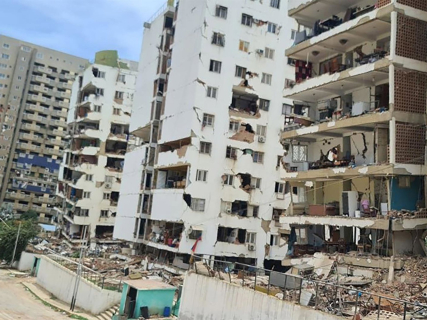

The earthquake recorded this Monday August 10, 2026 near San José del Palmar, in the department of Chocó, reached a magnitude of 7.4 and a depth of 96 kilometers, according to the Colombian Geological Service.
The magnitude of the movement and the damages recorded in different cities raise an inevitable question: Were Colombian buildings prepared to withstand an earthquake of this intensity?
The answer cannot be reduced to a yes or a no. Colombia has had seismic-resistant construction regulations for decades and currently applies the NSR-10, but its compliance depends on the age of the property, the legality of the construction, the materials, the soil, the maintenance, and the correct execution of the designs.
Furthermore, technically there are no certified buildings simply to withstand an earthquake of magnitude 7.4.
What is the NSR-10?
The NSR-10 is the Colombian Seismic Resistant Construction Regulation. It was adopted through Decree 926 of 2010 and currently constitutes the national reference for establishing the technical and scientific requirements that buildings subject to the seismic-resistant regime must meet.
Its foundation is found in the Law 400 of 1997, which established the legal framework for seismic-resistant constructions in Colombia. The regulation fundamentally aims to protect human lives against the collapse of buildings, not to guarantee that after an earthquake all homes remain intact. Law 400 itself establishes different levels of behavior.
A properly designed building must be able to withstand tremors:
- Of low intensity without damage.
- Moderate without structural damage, although non-structural elements may show defects.
- Strong with possible structural and non-structural damage, but without reaching collapse.
This last difference is fundamental. That a building shows cracks after a strong earthquake does not automatically demonstrate that it has violated the regulations. The ultimate goal is to prevent the structure from collapsing and causing casualties.
What must a newly constructed building in Colombia comply with?
Seismic resistance does not depend exclusively on using more concrete or steel. Projects subject to the regulations must incorporate, among other requirements:
- A structural design, developed according to the seismic forces anticipated for the area.
- Geotechnical and soil studies, to determine how the ground may behave and how the foundation should be designed.
- Design of non-structural elements, which includes components that may detach or cause damage even if the structure remains standing.
- Qualified professionals responsible for the designs, calculations, and execution.
- Review within the construction license procedure, during which the competent authorities must verify compliance with the seismic-resistant regulations.
The regulation also determines which materials and structural systems can be used and establishes different requirements according to the size, use, location, and characteristics of each construction.
What about old buildings?
Here appears one of the great limits of the system.
That the NSR-10 currently exists does not mean that all buildings constructed before 2010 have been rebuilt according to it.
Colombia has had different generations of seismic-resistant regulations, and existing buildings are subject to specific rules when they are renovated, change use, need reinforcement, or fall within certain categories that require updating.
The regulation itself includes procedures to assess vulnerability and reinforce buildings constructed before the current regulations came into effect.
Particular attention is given to essential buildings intended for community care, precisely because hospitals, emergency centers, and other essential infrastructures must continue to function after an earthquake.
But an old building does not automatically violate the law simply for having been built before the NSR-10.
Informal housing, the great weak point
Another problem is that the existence of advanced regulations does not guarantee that the entire real estate stock has been built according to it.
Technical documentation prepared for the Ministry of Housing acknowledges that there is a significant volume of informal origin housing with inadequate structures in Colombia, whose seismic vulnerability constitutes one of the challenges of housing policy.
This type of property may have been built progressively, without professional structural design, soil study, license, or technical supervision.
Precisely for that reason, the Ministry has developed specific methodologies to evaluate and reduce the seismic vulnerability of existing homes, especially masonry constructions that cannot be analyzed in the same way as a new building.
So, were Colombian buildings prepared?
The regulations do prepare modern constructions for a seismic country. That does not allow us to affirm that all buildings in Colombia were prepared for this specific earthquake.
A construction designed, licensed, executed, and supervised according to the regulations must have a considerable capacity to avoid collapse during a strong earthquake. But there are old buildings, informal homes, constructions modified later, and structures whose real degree of compliance can only be known through an individual assessment.
Moreover, the magnitude 7.4 does not alone allow us to determine what each building should have withstood. The earthquake in San José del Palmar occurred at a depth of 96 kilometers and the intensity experienced varied considerably from one territory to another.
The true test of the regulations will come now, when technicians analyze which constructions were damaged, when they were built, under what regulation, what type of soil they had, and whether their structures were executed according to the approved designs.
Only then can it be determined where seismic-resistant construction worked and where it failed.