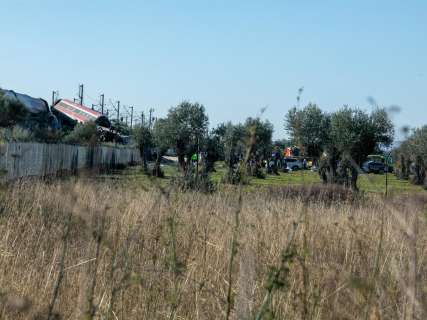
The number of fatalities in the Urda railway accident rises to 74, according to the Investigation Commission

The CIAF file raises the death toll from the collision between a Renfe AVE and an Iryo train in Toledo, while emergency services continue rescue work and investigations into the causes of the accident advance

fotonoticia 20261028190550 1920

fotonoticia 20261028190550 1920

Add DEMÓCRATA to Google

Ask FREN

Published

Last updated

1 minute

Most read

Elecciones 29N · Encuestas

La media de las encuestas

Media a 27 de octubre de 2026 · 15 institutos

  • PP31,0 %
  • PSOE27,3 %
  • Vox18,9 %
  • Sumar6,3 %
  • Podemos2,9 %
  • ERC2,3 %
010203040ene 2024jul 2024ene 2025jul 2025ene 2026jul 2026

Media del último estudio de cada instituto en 30 días y su evolución semanal desde el 23J. Partidos con al menos un 2 %.

Todas las encuestas

Elecciones generales del 29 de noviembre · Demócrata

The number of deceased in the Urda (Toledo) railway accident has risen to 74, according to the file opened by the Railway Accident Investigation Commission (CIAF).

The updating of the victim toll comes while emergency teams continue working at the site where a Renfe AVE collided from behind with an Iryo train on Wednesday morning.

The tragedy, recorded on the Madrid-Sevilla high-speed line, remains under investigation after the initial reconstructions pointed to a computer failure in the LZB safety system and a series of decisions adopted from the Adif control center that are being examined to determine how the collision could have occurred.

A failure in the safety system preceded the collision

According to the explanations offered by the Minister of Transport, Óscar Puente, the problems began around 8.30 a.m. on Wednesday, when a computer incident caused the LZB system to go down, responsible for supervising and controlling rail traffic on that section.

The failure forced the circulation conditions of the affected trains to be modified, which came to depend on the procedures provided for situations of degraded operation of the safety systems.

According to the audio recordings of the communications, the Adif control center authorized the AVE driver to resume circulation "at normal speed", despite the fact that the LZB system had stopped working.

The same indication was passed on to the Iryo driver, who later, around 8.48 a.m., reported that her train was still stopped on the track and that she had not been able to move forward.

The circulation conditions and Adif's orders, under investigation

The failure of the LZB system constitutes one of the central elements of the investigation, given that its deactivation requires resorting to other signaling and railway protection mechanisms.

In these circumstances, the lateral signaling blocking system (BSL) takes on a fundamental role, while the ASFA system provides automatic protection through the beacons installed along the infrastructure.

At the moment, the CIAF has not concluded its investigation, so the information known so far does not allow the chain of responsibilities that led to the accident to be definitively established.

More key points, information and questions with FREN

AI-GENERATED CONTENT

What is the status of the official CIAF investigation and what are the next steps to determine responsibilities in railway accidents in Spain?

In Spain, an official investigation by the Railway Accident Investigation Commission (CIAF) is considered "open" from the moment the resolution to initiate the file is issued and remains so until the approval and publication of the final report, for which the Administration itself recalls there is an indicative period of one year. During this time, the CIAF conducts an independent technical investigation focused on causes and safety, not on blame. The determination of legal responsibilities (criminal, civil, or administrative) is left to the courts and competent authorities, who may use the CIAF report as a reference but are not legally bound by it.

Nature and purpose of the CIAF

According to the Ministry of Transport itself, the CIAF is a specialized collegiate body, attached to the ministry but with functional independence, dedicated to the technical investigation of railway accidents and incidents on the General Interest Railway Network, with the aim of drawing conclusions that allow strengthening railway safety. This is explained, for example, in the Ministry of Transport's statement on the Adamuz accident (official statement) and a contextual piece by Demócrata about Gelida (article about Gelida).

Demócrata's news highlights that the CIAF began operating in 2007 as an independent body and that its investigations “in no case determine fault or responsibility for the event and will be independent of any judicial investigation” (same article). This philosophy is reiterated in the preliminary report of the Adamuz accident, which expressly reminds that the technical investigation “does not determine blame” and is based on Royal Decree 623/2014 (preliminary Adamuz report).

Typical phases of an "open" investigation

Recent cases allow reconstructing the usual scheme:

  • Opening of file: after a serious accident, the CIAF issues a resolution to open the file and assigns a file number (for example, 08/2026 for Adamuz, 011/2026 for Gelida), as reported by several Demócrata news items (start of Adamuz file and opening in Gelida).
  • Initial on-site actions: CIAF teams travel to the accident site, inspect the track, rolling stock, and coordinate the extraction and custody of evidence with the Civil Guard, judicial police, and judicial authority. All this is detailed in the official statement about Adamuz (Ministry statement) and was described by the Prime Minister in Congress (Congress appearance).
  • Data collection and technical analysis: samples of rails are taken, wheels and other elements are inspected, recorders from the involved trains are downloaded, and circulation records are requested from Adif. The preliminary Adamuz report details this work and the first findings about a possible prior rail fracture (CIAF preliminary report).
  • Laboratory and office analytical phase: samples are sent to metallographic laboratories and analysis of data and human, technical, and organizational factors continues. The CIAF has explained that “all hypotheses are open” at this stage (statement).
  • Preliminary report (when considered necessary): in high-impact accidents, the commission may release a preliminary report with technical hypotheses and next steps, as occurred in Adamuz (summary of preliminary report).
  • Final report and recommendations: regulations remind that the CIAF has an indicative period of one year to publish the final report, with the accident narrative, probable causes, and safety recommendations. This time commitment is expressly cited in the Ministry's official note (statement).

Next steps and relation to responsibility determination

While the CIAF investigation is open, the key next steps are: completing laboratory tests, analyzing recorders and communications, contrasting hypotheses with other trains or similar facilities, and finally closing a draft report that is discussed and approved within the commission. At that moment, safety recommendations are formulated directed to Adif, Renfe, and other operators or authorities, which may then be subject to political and parliamentary follow-up (for example, in the Senate commission on Adamuz and Gelida, where the CIAF president, Ignacio Barrón, has appeared, according to several Senate notes: Senate note 27/04/2026 and parliamentary report in Demócrata).

From a legal point of view, the next level consists of criminal or administrative proceedings opened by courts and railway safety authorities. The CIAF itself and the Ministry insist that the technical investigation does not determine blame and is independent of the judicial one (Demócrata article; preliminary report). The CIAF final report is normally incorporated into the proceedings as a qualified expert element, but the judge may reach different conclusions or require more evidence, as illustrated by the Civil Guard's request for additional data on Adamuz (Demócrata information).

Moreover, the institutional framework is in transition: a 2024 law creates a multimodal Independent Administrative Authority that will assume the functions of the CIAF, the maritime accident commission, and the civil aviation commission, but its deployment has been delayed and the CIAF continues operating while its statutes are approved and its board members appointed (Congress note on the new authority; regulatory analysis in Demócrata; statements by Óscar Puente; report on the “regulatory failure”).

In summary, while a CIAF investigation is "open," the focus is on technically reconstructing the event and proposing safety improvements; the decision on who is legally responsible and with what consequences is made later, in separate proceedings, based on that report and other evidence.

How is the CIAF investigation practically coordinated with the court's investigation in a specific railway accident? What exact changes does the new Independent Administrative Authority introduce compared to the current CIAF? What political and victim criticisms have been raised about the independence and resources of the CIAF in cases like Adamuz or Urda?

What are the powers and functions of the Minister of Transport according to current legislation?

The Minister of Transport and Sustainable Mobility directs the state policy on infrastructure and transport services by land, air, and sea, as well as promoting sustainable mobility. To specify their functions, it is necessary to distinguish between the competences of the Ministry, exercised through its bodies, and the decisions personally attributed to the minister: not all authorizations or actions of the department correspond directly to its head.

Legal framework

The distribution of matters starts from article 7 of Royal Decree 829/2023. Its main development is Royal Decree 253/2024, especially its articles 1 and 2. The latter was amended by Royal Decree 690/2025, regarding crisis management and civil aviation. The general organizational framework is established by Royal Decree 1009/2023.

Areas of competence

According to article 1 of Royal Decree 253/2024, the department is responsible for proposing and executing the Government's policy in the following areas:

  • State infrastructures: roads, railways, and air and maritime infrastructures of state competence, including planning and programming their investments.
  • Transport services: control, organization, and administrative regulation of land, air, and maritime transport corresponding to those competences.
  • Sustainable mobility: promotion of its social, economic, and environmental dimensions, including active mobility, with criteria of safety and social justice.
  • Postal services: normative regulation of the sector.
  • Geographic and scientific information: promotion and direction of state services of astronomy, geodesy, geophysics, and cartography.
Direction and decisions of the minister

The minister exercises the direction of the department. The Secretariat of State for Transport and Sustainable Mobility and the Undersecretariat depend directly on them. They have a support Cabinet and a General Subdirectorate of International Relations, responsible for coordinating the Ministry's international relations and representation, especially before the European Union, in collaboration with Foreign Affairs.

Among the decisions expressly linked to the minister, the royal decree contemplates the authorization for the establishment and qualification of civil airports, at the proposal of the Secretariat of State. It also foresees that the latter submits to the minister the master plans of airports of general interest and the master plan of air navigation, along with their modifications.

Functions carried out through its bodies

Under the minister's direction, the Secretariat of State defines and proposes infrastructure and transport policies. It is responsible for strategic planning, investment programming, infrastructure execution, and coordination and supervision of the bodies and entities within its scope.

It also develops the general regulation of state transport; promotes connection between different transport modes; cooperates with territorial administrations in urban mobility; promotes aid, innovation, and decarbonization; and monitors European transport policy.

This distinction has practical consequences: article 2 attributes to the Secretariat of State, not directly to the minister, the determination of minimum services in the cases provided, certain sanctioning resolutions, and structural or functional modifications of airports of general interest. Likewise, it may enter into contracts, grant aid, and sign agreements not reserved for the minister, within established limits.

In short, the minister directs the entire departmental policy, but concrete decisions are distributed among different bodies. Furthermore, the described competences are exercised without prejudice to those attributed to other ministries and within the state scope: they do not equate to a general competence over any regional or municipal transport.

What legal requirements and procedures must be met to modify railway circulation protocols after a security system failure?

To modify railway circulation protocols after a failure, it is necessary to distinguish between applying an already provided emergency procedure and approving a new rule. The failure alone does not authorize lowering safety requirements nor replacing a mandatory rule with an internal instruction. The following response refers to the Spanish state framework; specific conditions depend on the network, the failed system, and the procedure intended to be changed.

1. Identify what is being modified and who decides

The first step is to determine whether the change affects a regulatory rule, the infrastructure's operating rules, or an internal procedure of a railway company. This distinction determines who can approve it and by what instrument.

Article 19 of Law 38/2015, on the railway sector, includes in infrastructure administration its maintenance, operation, and management of the control, circulation, and safety system. This is reflected in Judgment 124/2016. Therefore, a railway company cannot unilaterally modify circulation conditions that correspond to the infrastructure administrator.

Moreover, an operational instruction cannot contradict a higher provision. If it is intended to change an obligation established by regulation, the competent body must intervene through the corresponding normative modification procedure.

2. Separate urgent action from permanent change
  • Specific failure: it must be checked which current procedure regulates circulation under degraded conditions, who can activate it, and what restrictions it establishes. Applying it does not mean modifying it.
  • New provisional solution: it is not enough to call it temporary. It must have legal coverage, identified responsible parties, application conditions, and a duration or review limit.
  • Structural change: requires formally reviewing the procedure and its fit within operating rules and safety management before incorporating it permanently.
3. Justify safety and document the decision

The review must address how the risks previously covered by the failed system will be controlled: train separation, protection against incompatible movements, communications, and human errors. A speed limitation alone does not demonstrate that all those risks are controlled.

As basic content of the technical and operational file, the following must be identified:

  • The failure, its scope, and the affected safety functions.
  • The previous procedure, the proposed change, and its regulatory basis.
  • The identified hazards, compensatory measures, and their responsible parties.
  • Implementation conditions, communication to personnel, training, and effectiveness verification.
  • Criteria to suspend the measure or recover ordinary operation.

This list guides the review; it does not replace checking the specific applicable risk assessment requirements.

4. Check authorizations and supervision

Internal approval of a procedure should not be confused with administrative authorization. It must be checked whether the change affects authorized safety conditions and if it requires communication, updating, or prior authorization. The consulted sources do not allow specifying these procedures for any case of signaling or automatic protection failure.

Judgment 245/2012 explains the function of the safety certificate as accreditation of a proprietary management system and capacity to control risks. Its normative reference is historical and is not sufficient to establish the currently required procedures.

5. Incorporate conclusions from an investigation

If the failure causes an accident or incident under investigation, its conclusions must be considered in the preventive review. Judgment 85/2018 covers the investigation of serious accidents and the regulation of the Railway Accident Investigation Commission in Law 38/2015. An investigation does not replace the competent approval of the new protocol nor automatically convert its recommendations into operating rules.

Play

Test your knowledge with FREN!

How much do you know about this topic? Answer the following 3 questions.

What is the number of confirmed deaths by the CIAF in the Urda train accident after the correction?

Question 1 of 3

Which safety system failed before the Urda train accident?

Question 2 of 3

What action did the Adif control center authorize the drivers of the affected trains to take after the safety system failure?

Question 3 of 3