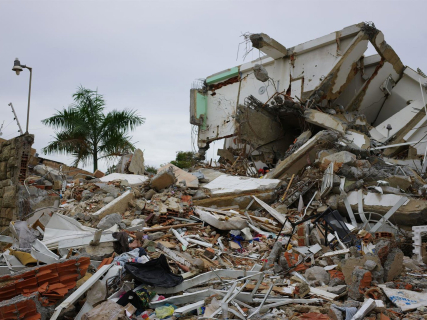

After an earthquake, it is common to find cracks in walls, ceilings, or facades. Some only affect the cladding; others may indicate damage to elements responsible for supporting the building.

Correctly distinguishing them requires technical knowledge. A visual inspection by a neighbor may help identify obvious danger signals, but it does not replace the assessment of an architect, structural engineer, or teams authorized by the authorities.
Which cracks can be dangerous?
There is no rule that allows determining risk solely by the length or thickness of a crack.
It matters where it appears, what element it crosses, its orientation, whether it is accompanied by deformations, and if it changes after the aftershocks.
The signals that justify taking extra precautions include:
- Large cracks in columns, beams, or slabs.
- Significant concrete spalling.
- Visible steel bars or reinforcements.
- Visibly deformed columns or walls.
- Floors that show new unevenness.
- Facades that are tilted or separated from the rest of the structure.
- Partial sinkholes.
- Doors and windows that have become abruptly deformed along with other damages.
- New significant cracks in the ground around the building.
The District Institute for Risk Management and Climate Change (IDIGER) recommends not entering when large cracks or significant material spalling are observed and staying in a safe place until an assessment can be made.
Which parts of the building are the most important?
Technicians pay special attention to structural elements, that is, those that receive and transmit the loads of the construction.
These include columns, beams, structural walls, slabs, and foundations.
Non-structural elements that can cause injuries even if the building remains stable are also examined: facades, false ceilings, glass, cornices, chimneys, tanks, installations, and cladding.
The guide currently being prepared by the National Unit for Disaster Risk Management aims precisely to establish national criteria for visually assessing structural and non-structural damage in buildings and essential infrastructures after an earthquake.
What is Colombia's seismic-resistant standard?
Colombia has the Colombian Regulation for Earthquake-Resistant Construction NSR-10, adopted through Decree 926 of 2010 within the framework established by Law 400 of 1997.
The regulation establishes technical and scientific requirements for the design, construction, and supervision of buildings with the aim of reducing the risk from seismic movements.
The NSR-10 continues to be the current reference in 2026. Documents published by the Ministry of Housing during this same summer continue to expressly qualify it as "current regulation" for analyzing the structural safety of homes.
But complying with an earthquake-resistant standard does not mean that a building is indestructible. The fundamental objective is to reduce the risk of collapse and protect lives against the levels of movement considered in the design.