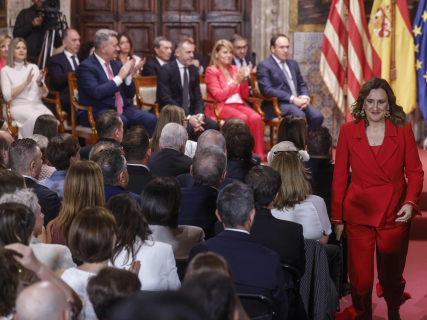

Àgueda Micó, María José Catalá, and Joan Baldoví are the most influential Valencian politicians on social media. This is confirmed by the ranking of Poder Digital, the application developed by Vinces, which collects and organizes public information about the digital activity of political representatives and displays it through transparent and objective rankings.
On the occasion of the Day of the Valencian Community, celebrated this October 9, DEMÓCRATA analyzes the profiles that accumulate the most power and impact in the digital environment.
DIGITAL POWER
The application that you can consult on Demócrata measures the real capacity, the digital power, of a political actor to connect with voters and lead the public conversation on X, Instagram, and LinkedIn, expressed on a scale from 0 to 100.
The index is obtained by applying the RIO formula (Regularity, Interactions, and Originality), which weighs key aspects of their digital presence: the size and quality of their audience, the impact of their messages, and recent activity, reviewing up to 30 posts from the last 60 days.
Top 10:
- Àgueda Micó, former deputy of Compromís in Congress
- María José Catalá, mayor of Valencia (PP)
- Joan Baldoví, spokesperson for Compromís in Les Corts
- Diana Morant, Minister of Science, Innovation, and Universities (PSOE)
- Rebeca Torró, Secretary of Organization of the PSOE
- Pilar Bernabé, Government Delegate in the Valencian Community (PSOE)
- Nahuel González, former deputy of Sumar-IU in Congress
- Juan Francisco Pérez Llorca, President of the Generalitat Valenciana (PP)
- Arcadi España, Minister of Finance (PSOE)
- Miguel Barrachina, Counselor of Agriculture, Water, Livestock, and Fishing (PP)
No surprises
The first place this week is for Àgueda Micó, who is positioned as the most influential Valencian politician on social media just after losing her status as a deputy in Congress following the early elections. The leader of Compromís heads a ranking that again reflects the weight of the nationalist formation in the digital debate and makes her the leader of the opposition (at least, on social media).
On the podium, she is accompanied by the mayor of Valencia, María José Catalá (PP), who occupies the second position, and Joan Baldoví, current spokesperson for the Valencian coalition in Les Corts.
This result confirms Catalá as the main asset of the populars. The image of the mayor was less affected than that of other leaders of her party by the catastrophe of October 29. Furthermore, Catalá is already immersed in the task of running for reelection in the municipal elections next May. Opposing her will be Pilar Bernabé (PSPV-PSOE), who occupies the sixth place in this ranking and Mónica Oltra (Compromís), who has returned to politics after the judicial cases that forced her to step aside were resolved.
Building a talent pool
For its part, although the PSPV-PSOE does not manage to have any of its members in the upper part of the table, it is the party with the most members in the top 10. Diana Morant, Minister of Science, Innovation and Universities and candidate for the Generalitat, manages to secure the fourth position. Closely followed by her party mate Rebeca Torró, who occupies the Secretary of Organization of the PSOE after the scandal of the 'Koldo Case' that led to the resignation of her predecessor, Santos Cerdán.
As already mentioned, the sixth position is also for a socialist: Pilar Bernabé. The Government delegate in the Valencian Community and candidate for the mayoralty of Valencia emerged much strengthened after the crisis of the dana and also gained great prominence during the teachers' strike last June.
The "influential" team of the PSPV-PSOE is closed by Arcadi España, Minister of Finance, who achieves the ninth highest score. This governmental presence also hints that the strength of Valencian socialism lies in national positions.
And the President?
The Popular Party governs in the Valencian Community and in the main cities: Valencia, Castellón, and Alicante. But despite being the formation with the most institutional power, in terms of influence on networks, they are not the best positioned.
Alongside Catalá, we find in the eighth position the president of the Generalitat Juan Francisco Pérez Llorca. This position is far from those occupied by his counterparts such as Juanma Moreno Bonilla, president of Andalusia, or Jorge Azcón, president of Aragón, who lead digital power in their territories.
It is worth noting that Génova 13 has not confirmed Llorca as a candidate for the upcoming regional elections and names such as Vicente Mompó, current president of the Valencia Provincial Council, stand out on the table.
Also from the PP is Miguel Barrachina, who this week closes the top 10. The councilor of Agriculture, Water, Livestock, and Fishing is also the spokesperson for the Government of the Generalitat.
Absences and presences
Micó is not the only former deputy who manages to make a place for herself in this ranking. Nahuel González, who until a week ago was a member of the Lower House representing IU in Sumar, manages to enter in seventh position.
On the other hand, Vox is the only party that fails to have any representation. A reality that highlights the lack of implantation and territorial leadership that the conservative formation has, which shows difficulties for the voter to identify its candidates apart from its national leader, Santiago Abascal.
You can download Poder Digital for Android here. Also available for Apple