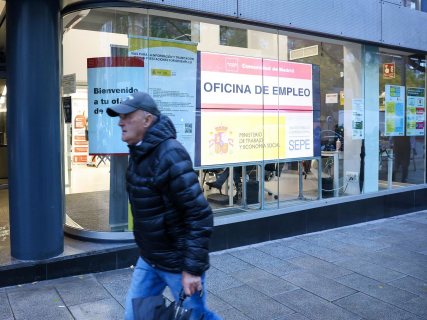

The end of the summer tourism season will cause the labor market to face in the fourth quarter a slight drop in employment and a moderate increase in unemployment. With this, the unemployment rate would move between 10.3% and 10.6%, above the 10.18% recorded in the third quarter, according to projections from The Adecco Group Institute.
The latest Active Population Survey (EPA) for the third quarter, released by the National Statistics Institute (INE) last week, showed a sharp increase in unemployment, with almost 96,000 more unemployed in quarterly terms.
This rebound brought the unemployment rate back above 10%, to 10.18% at the end of September, after having ended the second quarter at 9.87%.
If Adecco's calculations for the final stretch of the year are met, the unemployment rate will end 2026 above the 9.93% recorded at the end of 2025.
Adecco's estimates also indicate that employment will maintain in the fourth quarter a year-on-year increase close to 2%.
The third quarter ended with a record high of 22,852,600 employed people, after employment increased by 73,600 people between July and September and by 465,500 compared with the same period of 2025.
"Traditionally, the end of the year comes accompanied by a correction in employment after the summer tourism season. For this reason, it is likely that employment will register a moderate decline and that unemployment will rise slightly in gross terms, especially in activities linked to hospitality, seasonal retail and recreational services," according to the director of The Adecco Group Institute, Carlos Arcas.
For Arcas, the third-quarter EPA known last week confirmed the "notable capacity for job creation" that the Spanish labor market maintains, although with "signs of slowdown".
In this line, he has warned that, looking to 2027, the main focus of concern is not a massive destruction of jobs, but rather "the consolidation of a labor market that continues creating jobs, but with ever lower intensity and with greater difficulties to significantly reduce an unemployment rate that remains above 10%".
In the medium term, Arcas maintains that the strength of employment will depend on the business fabric's ability to sustain stable hiring rates.
PRESSURE OF THE ACTIVE POPULATION AND ROLE OF IMMIGRATION
Adecco has linked part of the increase in unemployment in the third quarter to the intense incorporation of people into the labor market.
During the summer months, 169,500 new active workers were added (443,500 in the last twelve months), so that the entry of labor advanced at almost the same pace as job creation, making a more intense reduction in unemployment difficult.
After the extraordinary regularization process promoted by the Government, foreign workers represented 99,900 of the 169,500 new active workers in the third quarter.
According to Adecco, sectors such as logistics, transport, construction, hospitality, and care depend increasingly on foreign labor to address generational replacement and fill vacancies. For this reason, it calls for effective policies to attract, integrate, and qualify international talent, together with initiatives that boost productivity and strengthen industrial competitiveness.