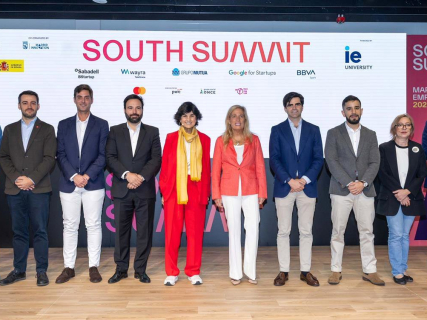

Artificial intelligence (AI) has become a "significant" engine for the creation of startups driven by a single founder. According to data released this Friday by South Summit and IE University, these companies led by a single entrepreneur already represent 26.5% of the emerging ecosystem in Spain.
The weight of companies with a solopreneur model (projects founded by a single person) grows by 3.5 percentage points compared to 2025 and marks the maximum of the historical series, although it still remains below the European average, which reaches 29.6%. Nevertheless, teams formed by two or three partners still predominate, concentrating 59% of the projects.
"We have seen a strong relationship between AI and solopreneurs. Entrepreneurs who, with very limited resources, are able to build their own projects. It is just a first indicator of everything that is to come," emphasizes the CIO of IE University, Salvador Aragón.
The 'Entrepreneurship Map 2026', prepared by South Summit and IE University, confirms that AI acts "increasingly" as a transversal tool rather than as an exclusive technology. In Spain, 64.2% of startups use it as an amplifying technology, while only 40.9% consider it 'core' technology. This gap of 23 points is the largest among the analyzed regions, surpassing Latin America (21 points) and Europe (19).
The implementation of AI is also predominant on an international scale. In Europe, 66.8% of startups use it as a primary or secondary technology, above the 62.5% in the United States and Canada. However, if we only look at its use as a primary technology, the percentages drop to 47.6% in Europe and 49% in the United States and Canada.
Profile of the Spanish entrepreneur: male, 39 years old, and master's degree education
The study paints a portrait of the typical entrepreneur in Spain: predominantly male —77% of founders are men and 22.6% women, 4.6 points more than the previous year—, with an average age of 39.4 years (compared to 38 years in 2025) and with a "solid" academic background. Half of them (49%) have completed a master's degree, in line with the European average.
Serial entrepreneurs have a growing weight: in 2026 they represent 52.2% of the total, well above the 39% recorded in 2013, which evidences greater accumulated experience in project creation.
The main reason for launching a startup in Spain remains the detection of a market opportunity. This reason accounts for 47% of the responses, compared to 45% in 2025 and 28.3% in 2020. In parallel, the vocation to undertake loses some ground, dropping from 35% to 33.3% in the last year.
Profitability: Latin America leads, Europe stands out for its international expansion
The report places Latin America as the region with the highest proportion of profitable startups: 28.6% show a positive EBITDA. Europe, for its part, stands out for its international vocation, with 24.9% of companies having a strong presence outside their home market. This divergence is explained, in part, by the different conditions of access to financing.
According to the analysis, "the resource limitations in Latin America push entrepreneurs to build profitable businesses from early stages, focused on the needs of their local market," while in Europe "the greater access to capital favors models that prioritize international expansion before achieving profitability," which is reflected in the fact that only 9.3% of European startups have a positive EBITDA.
"If for years Latin America adapted European and American business models to its reality, now the ecosystem could experience a tropicalization: startups from different global regions can incorporate Latin American strategies based on early profitability, local growth, and attention to underserved segments, especially in sectors like finance and retail," point out the authors of the report.
Financing: more own resources and less weight of private capital
In terms of financing, the study reflects an increase in dependence on own funds. In 2026, 61% of Spanish startups resort to internal resources to cover their first round, compared to 52% in 2025. This is one of the highest percentages in the entire series, although still below the European average, which stands at 66.7%.
The contribution from family and friends (FFF) drops to 13%, its historical low, although it still doubles the European figure, which is at 7%. Private capital participates in 20% of the first rounds of Spanish startups, a decline from the 25% recorded in 2013.
In the more advanced rounds, the presence of private capital rises to 30.3%, but continues to be below the European average of 35.2%. At the same time, own resources continue to have a very relevant weight, representing 46.8% of the financing in these final phases.
Visibility remains the top priority for Spanish startups —it is the only analyzed region where this happens— with 19.5% of mentions, ahead of investment attraction, which totals 18.7%.
Maturity of the ecosystem, leading sectors, and business model
The document concludes that "the Spanish ecosystem has gained in maturity, but not in scale." The average age of projects has grown by 59%: since 2019 it has increased from 2.2 to 3.5 years, and 61% of startups are between one and five years old. However, only 17.9% of companies obtain more than 20% of their income outside their main market, compared to 24.9% in Europe.
By sectors, health once again ranks at the top of the activity ranking among Spanish startups, followed by 'fintech' and education. In addition, three out of four emerging companies (74.7%) bet on B2B models, whether exclusively or combined with other types of clients, a proportion slightly lower than the European one, which reaches 78.1%.
With an eye on its 15th anniversary and the upcoming edition, which will be held from June 2 to 4, 2027, South Summit reviews the transformation of the entrepreneurial ecosystem in the last 14 years.
During this period, "the finalist startups of our competition have raised more than 22.2 billion euros in investment, of which 52% corresponds to Spanish startups. These are figures that reaffirm our commitment to national talent and demonstrate that we have managed to place Spain on the global entrepreneurship map," highlights the president and founder, María Benjumea.